
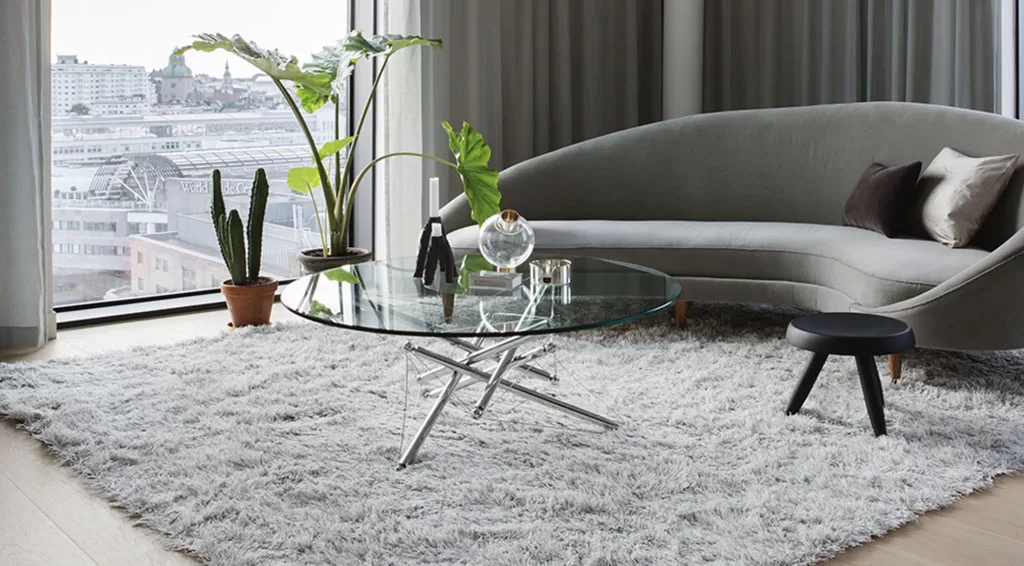

Kasthall Rugs: Swedish Craftsmanship Since 1889
Kasthall creates luxury Swedish rugs distinguished by exceptional materials, nuanced color, and more than a century of textile expertise. Every Kasthall rug is woven or hand-tufted at the company’s mill in Kinna, Sweden, where designers and craftspeople work together to unite traditional knowledge with contemporary innovation.
The collection includes woven rugs, hand-tufted rugs, custom designs, and wall-to-wall solutions for private residences, hospitality interiors, workplaces, boutiques, and cultural spaces. Made primarily from wool and linen, Kasthall rugs bring warmth, acoustic comfort, texture, and lasting beauty to the architecture around them.
Swedish Rugmaking Since 1889
Kasthall was founded in Kinna in 1889, within a Swedish region shaped by generations of textile production. What began through local weaving traditions has developed into an internationally recognized design company, yet the heart of the business remains in the same community.
More than a century of textile knowledge informs each new rug. Techniques are passed between generations, refined through experience, and expanded through contemporary technology and design research.
Kasthall treats heritage as a living practice rather than a fixed set of historical rules. Traditional weaving and tufting knowledge provides the foundation for ongoing experiments with yarn, color, pattern, structure, and surface.
Made at the Kasthall Mill in Kinna
Every Kasthall rug is produced at the company’s mill in Kinna, Sweden. Yarn development, weaving, tufting, finishing, and quality control take place under one roof.
Keeping these processes together creates a close relationship between concept and production. Designers can work directly with craftspeople, test materials, adjust color combinations, and refine constructions as a rug develops.
Industrial equipment provides precision and consistency, while skilled hands bring judgment, sensitivity, and finishing expertise. The resulting rugs express both technical control and the subtle variation that gives crafted textiles their character.
Woven and Hand-Tufted Rugs
Kasthall specializes in two principal methods of rug production: weaving and hand-tufting. Each offers different aesthetic, tactile, and performance possibilities.
Woven rugs are constructed on looms by interlacing warp and weft yarns. Their structure may be flat, tightly patterned, softly textured, or highly dimensional depending on the yarn and weaving technique.
Hand-tufted rugs are created by inserting yarn through a backing material with a tufting tool. Tufting allows greater freedom in shape, pile height, pattern, and sculptural texture.
Both methods draw upon Kasthall’s material knowledge and exacting production standards. The correct construction depends on the desired appearance, location, scale, and functional needs of the interior.
Kasthall Woven Rugs
Kasthall’s woven rugs combine architectural clarity with rich tactile detail. Their relatively structured construction makes them particularly effective in dining rooms, entryways, libraries, offices, and other areas where furniture movement and regular use are important considerations.
Subtle variations in yarn color can create depth without requiring an elaborate pattern. More graphic constructions use stripes, checks, geometric forms, or shifts in weave to establish a stronger visual rhythm.
The collection ranges from quiet, tonal rugs to colorful statement pieces. Because a woven rug often has a lower profile than a tufted design, it can define an area while maintaining a clean relationship with the surrounding floor.
Kasthall Hand-Tufted Rugs
Hand-tufting allows Kasthall to create rugs with softness, volume, and expressive texture. Wool or linen yarn is punched through a backing according to the design, after which the surface is finished by experienced craftspeople.
Different pile heights, densities, and yarn combinations can produce carved effects, soft gradients, raised patterns, and richly dimensional surfaces. The process also permits organic outlines and custom shapes beyond conventional rectangles.
A hand-tufted Kasthall rug can become a quiet field of texture or a dramatic artistic centerpiece. Its plush surface is particularly suited to bedrooms, living rooms, lounges, private offices, and hospitality environments.
Wool and Linen
Natural fibers are central to the character of Kasthall rugs. Wool provides warmth, resilience, softness, and natural variation. Its fibers can recover from compression, making properly specified wool rugs suitable for spaces where durability and comfort are both priorities.
Linen has a cooler, more lustrous appearance. It reflects light differently from wool and can bring definition, depth, and a subtle sense of movement to a rug’s surface. Because linen behaves differently under pressure, its appearance develops naturally through use.
Kasthall frequently combines these materials to balance softness, sheen, structure, and visual complexity. Each yarn is selected according to the performance and expression required by the design.
The Art of Color
Color development begins before the rug reaches the loom or tufting frame. Kasthall develops its own yarns and color recipes, giving the company close control over tone, texture, and the interaction between individual threads.
A rug that appears to be a single color may contain several related shades. When combined, they create a more nuanced and responsive surface than a uniform flat color.
Natural and artificial light can reveal different qualities throughout the day. Wool absorbs light softly, while linen may create brighter highlights. Understanding these relationships allows Kasthall to develop rugs with unusual visual depth.
Custom Kasthall Rugs
Kasthall offers extensive customization for architects, interior designers, and clients seeking a rug tailored to a particular space. Depending on the design, dimensions, shape, colors, yarn combinations, borders, patterns, and pile treatments may be adjusted.
Customization makes it possible to align the rug precisely with a furniture arrangement or architectural feature. A custom rug can follow the dimensions of a room, define a curved seating composition, frame a dining table, or respond to an established material palette.
Kasthall’s expertise supports the process from early selection through final production. Samples and material references help communicate how yarn, color, and construction will appear in the completed rug.
Bespoke Rug Design
For projects requiring a completely individual solution, Kasthall’s bespoke capabilities extend beyond modifications to an existing collection. Designers can work with the company to translate an original concept into a woven or tufted textile surface.
The process may begin with architecture, artwork, landscape, historical references, or a project-specific pattern. Kasthall then considers how the idea can be expressed through yarn, color, pile, and construction.
Technical feasibility, traffic level, maintenance, scale, and installation are evaluated alongside the design. This collaboration turns the rug into an integral part of the interior rather than an accessory selected at the end.
Wall-to-Wall Carpeting
Kasthall wall-to-wall solutions bring the company’s color and textile expertise to larger architectural surfaces. They can create continuity across bedrooms, corridors, offices, hotel suites, meeting rooms, and other interior environments.
Wall-to-wall installations provide acoustic comfort, tactile warmth, and a unified visual foundation. Depending on the project, the flooring can remain quiet and neutral or introduce a repeated texture or pattern.
Accurate measurements, seam planning, transitions, substrate conditions, and installation requirements should be reviewed early. Coordinating these factors helps preserve the intended appearance and performance of the finished interior.
Rugs for Living Rooms
A living-room rug can unify seating, provide softness underfoot, and establish the color and texture of the entire space. Its scale should relate to the sofa, lounge chairs, occasional tables, and room proportions.
Woven Kasthall rugs create a tailored and architectural foundation. Hand-tufted rugs offer greater softness and can introduce a sculptural surface beneath a seating arrangement.
Neutral colors allow furniture and artwork to remain prominent, while bolder patterns or custom shapes can make the rug itself the visual focus.
Rugs for Dining Rooms
Dining-room rugs must accommodate the table and chairs while maintaining sufficient space for the chairs to move comfortably. The rug should extend beyond the tabletop so chair legs remain supported when pulled away from the table.
Woven constructions are often well suited to dining environments because of their lower profile and defined surface. Color and pattern can help establish the dining area within an open-plan room.
When selecting materials, the project team should also consider cleaning, chair movement, table dimensions, and the frequency of use.
Rugs for Bedrooms
In a bedroom, a rug adds warmth, quiet, and softness to the area around the bed. Hand-tufted rugs create a plush surface, while woven designs offer a more tailored appearance.
The rug may sit partially beneath the bed, extend across the complete sleeping area, or appear as individual runners along the sides. A custom size helps relate the textile precisely to the bed, nightstands, and circulation space.
Soft tonal color often reinforces a calm atmosphere, while linen highlights and dimensional textures add richness without requiring a bold pattern.
Rugs for Hospitality and Commercial Interiors
Kasthall rugs are used in hotels, restaurants, boutiques, offices, cultural institutions, and other public interiors. These projects require a balance of visual impact, durability, maintenance, and project-specific performance.
A custom rug can define a hotel lobby, soften a private dining room, add acoustic comfort to a workplace, or reinforce a brand’s color identity within a retail environment.
Kasthall works with design professionals to evaluate the most appropriate construction, fiber, scale, and detailing for each setting.
Design Collaborations
Kasthall Design Studio develops collections internally while also collaborating with internationally recognized architects and designers. These creative partnerships bring new perspectives to the company’s materials and production techniques.
Collaborators explore what a rug can contribute beyond surface decoration. Pattern, structure, pile, color, and shape become tools for connecting furniture with architecture and influencing how a space is experienced.
Collections developed with designers such as Cecilie Manz and Barber Osgerby demonstrate how distinct creative viewpoints can be translated through Kasthall’s Swedish textile expertise.
Timeless Patterns and Contemporary Textures
The Kasthall collection includes geometric patterns, expressive color combinations, quiet tonal fields, organic forms, and tactile surfaces inspired by nature, architecture, fashion, art, and textile history.
Some rugs make their presence known immediately. Others reveal their detail gradually through variations in yarn and construction. This range allows Kasthall to support both minimalist interiors and more decorative environments.
Even visually simple rugs are developed with close attention to scale and repeat. Pattern must relate to the dimensions of the finished rug as well as the furniture placed upon it.
Sustainability Through Longevity
Kasthall’s approach to sustainability begins with making rugs intended to remain in use. Durable natural fibers, made-to-order production, careful craftsmanship, repair possibilities, and timeless design all contribute to longer product life.
The company measures greenhouse-gas emissions, uses life-cycle assessment methods, publishes verified environmental information, and establishes documented requirements for materials and suppliers.
Producing primarily to order helps reduce unnecessary inventory and overproduction. Surplus materials are reused where possible, while returned products may be repaired or resold rather than discarded.
Responsible Materials and Production
Kasthall carefully selects wool and linen and works with established suppliers. According to the company, most of its virgin wool comes from New Zealand, while linen is sourced from France and other trusted European partners.
Yarns are certified according to OEKO-TEX Standard 100, and selected collections incorporate recycled wool. Kasthall’s weaving and tufting operations in Kinna avoid wet-processing stages and do not intentionally add chemical treatments during production.
Local manufacturing also provides oversight of quality, working methods, waste, and energy use. Responsibility is considered from raw material selection through production, delivery, care, and eventual reuse.
A Supplier to the Swedish Royal Court
Kasthall holds a Royal Warrant as a supplier to the Swedish Royal Court. This recognition reflects the quality and continuity of craftsmanship the company has maintained since the 19th century.
Its rugs can be found in heritage interiors as well as contemporary homes and public spaces. The ability to work respectfully within historic architecture while contributing a current design perspective is an important part of the brand’s international reputation.
Choosing the Right Kasthall Rug
Selecting a rug begins with understanding the room’s dimensions, furniture arrangement, circulation, and intended use. Size is especially important: a correctly proportioned rug connects furniture and makes an interior feel considered.
Construction and fiber affect both appearance and performance. Woven rugs tend to feel more structured, while tufted designs offer greater softness and dimensional possibilities. Wool and linen each respond differently to light, pressure, and everyday use.
Color samples should be reviewed within the actual space whenever possible. Natural light, artificial lighting, flooring, upholstery, and wall finishes can all influence how the yarn appears.
Caring for a Kasthall Rug
Regular care helps preserve a rug’s appearance and extends its useful life. Gentle vacuuming removes loose particles before they become embedded within the fibers. The rug may also be rotated periodically to distribute traffic and light exposure more evenly.
Spills should be addressed promptly using methods appropriate for the specific fiber and construction. Aggressive rubbing or unsuitable cleaning products may damage the yarn.
Professional cleaning should be performed by a specialist familiar with high-quality wool and linen rugs. Kasthall’s product-specific care guidance should always be followed.
Discover Kasthall Rugs at Scott + Cooner
Explore Kasthall rugs at Scott + Cooner and experience Swedish textile design shaped by craftsmanship, natural materials, and more than 135 years of production knowledge.
Our experienced team works with homeowners, architects, and interior designers to select woven, hand-tufted, custom, and wall-to-wall Kasthall rugs for residential and commercial projects. We can assist with construction, materials, colors, samples, dimensions, custom shapes, and bespoke designs.
Contact Scott + Cooner or visit one of our showrooms to discover how a Kasthall rug can bring texture, warmth, color, and lasting character to your interior.