
Fiam Italia Glass Furniture
Fiam Italia transforms glass into extraordinary contemporary furniture through an exceptional combination of craftsmanship, technical innovation and Italian design. Founded by Vittorio Livi in 1973, the company pioneered the use of curved glass for furniture and continues to explore the material through bending, fusing, sculpting, silvering and advanced surface treatments.
At Scott + Cooner, the Fiam Italia collection includes glass dining tables, coffee tables, consoles, mirrors, display cabinets, bookcases, desks, lighting and iconic sculptural seating. Each piece uses transparency, reflection, light and form to create a distinctive relationship with the surrounding interior.
The Culture of Glass Since 1973
Vittorio Livi founded Fiam Italia with a radical idea: glass should become a structural protagonist in furniture rather than remain limited to windows, shelves and cabinet doors.
Developing this concept required the company to invent new production methods, specialized machinery and ovens capable of controlling glass at the point where it becomes malleable. A flat sheet could then be shaped into a three-dimensional object while retaining the clarity, strength and visual lightness that make the material unique.
Fiam’s early curved-glass experiments established a new category within furniture design. Over time, the company expanded its knowledge to include fusing, casting, silvering, engraving, waterjet cutting and other processes that create color, texture and unexpected depth.
The result is an evolving culture of glass in which technical research and artistic expression are inseparable.
Onda: The First Curve
The Onda pouf represents the beginning of Fiam Italia’s design story. Created by Vittorio Livi, it transformed a single transparent sheet into a sinuous seat at a time when the idea of sitting on curved glass appeared almost impossible.
Onda demonstrated that glass could become more than a flat or secondary surface. It could form the structure, support the body and define the identity of an object.
Its minimal shape expressed the material with remarkable directness. Nothing concealed the method of construction, and no decorative detail distracted from the glass itself. That first curve opened the way for decades of experimentation and established the central idea behind Fiam Italia.
Ghost: The Iconic Glass Armchair
Designed by Cini Boeri with Tomu Katayanagi and introduced in 1987, Ghost is among the most celebrated pieces of glass furniture in the world. The chair is formed from a single sheet of curved glass, shaped into a seat, back and armrests without a separate supporting frame.
Its transparent structure seems to dematerialize within the room. The surrounding architecture remains visible through the chair, while the curved edges capture light and reveal the complexity of its construction.
Ghost is both a functional armchair and a technical achievement. Its form challenged conventional assumptions about the strength, comfort and possibilities of glass furniture.
The design received the Compasso d’Oro Career Award recognition associated with Cini Boeri in 2022 and is represented in museum collections, including the Museum of Modern Art in New York. It remains an enduring symbol of Italian experimentation and Fiam’s ability to translate an apparently impossible concept into a lasting design icon.
Ragno: The First Monolithic Curved-Glass Dining Table
Designed by Vittorio Livi in 1984, Ragno was the first monolithic curved-glass dining table in design history. A single sheet of thick glass flows from the tabletop into its supporting legs, eliminating the conventional distinction between surface and base.
The softness of the curves contrasts with the strength of the material. From different viewpoints, overlapping transparent surfaces create changing reflections and varying degrees of visual density.
Ragno was selected by ADI for the 14th Compasso d’Oro in 1987 and has been exhibited internationally. Its clarity and technical ambition make it as relevant to contemporary interiors today as when it was introduced.
The table demonstrates one of Fiam’s defining abilities: using sophisticated engineering to create an object that appears visually simple and almost effortless.
Caadre Mirror by Philippe Starck
The Caadre mirror, designed by Philippe Starck, surrounds its reflective surface with four curved-glass elements. The frame appears to fold and flow around the mirror, turning a familiar object into a strong architectural feature.
Caadre is available in wall-mounted and floor-standing versions. Depending on the configuration, it can be installed horizontally or vertically and specified in silvered, bronze or semi-reflective titanium glass. Optional integrated LED lighting adds functional illumination while emphasizing the depth of the frame.
Custom sizes and modular arrangements allow Caadre to expand across a wall, functioning as both mirror and architectural surface. This flexibility makes it suitable for residences, hotel suites, dressing areas, boutiques and other contract interiors.
Glass Dining and Conference Tables
Fiam Italia offers an extensive collection of fixed and extendable dining tables, meeting tables and desks. Transparent, extra-light, smoked and bronze glass can be combined with curved-glass supports or contrasting bases in wood, metal, marble and other materials.
Some tables emphasize the purity of an all-glass construction, allowing light and surrounding materials to remain visible. Others use sculptural bases or textured surfaces to give the table a stronger visual presence.
Extendable designs add practical flexibility for dining and meeting spaces. Carefully engineered mechanisms allow the usable surface to increase while preserving the refinement expected from the collection.
Beyond Ragno, designs such as LLT, Atlas, Cristaline, Phantom, Magma and Big Wave demonstrate the diverse ways Fiam approaches scale, support, transparency and texture.
Coffee Tables, Consoles and Desks
Smaller furniture pieces allow Fiam’s glass expertise to appear throughout an interior. Coffee tables and side tables can visually lighten a seating arrangement, while consoles bring reflective surfaces to entryways, corridors and dining spaces.
The Sigmy table by AquiliAlberg is formed from a continuous curve of glass. Its fluid profile creates both tabletop and support through one gesture, expressing material and function with exceptional economy.
The Rialto family applies curved glass to consoles, desks, shelves and occasional furniture. These pieces provide practical surfaces while maintaining a light architectural presence that works particularly well in compact or visually complex rooms.
Home-office furniture and executive tables extend this approach into professional environments, where transparency can reduce visual weight without sacrificing sophistication.
Designer Mirrors and Reflective Surfaces
Mirrors are a major part of the Fiam Italia collection. Rather than treating them as flat decorative accessories, the company uses curved, fused, silvered and textured glass to create objects with depth and architectural character.
Frame elements may appear to fold around the reflection, dissolve into irregular textures or extend outward to interact with light. Available forms range from restrained rectangles and circles to expressive sculptural compositions.
Collections by Philippe Starck, Daniel Libeskind, Marcel Wanders and other designers demonstrate the breadth of possibilities within reflective glass. Selected models incorporate lighting or television technology, allowing the mirror to perform additional functions while retaining a refined appearance.
Echo and Fused-Glass Storage
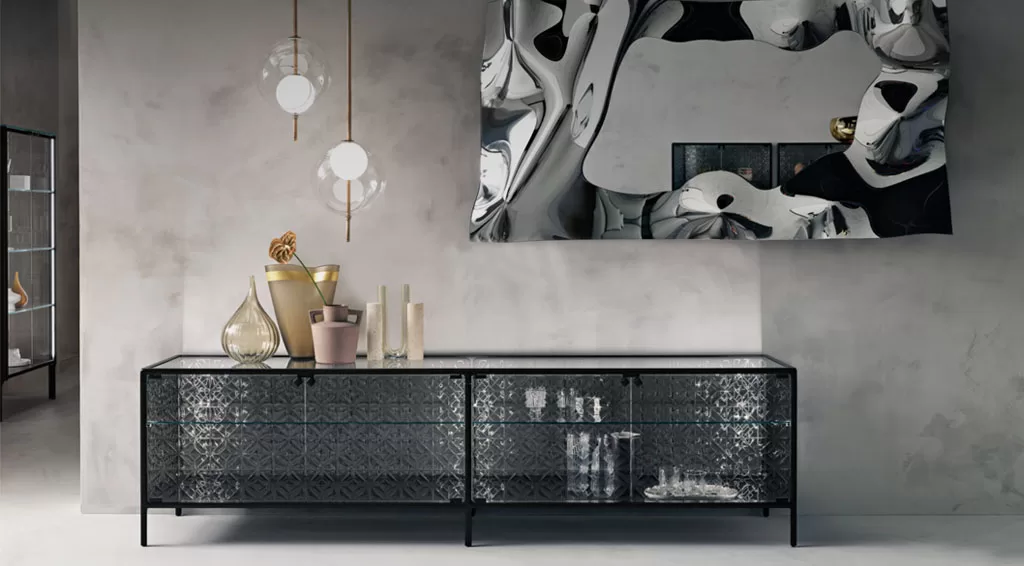
The Echo collection by Marcel Wanders studio applies decorative fused glass to display cabinets and storage furniture. Repeated dimensional patterns give doors a tactile surface that shifts in appearance as light moves across it.
The technical precision of the glass is balanced by an artisanal sense of variation and depth. Metal frames and carefully finished interiors support the decorative doors without overwhelming them.
Echo and Echo Line demonstrate how Fiam’s expertise extends beyond transparent furniture. Glass can become textured, opaque, colored or reflective, giving cabinets and sideboards the visual richness usually associated with carved or cast materials.
Display Cabinets and Bookcases
Fiam Italia display cabinets use transparency to protect and organize objects without visually separating them from the room. Curved-glass cases, metal frames, interior lighting and refined shelving turn storage into a carefully composed presentation.
Collections such as Palladio and Palladio Uno reflect Vittorio Livi’s direct approach to glass construction, while newer families introduce color, decorative surfaces and contrasting materials.
Bookcases and shelving systems similarly use glass to maintain openness. They can divide a room, display books and objects or create storage along a wall without introducing the visual mass of conventional cabinetry.
Collaborations with International Designers
Fiam Italia has collaborated with many influential designers and architects, including Cini Boeri, Philippe Starck, Enzo Mari, Vico Magistretti, Ron Arad, Giorgetto Giugiaro, Marcel Wanders, Daniel Libeskind, Massimiliano and Doriana Fuksas, Makio Hasuike and Patrick Norguet.
These designers have approached glass from different perspectives. Some emphasize transparency and formal reduction, while others explore decoration, color, asymmetry or architectural scale.
Fiam’s role is not simply to manufacture an existing sketch. The company works with designers to test the technical limits of the material and develop processes capable of realizing ideas that may initially appear impossible.
Glass Furniture for Residential and Contract Interiors
Fiam furniture can be used in private residences, hospitality environments, workplaces, boutiques and public interiors. Its transparent character makes it especially useful when a design requires functional furniture without excessive visual weight.
A glass dining table can preserve sightlines through an open-plan room. A large mirror can multiply light and perceived space. Display cabinets can organize collections while allowing surrounding finishes to remain visible.
At the same time, fused and textured glass can create dramatic focal points for hotel lobbies, restaurants, executive offices and luxury retail environments. Custom options and contract services support more complex architectural projects.
Responsible by Nature
Glass is composed primarily of sand and lime, does not release harmful substances and can be recycled repeatedly without losing its essential qualities. Fiam builds on these inherent advantages through internal processes intended to recover material and reduce waste.
The company’s patented DV-GLASS technology creates unusually thick glass surfaces while returning approximately 95% of relevant manufacturing offcuts to the production cycle. Strips remaining after float-glass sheets are shaped can be arranged and fused at high temperatures into a new surface.
This process transforms production remnants into a material with its own distinctive depth and texture. It demonstrates how environmental responsibility can become a source of technical and aesthetic innovation rather than a limitation.
Discover Fiam Italia at Scott + Cooner
Explore Fiam Italia at Scott + Cooner and discover iconic curved-glass chairs, dining tables, coffee tables, mirrors, cabinets and office furniture shaped by more than five decades of Italian innovation.
Our experienced team can help homeowners, architects and interior designers compare Fiam collections, evaluate glass colors and finishes, and select appropriate dimensions or custom configurations for residential and contract projects. Contact Scott + Cooner or visit one of our showrooms to experience the remarkable transparency, craftsmanship and sculptural presence of Fiam Italia glass furniture.