
Fritz Hansen Danish Furniture and Iconic Design
Fritz Hansen creates timeless Danish furniture, lighting and accessories shaped by Nordic simplicity, exceptional craftsmanship and more than 150 years of design innovation. Its collection brings together some of the most influential designs of the twentieth century with contemporary pieces created for modern life.
Iconic Fritz Hansen furniture includes Arne Jacobsen’s Egg, Swan, Ant and Series 7 chairs, Poul Kjærholm’s PK22 lounge chair and PK80 daybed, and enduring designs by Hans J. Wegner. Contemporary collections by designers such as Jaime Hayon and Cecilie Manz continue the company’s tradition of combining sculptural expression, function and comfort.
Scott + Cooner helps homeowners, architects and interior designers select Fritz Hansen furniture and lighting for distinctive residential and commercial interiors.
Defining Danish Design Since 1872
The Fritz Hansen story began in Copenhagen in 1872, when cabinetmaker Fritz Hansen obtained a trade license and established his own workshop. His early reputation was built on skilled craftsmanship, careful construction and an ability to translate ambitious ideas into beautifully made furniture.
The business grew through commissions for prominent Danish institutions, including Copenhagen City Hall and government buildings. Under the leadership of Fritz Hansen’s son Christian E. Hansen, the company combined its cabinetmaking heritage with new manufacturing processes and collaborations with architects.
Experiments with steam-bent wood, tubular steel and laminated veneer positioned Fritz Hansen at the forefront of modern furniture production. These innovations later made it possible to manufacture some of the most recognizable chairs in design history.
Today, the company continues to balance industrial precision with hand-finished quality, creating furniture intended to remain functional and visually relevant for generations.
Collaboration as a Design Tradition
Fritz Hansen’s identity has been shaped by sustained collaboration with architects and designers. Rather than applying one fixed style to every product, the company works closely with each designer to preserve the original idea while resolving the demands of materials, engineering and production.
Historic collaborators include Arne Jacobsen, Poul Kjærholm, Hans J. Wegner, Børge Mogensen, Piet Hein and Verner Panton. Contemporary contributors include Jaime Hayon, Cecilie Manz and other leading international designers.
The resulting collection is diverse, but its pieces share a commitment to clarity, proportion and lasting quality. A single Fritz Hansen chair or table can introduce a strong design presence without overwhelming the surrounding architecture.
Arne Jacobsen and Fritz Hansen
Arne Jacobsen’s collaboration with Fritz Hansen produced several of the most celebrated works of Danish modern design. As both an architect and designer, Jacobsen considered furniture in relation to the spaces it would inhabit.
His designs balance organic form with technical innovation. Some are light, stackable and highly practical; others are sculptural lounge pieces that create privacy and comfort within open interiors.
The Ant, Series 7, Egg, Swan and Drop chairs each developed from specific architectural or functional needs. Together, they demonstrate Jacobsen’s remarkable ability to reduce a design to its essential form while preserving personality and human comfort.
The Series 7 Chair
Designed by Arne Jacobsen in 1955, the Series 7 chair is one of the most recognizable chairs in modern furniture history and the most popular design in Fritz Hansen’s chair collection.
Its seat and back are formed from a single piece of pressure-molded veneer. The narrowed waist provides visual lightness and controlled flexibility, while the slender metal base creates a clean, architectural profile.
Series 7 chairs can be used around dining tables, in kitchens, conference rooms, offices and hospitality environments. Their compact form and stacking capability make them especially versatile.
Available in a broad selection of veneers, colors, base finishes and upholstery options, Series 7 can appear understated and practical or richly tailored. Different specifications can also be combined to create a coordinated yet varied group around a table.
The Ant Chair
Introduced in 1952, the Ant chair was Arne Jacobsen’s first major breakthrough in molded-veneer furniture. The original design featured a visually slender shell supported by three legs, giving the chair its ant-like silhouette and name.
Its continuous seat and back were made possible by advances in laminated-veneer production. The result was a chair that appeared light and simple while providing flexibility and support.
Contemporary versions preserve the character of Jacobsen’s original design while offering practical configurations for dining, work and public environments. The Ant remains an example of how careful engineering can produce an object of extraordinary visual economy.
The Egg Chair
Arne Jacobsen designed the Egg chair in 1958 for the lobby and reception areas of the SAS Royal Hotel in Copenhagen. Its curved shell created a sense of enclosure and privacy within the hotel’s open public spaces.
The chair’s sculptural silhouette was developed through experimentation with new materials and modeling techniques. Its high back, enveloping sides and swivel base allow the sitter to withdraw comfortably without becoming completely disconnected from the surrounding room.
The Egg can serve as a focal point in a living room, executive office, hotel lobby or private lounge. Upholstery options in fabric and leather allow its expressive form to take on different personalities, from understated to dramatic.
The Swan Chair
Also designed for the SAS Royal Hotel in 1958, the Swan chair translates Jacobsen’s organic approach into a lower, more open form.
The design uses flowing curves without straight lines, creating a compact lounge chair that feels welcoming from every angle. Its sculptural shape makes it well suited to freestanding placement where it can be viewed throughout the room.
The Swan works individually as an accent chair or in pairs and groups within conversation areas, reception spaces and hospitality settings. A selection of upholstery and base options allows it to coordinate with both neutral and colorful interiors.
Poul Kjærholm and the PK Collection
Poul Kjærholm developed a distinct interpretation of Danish modernism through furniture that combines industrial materials with meticulous craftsmanship. Steel was central to his work—not simply as a structural necessity, but as a material with the refinement of wood or leather.
Kjærholm’s designs are characterized by precise frames, carefully selected natural materials and an exceptional sense of proportion. Leather, cane, marble, canvas and steel are brought together with visible clarity, allowing each material to express its own qualities.
The Fritz Hansen PK collection includes lounge chairs, dining chairs, tables, benches and daybeds. These pieces have a restrained architectural character that works naturally in modern homes, executive offices, galleries and hospitality interiors.
The PK22 Lounge Chair
Designed by Poul Kjærholm in 1956, the PK22 lounge chair is defined by a low profile and a precisely resolved steel structure. Its seat appears suspended within the frame, emphasizing the relationship between material, support and the human body.
Depending on the selected version, the seat may introduce leather, canvas or woven material against the cool geometry of the base. This contrast gives the chair both visual discipline and tactile warmth.
PK22 can be used as an individual statement chair, positioned in pairs or incorporated into a larger seating arrangement. Its reduced form makes it especially effective in interiors where architecture and artwork should remain visible.
The PK80 Daybed
The PK80 daybed demonstrates Poul Kjærholm’s ability to reduce furniture to an elemental composition. A generously upholstered rectangular cushion rests above a slender metal frame, creating a functional object of exceptional clarity.
The design can provide seating in a living room, office or reception area while also functioning as a place to recline. Because it has no conventional front or back, the daybed can be placed centrally within a room and approached from multiple directions.
Its low, horizontal form is particularly effective in open interiors, where it divides space without interrupting sightlines.
Tables for Dining, Work and Gathering
Fritz Hansen tables extend the company’s approach to proportion and material into dining rooms, kitchens, offices and meeting spaces.
The Table Series includes circular, rectangular, Super-Circular and Super-Elliptical forms developed by Piet Hein, Bruno Mathsson and Arne Jacobsen. Their visually light bases and carefully considered shapes make them adaptable to both residential and professional environments.
A circular table encourages conversation and fits naturally into compact dining areas. Rectangular designs accommodate larger groups, while the Super-Elliptical form softens corners and improves circulation around the table.
Fritz Hansen tables coordinate especially well with Series 7 and Ant chairs, although their restrained character also allows them to work with other seating designs.
Contemporary Fritz Hansen Furniture
Fritz Hansen continues to develop new furniture while maintaining a meaningful dialogue with its heritage. Contemporary designs respond to changing patterns of living, working and gathering without relying on temporary trends.
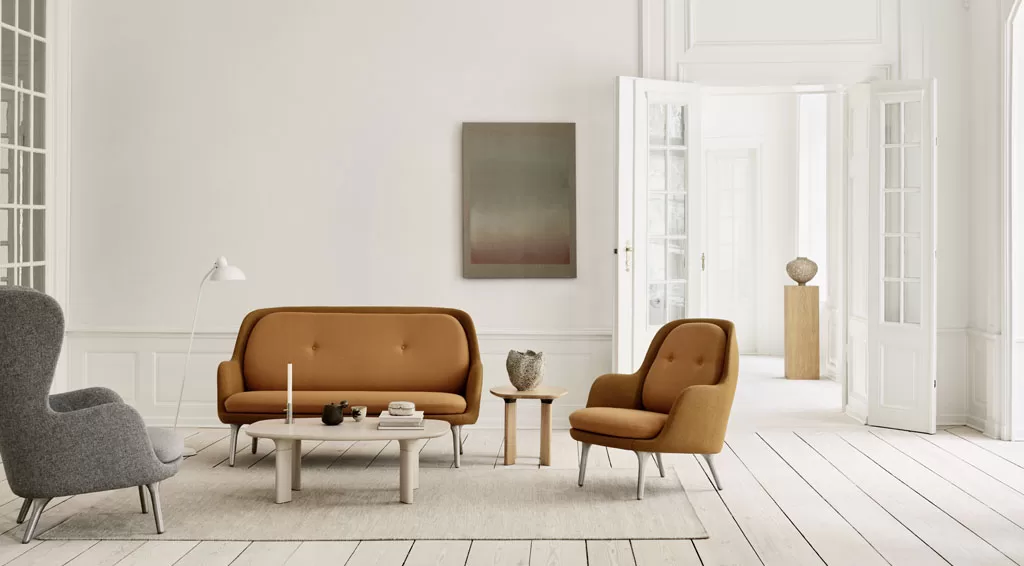
Jaime Hayon’s furniture brings warmth, comfort and a more expressive sensibility to the collection. Designs such as the Ro and Fri lounge chairs provide supportive, enveloping seating with a distinctly contemporary character.
Other recent collaborations explore modular seating, adaptable tables and furniture for increasingly flexible interiors. These designs complement the historic collection without imitating it, allowing classic and contemporary pieces to coexist naturally.
Fritz Hansen Lighting
The Fritz Hansen lighting collection combines atmospheric illumination with clean Scandinavian form. It includes pendant lights, table lamps, floor lamps and wall lights suitable for residential and commercial interiors.
The Caravaggio collection by Cecilie Manz is recognized for its strong silhouette, controlled downward light and subtle opening at the top of the shade. Its range of sizes makes it appropriate above dining tables, kitchen islands and in larger architectural settings.
Historic lighting designs add another dimension to the collection, while contemporary lamps bring new materials and lighting technology into the Fritz Hansen universe.
Lighting can be coordinated with the furniture without making the room feel overly matched. Shared qualities of proportion, material honesty and visual restraint create a natural relationship between the pieces.
Accessories and Finishing Details
Fritz Hansen accessories translate the company’s design values into smaller objects for everyday use. Mirrors, vases, cushions, throws and decorative pieces can introduce texture, color and craftsmanship without requiring a major furniture change.
These objects work well as finishing elements in a complete Fritz Hansen interior or as individual accents within a broader collection of furnishings.
Thoughtful accessories can also help balance the precision of modern furniture with softer, more personal layers. Textiles add warmth, while reflective and sculptural objects interact with light and architecture.
Craftsmanship, Materials and Longevity
Fritz Hansen furniture is designed to unite industrial innovation with skilled craftsmanship. Molded veneer, steel, leather, textiles, wood and stone are chosen according to the needs of each design.
The quality of a piece is expressed through its proportions as well as its details: the transition between a chair shell and its base, the tailoring of upholstery, the finish of metal, or the selection and matching of natural materials.
Many Fritz Hansen designs have remained in production for decades because their function and construction are as carefully considered as their appearance. Appropriate maintenance and care can allow these pieces to serve successive generations.
Fritz Hansen for Residential and Commercial Interiors
The breadth of the Fritz Hansen collection makes it appropriate for homes, workplaces, restaurants, hotels and other public spaces.
Series 7 and Ant chairs provide flexible seating for dining rooms, conference spaces and hospitality projects. Egg and Swan chairs can establish comfortable conversation areas or distinctive focal points. PK furniture brings architectural clarity to executive offices, lounges and refined residential interiors.
Selecting the right design involves considering scale, circulation, comfort, upholstery and intended use. A successful specification should support the daily life of the space while contributing to its visual identity.
Discover Fritz Hansen at Scott + Cooner
Scott + Cooner offers Fritz Hansen furniture, lighting and accessories for clients seeking authentic Danish design and exceptional quality.
Our experienced team works with homeowners, architects and interior designers to select appropriate models, finishes, upholstery and configurations. We can help coordinate dining furniture, lounge seating, tables and lighting within a complete residential or commercial project.
Explore iconic Fritz Hansen designs by Arne Jacobsen, Poul Kjærholm and other celebrated designers with guidance from Scott + Cooner. Contact us for product information, material samples, pricing and lead times.