
Flos Iconic Italian Lighting, Modern Designer Lamps & Architectural Illumination
Flos creates some of the world’s most recognizable modern lighting, combining Italian design culture, technological innovation, architectural intelligence, and a remarkable history of collaboration with influential international designers. Since 1962, the company has continually reconsidered what a lamp can be—developing lighting that ranges from sculptural design icons for the home to sophisticated architectural systems for residential, hospitality, workplace, retail, cultural, and public environments.
The Flos collection encompasses pendant and suspension lighting, chandeliers, floor lamps, table lamps, wall and ceiling lights, portable lamps, architectural lighting systems, spotlights, downlights, track lighting, integrated solutions, and outdoor lighting. Historic designs by Achille and Pier Giacomo Castiglioni coexist with contemporary work by Philippe Starck, Michael Anastassiades, Patricia Urquiola, Jasper Morrison, Konstantin Grcic, Formafantasma, Ronan and Erwan Bouroullec, Marcel Wanders, Antonio Citterio, Piero Lissoni, and other leading designers.
What Is Flos Known for in Modern Lighting?
Flos is known for iconic Italian lighting, experimental design, innovative technology, architectural lighting, and collaborations with some of the most important designers of the modern and contemporary eras.
Its extraordinary range is one of its greatest strengths.
A Flos lamp can be a collectible design object, a quiet source of ambient illumination, a precise architectural tool, or part of an integrated lighting system.
This ability to move between object and architecture has helped make Flos one of the most influential names in international lighting design.
Flos Has Been Reinventing Artificial Light Since 1962
Flos emerged during an extraordinary period of Italian design.
Its earliest experiments brought together innovative materials, new manufacturing techniques, and designers willing to challenge assumptions about what lighting should look like and how it should function.
From the beginning, experimentation was central to the company.
Light was not simply something emitted by a fixture.
It became a material for shaping atmosphere, architecture, and everyday life.
How Did Flos Change Modern Lighting Design?
Flos helped transform lighting by treating the lamp as a subject for serious design experimentation.
Instead of starting with a conventional lamp typology and refining its appearance, designers questioned the typology itself.
Could a floor lamp perform the role of a ceiling fixture?
Could industrial materials become poetic?
Could reflected light be more important than the visible source?
Could the structure almost disappear?
These questions produced some of the most recognizable lighting designs of the twentieth century.
Achille & Pier Giacomo Castiglioni Helped Define Flos
Few relationships in modern lighting are as important as the collaboration between Flos and Achille and Pier Giacomo Castiglioni.
Their designs combined curiosity, humor, observation, engineering, and an extraordinary ability to transform ordinary ideas into unexpected objects.
Rather than decorating familiar lamp forms, the Castiglioni brothers frequently reconsidered the basic problem of illumination.
The results became landmarks of Italian design.
Arco Is One of the World’s Most Iconic Floor Lamps
Designed by Achille and Pier Giacomo Castiglioni in 1962, Arco solved a practical problem with extraordinary elegance.
The designers wanted to provide light over a table without requiring a ceiling-mounted fixture.
A long curved stem extends from a substantial marble base, allowing the light source to project dramatically into the room.
The result is both functional and sculptural.
How Does the Flos Arco Lamp Work?
Arco effectively moves overhead lighting away from the ceiling and anchors it to the floor.
Its extended arch positions illumination over a dining table, seating area, or other surface while the base remains away from the activity below.
This allows furniture arrangements to gain overhead light without depending entirely on a fixed electrical point in the ceiling.
That combination of mobility, engineering, and visual drama is a major reason Arco remains relevant decades after its introduction.
The Arco Lamp Connects Lighting with Architecture
Arco occupies space differently from an ordinary floor lamp.
Its long arc creates an architectural gesture.
The marble base establishes a physical anchor.
The stem describes movement through the room.
The shade creates a destination for light.
This makes Arco particularly effective in open-plan interiors where lighting can help define an area without constructing a wall.
Taccia Turns Reflected Light into Sculpture
Taccia by Achille and Pier Giacomo Castiglioni is another important example of Flos experimentation.
Rather than presenting a conventional shade and bulb relationship, the design uses reflection to create illumination while giving the lamp a highly distinctive sculptural identity.
Placed on a console, low table, cabinet, or floor, Taccia has the presence of an object even when it is not illuminated.
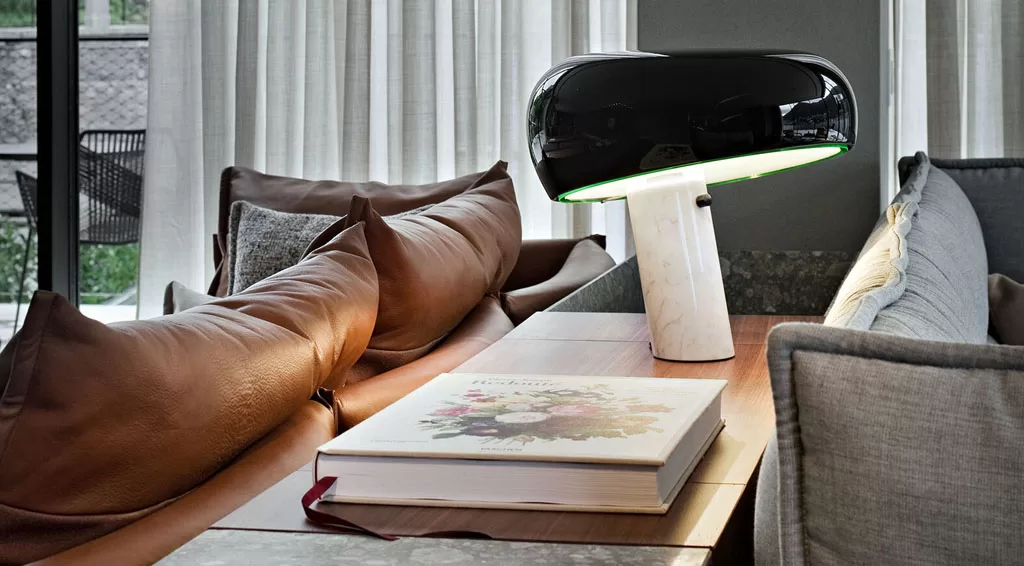
Snoopy Brings Humor into Italian Lighting Design
Snoopy demonstrates the Castiglioni brothers’ ability to combine wit with sophisticated industrial design.
Its unmistakable profile gives the lamp personality without compromising its function.
This balance between intelligence and playfulness is one of the qualities that made postwar Italian design so influential.
Parentesi Reconsidered the Floor-to-Ceiling Lamp
Designed by Achille Castiglioni and Pio Manzù, Parentesi uses the vertical relationship between floor and ceiling as part of its structure.
The light source can move along the system, transforming adjustment into an essential aspect of the design.
Instead of concealing the mechanics, Parentesi makes them part of the visual experience.
Luminator Demonstrates the Power of Reduction
Some of the strongest Flos designs are remarkable for how little they require.
Luminator reduces the floor lamp toward its essential components.
Structure and light become almost inseparable.
The result demonstrates an important principle of modern design: simplicity becomes powerful when every remaining element has purpose.
Flos Lighting Can Be Both Functional & Collectible
Many Flos lamps occupy an unusual position between useful object and collectible design.
They illuminate a room, but they also contribute to its cultural and visual identity.
For collectors and design-conscious clients, this means lighting can be selected with the same consideration given to important furniture, art, and architecture.
Philippe Starck Expanded the Flos Design Vocabulary
Flos began working with Philippe Starck during the 1980s, establishing a relationship that would produce numerous influential designs.
Starck’s approach ranges from highly recognizable decorative objects to sophisticated architectural and outdoor lighting.
His work demonstrates how lighting can be technologically advanced while remaining emotionally engaging.
KTribe Reinterprets the Traditional Shade
The KTribe family by Philippe Starck transforms the familiar lamp shade through contemporary materials and sophisticated layering.
Its recognizable silhouette gives the design an immediate sense of familiarity, while transparency, reflection, and material effects make it distinctly contemporary.
This makes KTribe particularly versatile in residential and hospitality interiors.
Guns Turns the Table Lamp into Commentary
Starck’s Guns collection demonstrates that lighting can communicate ideas beyond pure function.
The lamp becomes a provocative object as well as a source of illumination.
Within the broader Flos collection, pieces like this reveal how wide the company’s creative territory can be.
In Vitro Brings Philippe Starck Outdoors
Flos’s outdoor collection extends designer lighting beyond the interior.
In Vitro by Philippe Starck creates a contemporary interpretation of the lantern, allowing architectural outdoor environments to gain both illumination and a recognizable design presence.
Suspension, portable, and other configurations make the family adaptable to different exterior applications.
Michael Anastassiades Brings Poetic Minimalism to Flos
Michael Anastassiades has created some of the most recognizable contemporary Flos lighting.
His work often begins with elementary geometry—lines, spheres, circles, and balanced relationships.
Yet the apparent simplicity is deceptive.
Proportion, engineering, light quality, and material relationships are carefully controlled.
The resulting fixtures feel simultaneously minimal and expressive.
IC Lights Explores the Beauty of Balance
IC Lights is built around a deceptively simple relationship between a sphere and a slender structural element.
The glowing globe appears poised against the frame with remarkable visual lightness.
The collection demonstrates how one carefully resolved gesture can become a complete design language.
Why Are Flos IC Lights So Versatile?
IC Lights can work across many different interiors because the geometry is clear without being visually aggressive.
The spherical diffuser creates a familiar sense of softness.
The frame introduces precision.
Different configurations allow the same design language to appear as floor, table, wall, ceiling, and suspension lighting.
This makes IC Lights useful when designers want continuity across multiple spaces without repeating exactly the same fixture.
Captain Flint Combines Ambient & Directional Light
Michael Anastassiades’ Captain Flint explores the relationship between atmosphere and task lighting.
Its refined form can contribute sculptural presence while allowing light to be directed where it is needed.
This flexibility makes it particularly effective beside seating, in reading areas, and in sophisticated hospitality interiors.
Coordinates Creates Architecture with Lines of Light
Coordinates turns linear illumination into a spatial composition.
Horizontal and vertical elements establish luminous geometry within the room.
The fixture can therefore function almost like suspended architecture, making it particularly effective in large spaces where a conventional pendant might not have sufficient presence.
String Light Turns Electrical Cable into Design
Michael Anastassiades’ String Light transforms something normally hidden—the electrical connection—into an essential visual element.
Cables stretch through space to create geometric compositions while supporting the light sources.
The result is especially compelling in lofts, double-height rooms, galleries, restaurants, and other spaces where lighting can engage with the architecture at a larger scale.
Glo-Ball Creates Soft Diffused Illumination
Designed by Jasper Morrison, Glo-Ball demonstrates the power of apparently simple forms.
Its spherical or gently flattened diffuser creates soft, diffuse illumination while maintaining a restrained visual presence.
This makes the family particularly effective when the quality of light should take precedence over decorative complexity.
How Does Diffused Lighting Change a Room?
Diffused light reduces harsh contrast and creates a softer overall atmosphere.
Rather than producing a tightly focused beam, illumination spreads more evenly into the surrounding environment.
This can make living rooms, bedrooms, hospitality spaces, and dining areas feel calmer and more comfortable.
Fixtures such as Glo-Ball demonstrate how a simple luminous volume can shape the emotional character of a room.
Bellhop Makes Portable Lighting Part of Everyday Life
Portable lighting has changed how people think about lamps.
A fixture no longer needs to remain permanently connected to one location.
Bellhop, designed by Edward Barber and Jay Osgerby, allows light to move with the user.
A dining table, bookshelf, terrace, bedside area, or informal gathering space can gain illumination precisely where it is needed.
Portable Lamps Make Lighting More Flexible
Rechargeable lighting adds another layer to interior design.
Instead of planning every lighting experience around outlets and fixed electrical points, portable fixtures allow illumination to adapt to changing activities.
This flexibility is especially useful for dining, entertaining, outdoor living, hospitality, and spaces where architectural intervention should remain minimal.
Flos Pendant Lights Can Define a Room
Suspension lighting occupies a particularly important position because it relates directly to both architecture and furniture.
A pendant above a dining table can establish the center of the room.
A linear suspension can reinforce a kitchen island.
A sculptural chandelier can create a focal point within a stair hall or double-height space.
Flos offers suspension lighting ranging from historic icons to highly contemporary systems.
How Do You Choose the Right Flos Pendant Light?
Begin with the surface or space being illuminated.
A dining table usually benefits from a fixture scaled according to both table dimensions and ceiling height.
A kitchen island may require more linear illumination.
A large entry or stairwell can accommodate greater vertical volume.
Then consider whether the fixture should visually dominate, quietly complement the architecture, or become almost invisible while delivering precise light.
Flos offers options for each approach.
Flos Chandeliers Reinterpret Decorative Lighting
Contemporary chandeliers do not need to reproduce historic forms.
Flos designers use glass, linear LED elements, modular components, suspension systems, and innovative structures to create new forms of decorative overhead lighting.
These fixtures can provide significant visual presence without relying on conventional ornament.
Arrangements Turns Lighting into a Custom Composition
Arrangements by Michael Anastassiades uses geometric luminous elements that can be combined into larger compositions.
Rather than selecting one predetermined chandelier, designers can create a configuration appropriate to the architecture.
This makes the system especially effective where lighting needs to respond to unusual ceiling heights, stairwells, dining areas, or larger public spaces.
Noctambule Uses Transparent Glass to Build Vertical Light
Noctambule by Konstantin Grcic explores modular glass cylinders and luminous connections.
When unlit, the transparent components can appear remarkably quiet.
When illuminated, light reveals the structure and transforms the composition.
This shift between daytime transparency and nighttime presence gives the design a particularly architectural quality.
Skygarden Combines Contemporary Form with Decorative Detail
Designed by Marcel Wanders, Skygarden creates a dialogue between a restrained exterior form and an unexpectedly decorative interior.
The fixture demonstrates that contemporary design does not require the elimination of ornament.
Instead, historical references can be reinterpreted through new materials, technologies, and contexts.
Aim Creates Informal Suspended Lighting Compositions
Aim by Ronan and Erwan Bouroullec allows pendant lights to be positioned with unusual freedom.
Rather than forcing the electrical point to determine exactly where the fixture hangs, long cables become part of the composition.
Multiple lights can create an intentionally informal constellation within the room.
Flos Table Lamps Add Intimate Layers of Light
Table lamps bring illumination closer to human scale.
They can soften a living room, create a pool of light beside a bed, illuminate a desk, or add atmosphere to a restaurant table.
Because they are viewed at close range, material quality, proportion, controls, and glare management become especially important.
Flos Floor Lamps Can Provide More Than Ambient Light
A floor lamp can perform many roles.
It can provide reading light.
Wash a wall.
Create indirect illumination.
Define a seating group.
Replace a ceiling fixture.
Or function as a sculptural object.
Flos’s extraordinary history with the floor lamp—from Arco and Luminator to contemporary designs—demonstrates the possibilities within this category.
Wall Lights Can Become Part of the Architecture
Wall lighting is particularly effective when fixtures need to occupy minimal floor and ceiling space.
A wall lamp can provide ambient illumination, accent architectural surfaces, support circulation, or create repeated rhythm along a corridor.
Flos offers decorative and architectural wall lighting for both indoor and exterior applications.
Flos Architectural Lighting Extends Beyond Decorative Lamps
Flos is not only a manufacturer of recognizable designer lamps.
Its professional architectural collection includes sophisticated downlights, spotlights, track and lighting systems, wall and ceiling solutions, integrated architectural products, and other technical tools.
This gives architects and lighting designers the ability to combine decorative statement pieces with quieter sources of illumination within a coordinated project.
What Is the Difference Between Decorative & Architectural Lighting?
Decorative lighting is generally designed to have a visible identity within the room.
Architectural lighting often prioritizes the effect of light itself.
A pendant may become a focal point.
A recessed downlight may nearly disappear.
A track spotlight may emphasize artwork.
An integrated linear system may reveal the architecture.
Sophisticated interiors frequently use both approaches rather than choosing one exclusively.
Layered Lighting Creates Better Interiors
A room rarely performs best with one source of illumination.
Ambient light establishes overall brightness.
Task lighting supports activities.
Accent lighting reveals art, materials, and architecture.
Decorative fixtures create visual identity.
Indirect illumination can soften surfaces.
The strongest lighting plans combine these layers according to how the space will actually be used.
How Does Layered Lighting Work?
Think of lighting as a composition rather than a collection of fixtures.
Begin with the overall atmosphere.
Add focused illumination where activities require it.
Identify artwork or architectural surfaces that deserve emphasis.
Introduce decorative fixtures where a visible object will strengthen the room.
Finally, consider controls so these layers can change independently throughout the day and evening.
Flos Lighting Can Transform Art-Focused Interiors
Art collections require particularly thoughtful lighting.
The objective is not simply to make the room brighter.
Light should help artwork remain visible while respecting the atmosphere of the surrounding interior.
Adjustable architectural lighting can provide precision, while decorative Flos fixtures can contribute design presence elsewhere in the room.
Lighting Reveals Material & Texture
Stone, plaster, wood, textile, metal, glass, and artwork all respond differently to light.
Grazing light can emphasize texture.
Diffuse light can soften a surface.
Focused illumination can reveal material depth.
Indirect light can make architecture appear to glow.
A sophisticated lighting plan considers these relationships rather than treating every surface identically.
Flos Lighting Helps Define Open-Plan Interiors
Open-plan architecture often lacks walls to separate activities.
Lighting can create visual zones without physical barriers.
A pendant establishes the dining area.
A floor lamp defines a reading corner.
Architectural lighting emphasizes circulation.
A sculptural fixture can identify the center of a lounge.
These differences allow one large space to support multiple experiences.
Flos Lighting Is Ideal for Kitchens & Dining Areas
Kitchens require excellent functional illumination, but they also increasingly form part of the primary living environment.
Architectural fixtures can provide useful task light while decorative pendants introduce warmth and identity.
Dining areas can then use more intimate illumination to distinguish themselves from brighter work surfaces nearby.
Flos Lighting Brings Atmosphere to Living Rooms
Living rooms benefit from flexibility.
Bright overhead illumination is rarely sufficient by itself.
Floor lamps, table lamps, wall lights, and indirect architectural sources create layers that can shift from daytime activity to evening relaxation.
Dimming and individual control become especially important.
Flos Lighting Creates More Restful Bedrooms
Bedroom lighting should support multiple activities without becoming visually intrusive.
Soft ambient light establishes calm.
Bedside lighting supports reading.
Integrated architectural fixtures can illuminate wardrobes or circulation.
A carefully selected decorative lamp adds personality without requiring excessive brightness.
Flos Lighting Supports the Modern Home Office
Home offices require a balance between visual comfort and atmosphere.
Focused task lighting can support reading and computer work while ambient light reduces excessive contrast.
Decorative fixtures can also help the workspace feel integrated with the home rather than like a purely commercial environment.
Flos Lighting Is a Powerful Resource for Hospitality Design
Hotels, restaurants, bars, clubs, and other hospitality environments depend heavily on atmosphere.
Lighting determines how materials appear, how intimate a table feels, how guests move through a space, and how the environment changes from day to night.
Flos’s combination of decorative and architectural lighting makes it particularly valuable for these projects.
Flos Lighting Can Shape Restaurant Atmosphere
Restaurant lighting needs to perform several tasks simultaneously.
Food and faces should look appealing.
Tables need enough illumination without destroying intimacy.
Circulation must remain clear.
Architecture and artwork may need emphasis.
Decorative fixtures contribute identity.
Layered Flos lighting can help balance these requirements.
Flos Supports Workplace & Commercial Lighting
Workplaces increasingly combine focused work areas with lounges, meeting rooms, cafés, collaboration zones, and hospitality-inspired social spaces.
Different activities require different lighting conditions.
Architectural systems can provide controlled functional illumination, while decorative fixtures make shared areas warmer and more memorable.
Flos Lighting Works across Residential & Contract Projects
The breadth of the Flos portfolio allows the brand to participate in projects at very different scales.
A private residence may use an Arco lamp and several architectural fixtures.
A restaurant may combine decorative pendants with technical accent lighting.
A hotel may require hundreds of architectural fixtures alongside memorable statement pieces.
This scalability is one of the company’s greatest strengths.
Flos Outdoor Lighting Extends Architecture into the Landscape
Flos offers a substantial outdoor lighting collection for terraces, gardens, pathways, façades, pool environments, and other exterior spaces.
The range includes wall and ceiling fixtures, floor lamps, bollards, spotlights, in-ground lighting, suspension fixtures, portable lights, and other exterior solutions.
This allows the lighting plan to continue beyond the building envelope.
How Does Flos Outdoor Lighting Work in a Landscape?
Different exterior zones require different kinds of light.
Paths benefit from controlled guidance.
Terraces need comfortable ambient illumination.
Trees and architectural elements can be emphasized selectively.
Walls can receive grazing or accent light.
Portable fixtures provide flexibility around seating and dining areas.
The goal is not to illuminate everything equally, but to establish hierarchy and atmosphere.
Portable Outdoor Lighting Adds Flexibility to Terraces
Rechargeable outdoor lamps can move according to activity.
They can illuminate a dining table during dinner and later move beside lounge seating.
They can supplement permanent architectural lighting without requiring additional electrical work.
This makes portable Flos lighting particularly useful in sophisticated indoor-outdoor environments.
Outdoor Lighting Should Respect Darkness
More light is not always better.
Exterior lighting is most successful when it reveals important elements while preserving darkness elsewhere.
Controlled illumination can create depth, reduce unnecessary glare, and maintain a stronger connection with the night landscape.
The contrast between light and shadow becomes part of the design.
Flos Connects Technology with Emotion
Technical performance is essential to contemporary lighting, but performance alone does not create a memorable environment.
Flos consistently explores the emotional dimension of illumination.
Warmth.
Shadow.
Reflection.
Transparency.
Glow.
Movement.
These qualities affect how people experience a space even when they cannot identify the technical reason.
LED Technology Expanded the Possibilities of Lighting Design
The development of compact LED sources allowed designers to create forms that would have been difficult or impossible with earlier lighting technologies.
Fixtures could become thinner.
Light could be integrated into structure.
Linear systems could extend through architecture.
Smaller sources allowed greater control.
Flos has used these possibilities across decorative and architectural lighting.
Lighting Controls Are Essential to a Sophisticated Project
A beautifully selected fixture can still perform poorly if the room cannot adapt to changing conditions.
Daylight changes.
Activities change.
Evening requires a different atmosphere from daytime.
Dimming and separate control of lighting layers allow a space to respond to these differences.
How Do You Select the Right Flos Lighting for a Project?
Start with the architecture rather than the fixture.
Identify activities, daylight, important surfaces, art, circulation, furniture layouts, ceiling conditions, and electrical constraints.
Determine where light should come from and what it needs to accomplish.
Then select decorative and architectural Flos products that deliver those effects while contributing appropriately to the visual character of the space.
Flos Is an Exceptional Resource for Architects & Interior Designers
For design professionals, Flos provides unusual breadth.
Historic icons can introduce design pedigree.
Contemporary decorative fixtures create visual identity.
Architectural systems provide precision.
Outdoor lighting extends the concept into landscape.
This allows lighting to be developed as a coordinated element of the overall project rather than a collection of unrelated fixtures.
Flos Lighting Can Complement Contemporary Architecture
The clean lines and technical sophistication of many Flos products work naturally with contemporary architecture.
Concrete, stone, plaster, glass, steel, and wood can all be transformed by carefully controlled illumination.
Decorative fixtures can provide contrast, while recessed or integrated sources allow the architecture itself to remain visually dominant.
Flos Icons Also Work Beautifully in Historic Interiors
An iconic modern lamp can create a compelling dialogue with historic architecture.
Arco beneath ornate ceilings.
Taccia against traditional millwork.
A minimal Michael Anastassiades fixture within an older residence.
Contrast can make both the architecture and the lighting feel more intentional.
Why Choose Authentic Flos Lighting?
Authentic Flos lighting represents the original relationship between designer, manufacturer, materials, engineering, proportion, and production.
For iconic designs in particular, seemingly small details are fundamental to the integrity of the object.
Selecting authentic Flos also preserves the connection between the fixture and the design history that made it significant.
Where Can You Experience Flos Lighting at Scott + Cooner?
Scott + Cooner represents Flos through our San Francisco, Dallas, and Austin showrooms, connecting architects, interior designers, lighting designers, hospitality professionals, and design-conscious clients with one of the world’s most important modern lighting collections.
Our teams can help clients explore Flos decorative lighting, architectural lighting, pendant lights, chandeliers, floor lamps, table lamps, wall lights, ceiling fixtures, portable lamps, outdoor lighting, iconic designs, contemporary collections, and project-specific lighting solutions.
Where Can You Find Flos Lighting in San Francisco?
Scott + Cooner San Francisco represents Flos for architects, interior designers, lighting designers, hospitality professionals, collectors, and design-conscious clients throughout San Francisco and the Bay Area.
Flos is particularly relevant to Bay Area interiors because the collection can move easily between design icon and architectural tool.
Historic modern residences can incorporate classic Castiglioni lighting, while contemporary homes, hospitality projects, workplaces, galleries, and restaurants can draw from Flos’s decorative and architectural collections.
Flos Complements Bay Area Modern Architecture
Northern California architecture frequently emphasizes natural light, material authenticity, landscape, and open spatial relationships.
Lighting after sunset should respect these qualities.
Flos architectural fixtures can reveal surfaces and art without unnecessarily dominating them, while decorative lamps create warmer points of visual focus.
Flos Lighting Works Beautifully with San Francisco Art Collections
Art-focused interiors need flexibility and control.
Adjustable architectural lighting can emphasize paintings, sculpture, photography, and objects, while iconic Flos lamps contribute their own design history without needing to compete with the collection.
The relationship between light, art, and architecture can therefore be carefully layered.
Flos Supports San Francisco Hospitality & Workplace Design
The Bay Area’s restaurants, hotels, creative workplaces, technology environments, and cultural spaces frequently require lighting that performs technically while contributing to a distinctive experience.
Flos can support these projects with both architectural infrastructure and recognizable decorative lighting.
Flos Outdoor Lighting Extends Bay Area Indoor-Outdoor Living
Terraces, courtyards, gardens, and other exterior environments can continue the lighting concept beyond the interior.
Portable lamps create intimate points of light, while architectural exterior fixtures can illuminate circulation, landscape, and building surfaces.
This supports California’s strong relationship between indoor and outdoor living.
San Francisco Architects & Designers Can Specify Flos Through Scott + Cooner
Scott + Cooner San Francisco can assist architects, interior designers, lighting designers, and clients with Flos for residential, hospitality, workplace, retail, cultural, and contract projects throughout the Bay Area.
Our team can help explore decorative fixtures, iconic lamps, architectural systems, outdoor lighting, scale, placement, finishes, light quality, and relationships with furniture and architecture.
Where Can You Find Flos Lighting in Dallas?
Scott + Cooner Dallas represents Flos for architects, interior designers, lighting designers, hospitality professionals, collectors, and design-conscious clients throughout Dallas and North Texas.
Flos is especially compelling for substantial Dallas residences and sophisticated commercial interiors because the collection can address lighting at multiple scales—from an individual iconic lamp to a comprehensive architectural lighting concept.
Flos Lighting Can Define Large Dallas Interiors
Generous spaces require lighting with appropriate scale.
A small decorative fixture can disappear beneath a substantial ceiling.
Large suspension compositions, sculptural floor lamps, and coordinated architectural lighting can help establish hierarchy across expansive living rooms, dining spaces, galleries, stair halls, and entertaining areas.
Flos Is Ideal for Dallas Art-Focused Residences
Dallas has a strong relationship with contemporary art, architecture, and collectible design.
Flos fits naturally into these interiors.
Architectural lighting can provide precise illumination for artwork, while pieces such as Arco, Taccia, IC Lights, or other designer fixtures can participate in the room as important design objects.
Flos Creates Atmosphere for Dallas Entertaining
Entertaining spaces need flexibility.
A dining room may require brighter illumination during preparation and much softer light during dinner.
A living room can shift between conversation and larger gatherings.
Exterior spaces need different lighting after sunset.
Layered and dimmable lighting makes these transitions possible.
Flos Supports Dallas Hospitality & Commercial Projects
Hotels, restaurants, private clubs, workplaces, retail environments, multifamily developments, and other commercial projects can use Flos to combine functional architectural illumination with memorable decorative fixtures.
This ability to address both technical and experiential lighting is particularly valuable in hospitality environments.
Dallas Architects & Designers Can Specify Flos Through Scott + Cooner
Scott + Cooner Dallas can assist architects, interior designers, lighting designers, hospitality professionals, and clients with Flos for residential and contract projects throughout Dallas and North Texas.
Our team can help explore decorative lighting, architectural systems, pendants, floor lamps, wall lights, outdoor fixtures, iconic collections, contemporary designs, and project-specific applications.
Where Can You Find Flos Lighting in Austin?
Scott + Cooner Austin represents Flos for architects, interior designers, lighting designers, hospitality professionals, collectors, and design-conscious clients throughout Austin and Central Texas.
Flos’s combination of design innovation, technology, architectural precision, and expressive decorative lighting connects naturally with Austin’s contemporary architecture, creative culture, hospitality environments, and technology-driven workplaces.
Flos Complements Austin & Hill Country Architecture
Central Texas architecture frequently combines limestone, concrete, plaster, glass, steel, and warm natural wood.
Lighting can reveal the texture and depth of these materials after sunset.
Wall grazing can emphasize stone.
Focused light can reveal artwork.
Indirect illumination can soften concrete and plaster.
Decorative fixtures can introduce a more intimate human scale.
Flos Supports Austin’s Indoor-Outdoor Lifestyle
Austin residences often connect interior rooms directly with terraces, pools, courtyards, and landscape.
A coordinated lighting plan can strengthen this relationship after dark.
Interior illumination should remain visually balanced with exterior light so that glass continues to connect the spaces rather than becoming a reflective barrier.
Flos Outdoor Lighting Works Beautifully in Central Texas
Exterior lighting can reveal limestone walls, native landscape, pathways, terraces, and pool environments while preserving areas of darkness.
Portable Flos fixtures can add flexibility around dining and lounge areas, while permanent outdoor products can provide more architectural illumination.
Flos Is a Strong Resource for Austin Hospitality & Creative Workplaces
Austin’s hotels, restaurants, clubs, creative offices, technology workplaces, and mixed-use environments increasingly use lighting to establish identity.
Flos’s combination of decorative objects and professional architectural systems allows designers to create environments that feel distinctive while meeting practical lighting requirements.
Austin Architects & Designers Can Specify Flos Through Scott + Cooner
Scott + Cooner Austin can assist architects, interior designers, lighting designers, hospitality professionals, and clients with Flos for residential, workplace, hospitality, retail, landscape, and contract projects throughout Austin and Central Texas.
Our team can help explore iconic Flos lamps, contemporary decorative lighting, architectural systems, exterior fixtures, scale, placement, finishes, light quality, and complete project applications.
Scott + Cooner Represents Flos in San Francisco, Dallas & Austin
Scott + Cooner’s representation of Flos across San Francisco, Dallas, and Austin gives architects, interior designers, lighting designers, hospitality professionals, collectors, and design-conscious clients access to one of the world’s most important lighting manufacturers through experienced local showroom teams.
In San Francisco, Flos’s relationship with modern design, art, architecture, and indoor-outdoor living makes the collection particularly relevant to sophisticated Bay Area residential, hospitality, workplace, and cultural projects.
In Dallas, Flos can address substantial residences, significant art collections, large-scale entertaining spaces, hospitality projects, workplaces, and commercial interiors with lighting that ranges from iconic decorative objects to sophisticated architectural systems.
In Austin, Flos’s combination of technology, design experimentation, architectural precision, and outdoor lighting aligns naturally with contemporary Central Texas residences, Hill Country architecture, creative workplaces, hospitality environments, and Austin’s broader design culture.
Across all three markets, Scott + Cooner can help clients explore Flos according to architecture, function, light quality, scale, placement, control, finish, atmosphere, and the individual requirements of each project.
Discover Flos Italian Designer Lighting at Scott + Cooner
Scott + Cooner represents Flos in San Francisco, Dallas, and Austin as part of our curated collection of exceptional contemporary lighting, furniture, and international design.
Since 1995, Scott + Cooner has worked with architects, interior designers, lighting designers, hospitality professionals, collectors, and design-conscious clients seeking extraordinary modern furniture, lighting, kitchens, closets, rugs, accessories, textiles, outdoor furniture, and architectural products for sophisticated residential and contract interiors.
Our San Francisco, Dallas, and Austin teams can help you explore Flos pendant lights, chandeliers, floor lamps, table lamps, wall lights, ceiling fixtures, portable lamps, outdoor lighting, architectural lighting systems, iconic Castiglioni designs, Michael Anastassiades lighting, Philippe Starck collections, contemporary LED lighting, and project-specific solutions.
Whether you are selecting an authentic Arco lamp for a private residence, developing layered lighting for an art collection, creating an architectural lighting plan for a contemporary home, illuminating a restaurant or hotel, or extending a lighting concept into the landscape, Scott + Cooner can help you explore Flos’s exceptional combination of Italian design history, technological innovation, iconic lighting, architectural performance, and contemporary illumination.