

Gebrüder T 1819 and Original Thonet Furniture
Gebrüder T 1819 represents more than two centuries of furniture innovation by the German company now known as Thonet. From Michael Thonet’s pioneering bentwood chairs to the tubular-steel furniture of the Bauhaus era, the collection includes some of the most influential designs in modern furniture history.
Original Thonet furniture is produced in Frankenberg, Germany, where traditional craftsmanship is combined with precise contemporary manufacturing. Historic designs by Michael Thonet, Mart Stam, Marcel Breuer and Ludwig Mies van der Rohe are complemented by contemporary furniture from designers such as Stefan Diez and Sebastian Herkner.
Scott + Cooner helps homeowners, architects and interior designers select authentic Thonet chairs, tables and lounge furniture for residential, hospitality and commercial interiors.
A Furniture Legacy Beginning in 1819
The Thonet story began in 1819 when cabinetmaker and joiner Michael Thonet opened a woodworking shop in Boppard on the Rhine. Rather than relying solely on conventional carved and joined construction, he began experimenting with methods for bending wood into strong, graceful forms.
Michael Thonet moved to Vienna in the 1840s, where his ideas developed within the city’s expanding architectural and café culture. In 1853, he transferred the business to his five sons and renamed the company Gebrüder Thonet, meaning Thonet Brothers.
The family developed specialized machinery, production processes and an international distribution network. Their furniture became known for combining visual lightness, durability, affordability and efficient production.
These innovations helped establish Thonet as a pioneer of industrial design and changed the way furniture could be manufactured, transported and used around the world.
The Invention of Bentwood Furniture
Michael Thonet perfected a process for bending solid beechwood with steam and pressure. Once softened, lengths of wood could be formed in molds and allowed to dry into strong, permanent curves.
The technique replaced complicated carved components and joints with fewer, more efficient parts. It produced furniture that was structurally strong yet remarkably light in appearance and physical weight.
Bentwood allowed a continuous line to form chair backs, arms and legs. This gave Thonet furniture an unmistakable elegance while supporting serial production on a scale that had not previously been possible.
The process still requires substantial knowledge and skilled handwork. Wood must be carefully selected, steamed, bent and finished to achieve the desired strength and consistency without losing its natural character.
The Iconic No. 14 Coffee House Chair
Designed by Michael Thonet in 1859, chair No. 14—known today as model 214—is one of the most significant chairs in furniture history.
Its design was revolutionary in both form and production. The chair could be made from only a small number of components, packed in a compact shipping crate and assembled after reaching its destination. Thirty-six disassembled chairs could fit into a single cubic-meter box, enabling efficient distribution around the world.
The 214’s curved back, circular seat and visually light construction made it ideal for Vienna’s coffee houses. It was durable enough for frequent public use but elegant enough to complement sophisticated interiors.
Its reduced design remains remarkably adaptable. Today, the 214 can be used in dining rooms, kitchens, restaurants, cafés and hospitality environments ranging from traditional to contemporary.
Available configurations include classic cane, molded-plywood and upholstered seats, along with a variety of wood finishes and colors.
Vienna Cane and Natural Materials
Woven cane is closely associated with historic Thonet furniture. Its light appearance complements the curved bentwood frames while providing a resilient and gently flexible seating surface.
The open weave improves air circulation and contributes to the chair’s visual transparency. It also creates a subtle contrast between the smooth wood structure and the detailed texture of the natural cane.
Thonet continues to combine cane with bentwood in historic and contemporary designs. Depending on the model, furniture may also incorporate molded plywood, leather, upholstery, wood veneer and tubular steel.
These materials are selected according to the logic of each design rather than applied as decoration. Their construction remains visible, allowing users to understand how the furniture supports weight and responds to the body.
Bentwood Chairs for Modern Interiors
The Thonet bentwood collection extends beyond the 214 to include dining chairs, armchairs, rocking chairs, stools and other historic designs.
Model 209 is distinguished by its continuous curved arms and back. Its generous looped form demonstrates the expressive potential of bentwood while maintaining an open, visually light profile.
Other designs developed by Michael Thonet, his sons and later generations offer variations in scale, back construction, seating material and ornamental detail. Their clear structural logic allows these historic pieces to coexist comfortably with contemporary architecture and furniture.
Bentwood chairs are especially suited to dining spaces and hospitality environments because they are lightweight, durable and easy to arrange. Their familiar forms contribute warmth without creating visual heaviness.
Thonet and the Bauhaus
During the 1920s and 1930s, Thonet played an important role in the development and industrial production of tubular-steel furniture associated with the Bauhaus and the New Objectivity movement.
Steel tubing offered designers a new way to create furniture with minimal material and visual weight. Frames could be formed into continuous structures that appeared almost like lines drawn through space.
Thonet worked with architects and designers including Mart Stam, Marcel Breuer and Ludwig Mies van der Rohe. Their chairs and tables rejected heavy traditional forms in favor of open structures suited to modern architecture and changing lifestyles.
These designs remain in production because their clarity, comfort and efficient use of materials continue to feel contemporary.
The Cantilever Chair by Mart Stam
Mart Stam developed the principle of a chair without rear legs during the 1920s. Its seat was supported by a continuous tubular-steel frame that transferred weight toward the floor while allowing a controlled degree of movement.
The S 33 and S 34 chairs express this idea with remarkable directness. Their geometric forms and reduced construction helped define a new visual language for modern furniture.
Although the early versions were relatively rigid, the cantilever principle opened new possibilities for seating. The chair no longer needed four conventional legs, and its slight flexibility created a different relationship between structure and sitter.
S 33 and S 34 chairs are appropriate for dining rooms, conference areas, offices and hospitality interiors. Their compact silhouettes allow them to sit comfortably around both historic and contemporary tables.
Marcel Breuer’s S 32 and S 64 Chairs
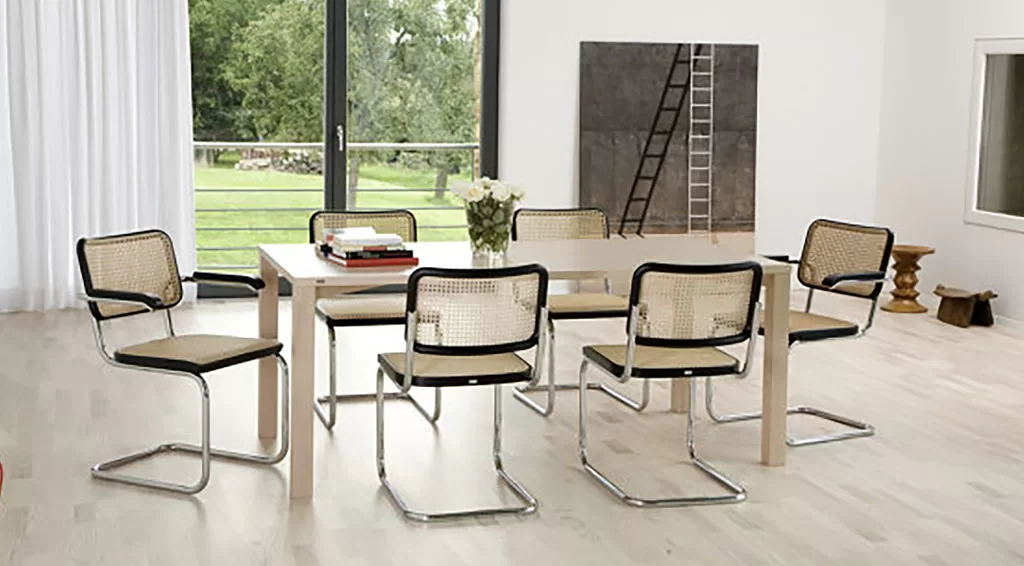
Marcel Breuer designed the S 32 and S 64 cantilever chairs in 1928. These models combine tubular steel with bentwood frames and woven cane, bringing together two defining chapters of Thonet’s material history.
The polished or finished steel frame gives the chairs a clear modern structure, while the wood and cane introduce warmth and tactile detail. This contrast is central to their lasting appeal.
The S 32 is the armless version, while the S 64 adds curved armrests. Both designs work well in dining rooms, offices, conference spaces and restaurants.
Their balanced combination of industrial precision and traditional material makes them easy to integrate into different interiors. They can complement contemporary architecture while also relating naturally to vintage and historic furnishings.
Mies van der Rohe’s S 533 Armchair
Ludwig Mies van der Rohe refined the cantilever concept through the elegant curves of the S 533 armchair. Rather than treating the tubular-steel frame as a rigid geometric outline, he gave it a broad continuous arc that flexes gently under the sitter’s weight.
The chair’s apparent simplicity depends on carefully balanced proportion and material tension. Its open frame gives it a sculptural presence without occupying excessive visual space.
Leather, cane and other seating options create different relationships between the suspended surface and the steel structure. The S 533 works particularly well as an occasional chair, dining armchair or statement piece within an architectural interior.
Authentic Bauhaus Furniture
The enduring popularity of Bauhaus furniture has led to many reproductions, but authentic Thonet pieces maintain a direct relationship with the company that helped develop and industrialize the original designs.
Original production preserves the intended proportions, construction details, materials and flexibility of the furniture. These qualities are particularly important in cantilever chairs, where small changes to the frame can alter both appearance and comfort.
Thonet continues to manufacture its tubular-steel classics in Germany using modern processes supported by generations of material knowledge. Each model is available in carefully selected configurations suited to contemporary residential and professional use.
Contemporary Thonet Furniture
Thonet’s collection is not limited to historical reproductions. The company continues to collaborate with international designers who respond to its bentwood and tubular-steel heritage without simply copying earlier forms.
Designers associated with the contemporary collection include Stefan Diez, Sebastian Herkner, Naoto Fukasawa, Piero Lissoni, James Irvine, Alfredo Häberli and Norman Foster.
These collaborations extend Thonet’s expertise into new dining chairs, lounge seating, tables, stools and workplace furniture. Some designs directly reference historic construction principles, while others explore new expressions of wood, upholstery and steel.
The result is a collection in which furniture from different periods can be combined through shared values of clarity, functionality and material intelligence.
The 118 Chair by Sebastian Herkner
Designed by Sebastian Herkner in 2018, the 118 chair offers a contemporary interpretation of the classic wooden dining chair.
Its frame is reduced to essential components, continuing Michael Thonet’s principle of achieving more with less material. The rear legs and curved back create a recognizable relationship with historic bentwood furniture, while refined details give the chair a distinct contemporary identity.
Versions with cane, molded or upholstered seats allow the design to respond to different comfort and maintenance requirements. The 118 works well around residential dining tables and in restaurants, cafés and other hospitality settings.
The 404 Chair by Stefan Diez
Stefan Diez’s 404 chair explores the structural capabilities of wood through a dynamic, ergonomically shaped frame.
Its components are designed to provide support with an efficient use of material. The chair feels lightweight and direct, yet its curved back and seat respond comfortably to the body.
The 404 demonstrates how Thonet’s experimental approach to wood continues within contemporary design. Rather than recreating a nineteenth-century form, it applies the company’s knowledge of material and production to present-day needs.
Tables and Complementary Furniture
The Thonet collection includes dining tables, café tables, side tables, desks and occasional furniture designed to coordinate with its seating.
Tubular-steel tables from the Bauhaus era use clean frames and carefully proportioned surfaces to complement cantilever chairs. Compact nesting and side tables provide flexible surfaces beside sofas, lounge chairs and beds.
Contemporary tables expand the collection for residential dining, meetings and collaborative work. Their restrained construction allows chairs to remain visually prominent while supporting practical daily use.
When selecting a table, dimensions should be considered alongside chair width, arm height, circulation and the number of users.
Furniture Made in Frankenberg, Germany
Thonet maintains its headquarters and production facilities in Frankenberg, Germany. The site has played a central role in the company’s history since the nineteenth century and continues to produce bentwood, tubular-steel and contemporary furniture.
Bentwood production combines specialized machinery with extensive handwork. Tubular steel requires precise forming, welding, finishing and assembly. Cane, upholstery and wood surfaces introduce additional layers of skilled craftsmanship.
This concentration of expertise helps preserve the construction quality and material knowledge associated with original Thonet furniture.
Longevity, Repair and Responsible Design
Many Thonet designs have remained relevant for generations because they use materials efficiently and avoid unnecessary complexity.
The 214 chair is an early example of resource-conscious design. Its limited number of components simplified production, transportation, assembly and repair. Wood for current versions is sourced from sustainably managed forests, and individual parts can be repaired when necessary.
Durability is an important part of environmental responsibility. Furniture that remains useful, repairable and visually relevant over a long period reduces the need for frequent replacement.
Residential, Hospitality and Workplace Applications
Thonet furniture has always been used wherever people gather. Its history is closely connected to cafés, restaurants, theaters, offices and public buildings as well as private homes.
Bentwood chairs bring lightness and warmth to dining rooms and hospitality settings. Tubular-steel designs complement modern kitchens, conference rooms and architectural interiors. Lounge chairs, tables and contemporary seating extend the collection into living rooms, reception areas and collaborative workplaces.
The range of finishes, upholstery and configurations allows designers to adapt the furniture to different performance and aesthetic requirements.
Discover Gebrüder T 1819 and Thonet at Scott + Cooner
Scott + Cooner offers original Thonet furniture for clients seeking authentic design, exceptional craftsmanship and lasting cultural significance.
Our experienced team works with homeowners, architects and interior designers to select historic bentwood chairs, Bauhaus tubular-steel furniture and contemporary Thonet designs. We can assist with model selection, finishes, cane, upholstery and project specifications.
Explore the iconic 214 coffee house chair, S 32 and S 64 cantilever chairs, S 533 armchair and contemporary Thonet collections with guidance from Scott + Cooner. Contact us for product information, samples, pricing and lead times.