
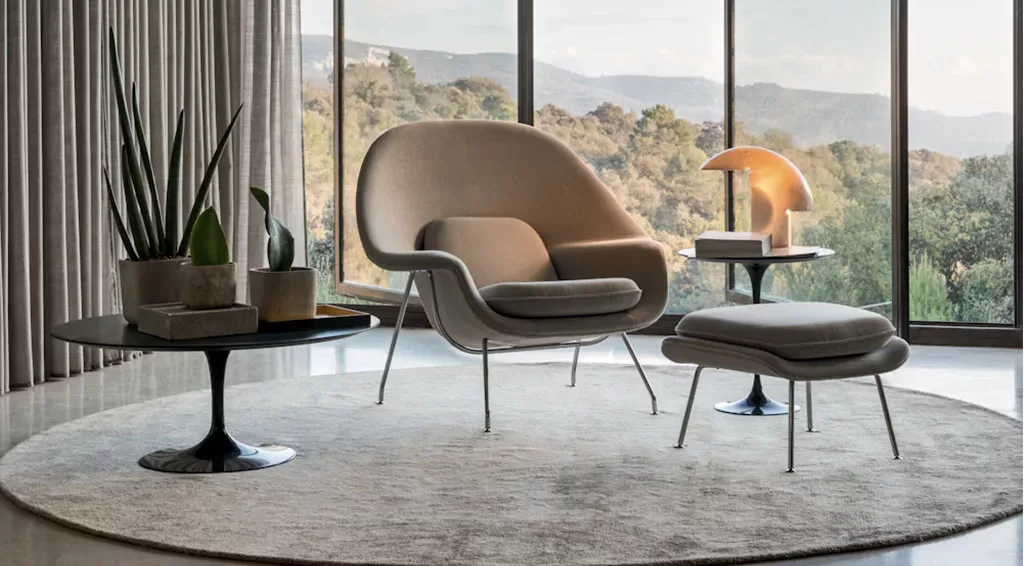

Knoll Iconic Modern Furniture, Bauhaus Classics & Contemporary American Design
Knoll occupies a singular place in the history of modern furniture. Since 1938, the company has brought architecture, furniture, materials, craftsmanship, and industrial production together through a design philosophy rooted in modernism and the Bauhaus concept of total architecture.
The Knoll collection encompasses some of the most recognizable furniture of the twentieth century alongside contemporary sofas, lounge chairs, dining chairs, tables, desks, storage, outdoor furniture, and workplace solutions. Designs by Florence Knoll, Eero Saarinen, Harry Bertoia, Ludwig Mies van der Rohe, Marcel Breuer, and other masters continue alongside work by contemporary designers, creating a collection that connects modern design history with the way people live and work today.
What Is Knoll Known for in Modern Furniture?
Knoll is known for authentic modern furniture created by many of the most influential architects and designers of the twentieth and twenty-first centuries.
The company helped establish modern furniture as an integral component of architecture rather than simply decoration placed within it.
Iconic designs including the Barcelona Chair, Womb Chair, Tulip Table, Bertoia Diamond Chair, Florence Knoll Sofa, and Wassily Chair have become enduring reference points for modern interiors.
Knoll Has Shaped Modern Design Since 1938
Knoll’s history began in 1938 with Hans Knoll and developed through his partnership with Florence Knoll.
Together, Hans and Florence built a company that brought European modernism into dialogue with emerging American architecture, manufacturing, and corporate culture.
The resulting furniture was progressive, functional, architecturally disciplined, and suited to an entirely new way of thinking about interior space.
Florence Knoll Transformed the Relationship Between Furniture & Architecture
Florence Knoll was trained as an architect and approached interiors architecturally.
Rather than treating furniture as decoration, she considered how every element related to the overall space.
Furniture placement, proportion, materials, textiles, color, lighting, graphics, and architecture were considered as parts of a unified composition.
This approach helped establish the professional discipline of modern interior planning.
How Does Knoll Apply the Bauhaus Idea of Total Architecture?
Knoll’s design philosophy is closely associated with the Bauhaus concept of total architecture—the idea that furniture should complement and participate in architectural space.
A chair is considered in relation to the room around it.
A table establishes scale and circulation.
A sofa helps organize a living environment.
Materials, proportions, structure, and function contribute to the larger architectural experience.
This principle remains one of the clearest ways to understand the Knoll collection.
Knoll Connects European Modernism with American Design
Knoll played an important role in bringing European modernist thinking into American interiors.
The company’s relationships with architects and designers created a remarkable bridge between Bauhaus and International Style principles and the development of American modernism.
Today, this history gives Knoll a design vocabulary that feels international rather than belonging to one place or moment.
Florence Knoll’s Design Network Shaped an Extraordinary Collection
Florence Knoll’s relationships with designers and architects were instrumental in building the collection.
Her connections at Cranbrook included Eero Saarinen and Harry Bertoia, while relationships with Ludwig Mies van der Rohe and Marcel Breuer helped bring their furniture into the Knoll portfolio.
This network created one of the most significant collections of authentic modern furniture in the world.
Authentic Knoll Furniture Preserves Important Modern Design
Authenticity matters when selecting a modern design classic.
Knoll manufactures authorized designs according to carefully controlled standards, preserving the proportions, materials, construction, and design intent that made the originals significant.
For collectors, architects, interior designers, and clients, authentic production provides a direct connection to the history of modern design.
Eero Saarinen Created Some of Knoll’s Most Recognizable Furniture
Eero Saarinen’s collaboration with Knoll produced furniture that challenged conventional assumptions about form, comfort, and structure.
His designs range from the enveloping Womb Chair to the sculptural Pedestal Collection.
Although visually different, these pieces share an interest in simplifying furniture while creating a stronger relationship with the surrounding space.
The Womb Chair Redefined Modern Comfort
Designed by Eero Saarinen for Knoll in 1948, the Womb Chair challenged the rigid seating conventions of its era.
Florence Knoll wanted a chair that would allow a person to sit comfortably in multiple positions rather than forcing the body into one prescribed posture.
Saarinen responded with an enveloping fiberglass shell and generous upholstery that created an entirely new expression of modern comfort.
Why Is the Knoll Womb Chair Still an Icon of Modern Design?
The Womb Chair remains relevant because its innovation was not purely visual.
Its form supports relaxed, informal ways of sitting while maintaining a clear sculptural identity.
The chair can be experienced as both furniture and architecture at a smaller scale: an enveloping space designed around the human body.
That combination of comfort, technology, and form explains its enduring appeal.
The Womb Chair Is Handcrafted for Long-Term Use
The Womb Chair’s apparently effortless form requires considerable craftsmanship.
Its molded shell, padding, upholstery, seams, and metal frame must come together precisely.
This relationship between industrial innovation and skilled hand finishing is characteristic of many enduring Knoll designs.
Saarinen’s Pedestal Collection Simplified the Space Beneath the Table
Eero Saarinen wanted to resolve what he saw as the visual clutter created by multiple table and chair legs.
His Pedestal Collection replaced conventional four-legged structures with sculptural central bases.
The resulting tables and chairs created a cleaner relationship between furniture, floor, and architecture.
The Saarinen Tulip Table Is an Enduring Modern Dining Icon
The Saarinen dining table—often known simply as the Tulip Table—has become one of the most recognizable tables in modern design.
Its sculptural pedestal base supports round and oval tops in a variety of materials and sizes.
The absence of perimeter legs creates both visual clarity and practical freedom around the table.
Saarinen Dining Tables Work Across Classic & Contemporary Interiors
The strength of the Saarinen table is its ability to move easily between architectural contexts.
It can complement a mid-century residence, provide contrast within a historic interior, or integrate naturally into highly contemporary architecture.
Different top materials allow designers to emphasize either visual restraint or material richness.
Saarinen Side & Coffee Tables Extend the Pedestal Language
The Pedestal Collection extends beyond dining tables.
Side and coffee tables bring the same sculptural base to smaller scales, allowing the design language to appear throughout a living space without becoming repetitive.
These pieces work especially well alongside upholstered seating because the central base minimizes visual clutter.
Harry Bertoia Turned Industrial Wire into Sculptural Seating
Harry Bertoia approached furniture with the sensibility of an artist and sculptor.
His wire seating collection transformed industrial metal rods into transparent three-dimensional forms.
The resulting chairs appear almost like drawings suspended in space.
Their visual lightness allows them to occupy a room without obscuring surrounding architecture.
The Bertoia Diamond Chair Is Sculpture You Can Sit In
The Diamond Chair demonstrates how structure itself can become ornament.
Rather than concealing the frame beneath upholstery, Bertoia made the wire grid the defining visual element.
The chair’s curved form creates comfort while the open structure preserves transparency.
It remains one of the most distinctive examples of modern sculptural seating.
Bertoia Side Chairs Bring Visual Lightness to Dining Spaces
The Bertoia Side Chair translates the collection’s wire construction into a compact dining format.
Repeated around a table, the open structure creates rhythm without excessive visual mass.
This makes Bertoia seating especially effective in spaces where architecture, art, or views should remain visually prominent.
Bertoia Furniture Works Indoors & in Selected Outdoor Settings
The transparency of the Bertoia collection gives it a natural relationship with open architecture and landscape.
Selected configurations and finishes allow the familiar wire forms to move beyond the conventional dining room or living space.
The result can create a compelling visual dialogue between modern furniture and exterior architecture.
Ludwig Mies van der Rohe Brought Architectural Precision to Knoll
Mies van der Rohe believed deeply in clarity of structure, proportion, and material.
His furniture applies the same discipline found in his architecture.
Metal, leather, and carefully controlled geometry create pieces with extraordinary visual economy.
Knoll’s authorized production preserves these designs as part of the living history of modernism.
The Barcelona Chair Is One of Modernism’s Most Famous Designs
Designed by Ludwig Mies van der Rohe with Lilly Reich for the 1929 International Exposition in Barcelona, the Barcelona Chair has become an international symbol of modern design.
Its polished structure, leather upholstery, and precise proportions demonstrate how minimal form can still communicate exceptional luxury.
Barcelona Seating Combines Modern Architecture with Traditional Craftsmanship
Although the Barcelona Chair appears visually simple, its refinement depends on exacting craftsmanship.
The relationship between leather cushions, upholstery detailing, frame, proportion, and finish gives the chair its distinctive presence.
This combination of modern geometry and traditional craft contributes to its lasting significance.
The Barcelona Daybed Extends an Architectural Modernist Classic
The Barcelona family extends beyond the familiar chair.
The daybed creates a strong horizontal plane that works particularly well within open architectural interiors.
It can function as seating, a place to recline, or a visual divider without the height of a conventional sofa.
Marcel Breuer Helped Define Tubular Steel Furniture
Marcel Breuer’s experiments with tubular steel changed the possibilities of furniture construction.
By using a material associated with industrial production, Breuer created chairs with extraordinary visual lightness.
The designs became important expressions of Bauhaus thinking and remain central to the history of twentieth-century furniture.
The Wassily Chair Remains a Landmark of Bauhaus Furniture
The Wassily Chair is one of the most recognizable examples of tubular steel furniture.
Its open frame reduces the conventional club chair to a series of structural lines and suspended surfaces.
The result is visually radical even decades after its creation.
In contemporary interiors, Wassily can function simultaneously as seating, sculpture, and a piece of design history.
Cesca Seating Brings Breuer’s Cantilever Innovation to Everyday Interiors
Breuer’s cantilevered seating combines tubular steel with warmer materials to create a different expression of modernism.
The absence of conventional rear legs produces a sense of visual movement.
Cesca chairs can work around dining tables, desks, and meeting tables while providing an authentic connection to Bauhaus design.
Florence Knoll Furniture Expresses Architectural Discipline
Florence Knoll often designed furniture because she needed a specific piece for an interior and could not find an existing solution.
Her sofas, benches, tables, and storage pieces therefore have a particularly architectural quality.
They are disciplined, proportional, functional, and designed to support a larger spatial composition rather than demand attention for themselves.
The Florence Knoll Sofa Is a Modern Architectural Classic
The Florence Knoll Sofa translates the rational geometry of modern architecture into upholstered furniture.
Its rectilinear form, carefully tailored cushions, and elevated base create a sophisticated sense of order.
The sofa is especially effective in interiors where furniture needs to establish structure without competing with art or architecture.
Florence Knoll Lounge Seating Brings Structure to Living Spaces
Florence Knoll lounge furniture can establish a disciplined foundation within residential, hospitality, and professional interiors.
Its clear geometry works well with more expressive chairs and tables, allowing designers to create balanced compositions that combine order with contrast.
Florence Knoll Tables Reflect Her Architectural Approach
Knoll tables by Florence Knoll emphasize proportion, materials, and structural clarity.
Rather than using excessive ornament, the designs rely on precisely resolved relationships between top and base.
This restraint makes them remarkably adaptable to changing interior styles.
Knoll Has Always Worked at the Intersection of Furniture & Architecture
Few furniture companies have been as closely connected to architecture as Knoll.
Many of its most important collaborators were architects first.
Their furniture reflects concerns familiar to architecture: structure, material, proportion, scale, circulation, technology, and the relationship between individual elements and the larger environment.
Knoll Furniture Works Naturally with Significant Architecture
Because so many Knoll designs were conceived architecturally, they can integrate naturally into spaces with strong design identities.
A Barcelona Chair can complement rigorous modern architecture.
A Womb Chair can soften a rectilinear room.
A Saarinen table can simplify a dining area.
Bertoia seating can preserve transparency around views and artwork.
The furniture contributes to architecture without simply imitating it.
Knoll Modern Furniture Complements Art Collections
Many Knoll pieces have enough design significance to stand alongside important art without competing with it.
The restrained geometry of Florence Knoll furniture can provide a calm backdrop, while sculptural pieces by Saarinen or Bertoia can create deliberate moments of contrast.
This makes the collection especially useful for art-focused residential and commercial interiors.
Knoll Dining Furniture Connects Modern Design with Everyday Living
Modern design is most meaningful when it becomes part of daily life.
Knoll dining tables and chairs bring important design ideas into the rituals of gathering, eating, working, and entertaining.
Saarinen, Bertoia, Breuer, and other collections allow designers to create dining environments with authentic architectural and historical depth.
Knoll Lounge Chairs Offer Multiple Expressions of Modern Comfort
There is no single Knoll interpretation of the lounge chair.
The Womb Chair is enveloping and organic.
The Barcelona Chair is disciplined and luxurious.
Bertoia seating is transparent and sculptural.
Breuer’s furniture is structural and visually light.
Together, these designs demonstrate how modernism produced many different answers to the same fundamental question: how should a chair support the human body?
Knoll Sofas Range from Modern Classics to Contemporary Seating
The Knoll sofa collection extends beyond archival designs.
Historic pieces coexist with contemporary seating developed for current residential, hospitality, and workplace environments.
This allows designers to combine authentic twentieth-century classics with newer furniture without leaving the broader Knoll design vocabulary.
Knoll Tables Combine Sculptural Form, Material & Function
Tables play an important role in the Knoll collection.
Dining, conference, coffee, side, and occasional tables demonstrate different relationships between structure and surface.
Marble, stone, wood, glass, metal, and other materials allow designers to adapt familiar forms to different architectural palettes.
Knoll Furniture Is Designed for Homes as Well as Professional Interiors
Knoll’s history is closely connected to the evolution of the modern workplace, but its furniture has always crossed boundaries between residential and professional settings.
A Saarinen table can anchor a dining room or meeting space.
A Barcelona Chair can work in a private residence or executive environment.
Bertoia seating can move between dining, hospitality, and workplace applications.
This versatility is fundamental to the collection.
The Knoll Planning Unit Changed Modern Office Design
Florence Knoll’s Planning Unit helped transform the American workplace.
Rather than simply supplying desks and chairs, the team considered space planning, architecture, furniture, textiles, graphics, and the way organizations functioned.
This comprehensive approach established an influential model for professional interior design and workplace planning.
Knoll Workplace Design Grew from Architectural Thinking
The company’s approach to workplace furniture has historically focused on the relationship between people, tasks, space, and architecture.
This is an extension of the same total-design philosophy visible throughout the residential collection.
Workspaces are not simply filled with furniture; furniture helps define how the environment functions.
Knoll Materials Bring Texture & Depth to Modern Interiors
Modernism is sometimes mistakenly associated with coldness.
The Knoll collection demonstrates how material can create warmth within disciplined forms.
Leather, wool, textiles, wood, marble, metal, glass, and woven materials introduce texture and natural variation while maintaining architectural clarity.
Marble Gives Saarinen Tables a Distinct Material Presence
The simplicity of the Saarinen pedestal makes the tabletop especially important.
Natural stone can transform the familiar silhouette by introducing veining, color, and visual weight.
Each stone top has its own character, creating a compelling contrast between organic material and controlled geometric form.
Upholstery Can Transform the Character of a Knoll Classic
Textile and leather selection can significantly change how an iconic design reads within a room.
A Womb Chair in a neutral bouclé can feel quiet and architectural.
A saturated textile can turn the same chair into a focal point.
Leather can emphasize the formal character of a classic design, while textured fabric can make it feel softer and more residential.
Knoll Furniture Allows Designers to Mix Different Generations of Modernism
One of the strengths of the collection is its historical depth.
Bauhaus furniture can coexist with mid-century American modernism and contemporary design.
The objective does not have to be a period-perfect interior.
Instead, designers can create layered spaces that show how modern design has evolved over time.
Knoll Classics Can Create Contrast in Traditional Architecture
Modern furniture does not require modern architecture.
A Barcelona Chair, Saarinen table, Breuer chair, or Florence Knoll sofa can create a compelling counterpoint within a historic home.
The contrast allows both the architecture and furniture to become more visible.
This approach can prevent interiors from feeling overly literal or tied to a single period.
Knoll Furniture Supports Warm Contemporary Minimalism
For clients who prefer restrained interiors, Knoll offers furniture with clear forms and strong design histories.
Natural stone, warm wood, tactile textiles, leather, and carefully chosen color can soften the geometry.
The result is minimalism with depth rather than an interior defined only by visual reduction.
Contemporary Knoll Continues a Culture of Designer Collaboration
Knoll’s history of collaboration did not end with the great figures of twentieth-century modernism.
The company continues to work with contemporary designers, extending its collection while maintaining a focus on architecture, materials, technology, and lasting relevance.
This allows Knoll to remain a living design company rather than simply an archive of historic classics.
Piero Lissoni Brings Contemporary Italian Refinement to Knoll
Piero Lissoni’s work adds a sophisticated contemporary European perspective to the Knoll collection.
His designs demonstrate how the company’s architectural approach can evolve through softer forms, refined proportions, and current ways of living.
The collaboration connects Knoll’s modernist heritage with contemporary international design.
Antonio Citterio Extends Knoll’s Architectural Design Language
Antonio Citterio brings decades of experience in architecture, interiors, and furniture to contemporary Knoll.
His work reflects the same concern with proportion, materials, comfort, and architectural integration that has defined the company historically.
This continuity allows new furniture to coexist naturally with Knoll classics.
Knoll Outdoor Furniture Brings Modern Design into the Landscape
Outdoor spaces can benefit from the same design discipline as interiors.
Knoll’s outdoor offerings allow selected modern furniture concepts to extend to terraces, courtyards, gardens, and other exterior environments.
The clean forms work especially well with contemporary architecture and landscape design.
Modern Outdoor Furniture Can Strengthen Indoor-Outdoor Architecture
When interior and exterior spaces are visually connected, furniture becomes an important part of the transition.
Modern outdoor seating and tables can continue the proportions and clarity established inside while responding appropriately to exterior conditions.
This creates a more cohesive relationship between architecture and landscape.
Why Choose Knoll Furniture for a Contemporary Interior?
Knoll offers something increasingly rare: authentic furniture with genuine historical importance that remains useful in contemporary life.
Its designs are not significant merely because they are old or famous.
The strongest pieces continue to solve fundamental problems of comfort, structure, proportion, material, and space with remarkable clarity.
For architects, interior designers, collectors, and design-conscious clients, Knoll provides a way to bring authentic modern design history into interiors without sacrificing function.
Knoll Is an Important Resource for Architects & Interior Designers
The collection offers designers a broad vocabulary of seating, tables, storage, workplace furniture, outdoor pieces, and modern classics.
Because many products are available in multiple sizes, materials, upholstery options, and finishes, designers can adapt them to the architecture and material palette of an individual project.
This combination of authenticity and specification flexibility makes Knoll particularly valuable to the professional design community.
How Do You Select the Right Knoll Furniture for a Project?
Begin with the architecture and the way the room needs to function.
A sculptural Womb Chair may soften a highly rectilinear room.
A Saarinen table can reduce visual clutter in a dining area.
Bertoia seating can preserve transparency around an important view.
A Florence Knoll sofa can establish architectural order.
A Barcelona Chair can introduce an iconic modernist statement.
The best selection is not simply the most recognizable design—it is the piece whose proportion, material, comfort, and history strengthen the overall interior.
Where Can You Experience Knoll Furniture at Scott + Cooner?
Scott + Cooner represents Knoll through all three of our showrooms: San Francisco, Dallas, and Austin.
Architects, interior designers, collectors, and design-conscious clients can work with our teams to explore iconic Knoll furniture, contemporary seating, lounge chairs, dining chairs, sofas, tables, desks, storage, workplace solutions, and outdoor furniture.
Our showroom teams can also assist with dimensions, upholstery, leather, textiles, stone and wood selections, finishes, configurations, and technical specifications for residential and contract projects.
Where Can You Find Knoll Furniture in San Francisco?
Scott + Cooner San Francisco represents Knoll for architects, interior designers, collectors, and clients throughout San Francisco and the greater Bay Area.
Knoll’s relationship with architecture, modernism, craftsmanship, and material innovation fits naturally within Northern California’s sophisticated design culture.
From urban residences and mid-century homes to contemporary architecture, hospitality environments, and professional spaces, Knoll offers furniture with authentic design history and enduring relevance.
Scott + Cooner San Francisco Connects the Bay Area with Authentic Knoll Design
The Bay Area has a deep appreciation for architecture, craft, innovation, and modern design.
Knoll fits naturally within this context.
A Saarinen table can complement a restrained dining space. A Womb Chair can create an inviting reading area. Bertoia seating can preserve views. A Barcelona Chair can introduce a defining piece of modern design history.
Scott + Cooner San Francisco provides a local resource for developing these relationships.
Knoll Furniture Works Beautifully in San Francisco Modern & Mid-Century Homes
Northern California contains an extraordinary range of modern and mid-century architecture.
Authentic Knoll furniture can reinforce this history without making an interior feel like a period recreation.
Mixing historic designs with contemporary materials, art, lighting, and newer furniture creates rooms that feel collected and relevant.
Knoll Complements Bay Area Art, Architecture & Landscape
Many Bay Area interiors are organized around art, views, landscape, or significant architecture.
Knoll’s disciplined forms can support these priorities.
Transparent Bertoia chairs minimize visual obstruction, while Florence Knoll furniture establishes quiet structure. Saarinen and Mies van der Rohe designs can introduce stronger sculptural moments where appropriate.
San Francisco Interior Designers Can Specify Knoll Through Scott + Cooner
Scott + Cooner San Francisco can assist architects and interior designers with Knoll product selection, upholstery, materials, finishes, dimensions, and technical information.
Whether the project requires a single modern icon or a broader residential, hospitality, or professional furniture specification, our San Francisco team provides a local Knoll resource for Northern California.
Where Can You Find Knoll Furniture in Dallas?
Scott + Cooner Dallas represents Knoll for architects, interior designers, collectors, and design-conscious clients throughout Dallas and North Texas.
Knoll’s architectural clarity and historic design pedigree work particularly well within Dallas residences where furniture must relate to generous room proportions, important art, and sophisticated materials.
The breadth of the collection also makes Knoll relevant to workplace, hospitality, and contract environments throughout North Texas.
Scott + Cooner Dallas Brings Iconic Knoll Modern Furniture to North Texas
Dallas interiors often provide enough architectural scale to appreciate modern classics as individual objects.
A Barcelona Chair can have room to breathe.
A Womb Chair and ottoman can establish an intimate destination within a larger living room.
A Saarinen dining table can create a sculptural center for entertaining.
Scott + Cooner Dallas helps clients and designers consider these pieces in relation to the complete interior.
Knoll Furniture Complements Dallas Art Collections
Knoll furniture has long existed in close dialogue with modern and contemporary art.
Its strongest pieces have their own formal identity while maintaining enough restraint to coexist with significant paintings, sculpture, and photography.
For Dallas collectors, this makes Knoll especially useful when furniture needs to contribute to the room without competing with the collection.
Knoll Works Well in Expansive Dallas Architecture
Large rooms require furniture with appropriate scale and visual presence.
Knoll’s range provides multiple ways to address these spaces.
Sofas can establish architectural structure, lounge chairs create individual seating moments, and dining or conference tables provide strong centers for gathering.
Historic and contemporary pieces can be combined to prevent the interior from feeling overly uniform.
Dallas Interior Designers Can Specify Knoll Through Scott + Cooner
Scott + Cooner Dallas can assist architects and interior designers with Knoll furniture for residential, workplace, hospitality, and contract projects throughout North Texas.
Our team can help navigate authentic classics, contemporary collections, upholstery, materials, finishes, dimensions, and technical requirements while considering the larger architectural concept.
Where Can You Find Knoll Furniture in Austin?
Scott + Cooner Austin represents Knoll for architects, interior designers, collectors, and clients throughout Austin and Central Texas.
Austin’s relationship with modern architecture, creativity, technology, natural materials, and relaxed living provides an especially interesting context for Knoll.
The collection’s disciplined forms can bring architectural clarity while remaining comfortable enough for everyday contemporary life.
Scott + Cooner Austin Connects Central Texas with Knoll Modern Design
Austin homes frequently combine limestone, wood, concrete, steel, glass, plaster, and strong connections to landscape.
Knoll furniture can interact naturally with these materials.
A Womb Chair introduces softness and color. A Saarinen table creates sculptural contrast. Bertoia wire seating preserves visual openness. Florence Knoll upholstery can bring structure to a larger living environment.
Knoll Furniture Fits Austin’s Contemporary Architectural Culture
Modern furniture can feel particularly relevant in Austin when it supports rather than overpowers architecture.
Knoll’s strongest designs are clear enough to have identity but disciplined enough to participate in a larger spatial composition.
This balance makes the collection appropriate to both highly minimal residences and more eclectic, art-filled interiors.
Knoll Supports Austin’s Relaxed Approach to Modern Living
Modern design does not have to feel formal.
The Womb Chair was specifically conceived around freedom of posture and relaxation.
Saarinen tables remove unnecessary visual clutter.
Bertoia chairs provide lightness and flexibility.
These qualities align naturally with Austin interiors that combine sophisticated architecture with informal daily life.
Knoll Outdoor Furniture Is Relevant to Central Texas Living
Austin’s terraces, courtyards, covered patios, and pool environments often function as extensions of the interior.
Modern outdoor furniture can strengthen this relationship.
Selected Knoll outdoor pieces allow designers to bring the brand’s architectural clarity into the landscape while creating comfortable spaces for gathering and relaxation.
Austin Interior Designers Can Specify Knoll Through Scott + Cooner
Scott + Cooner Austin can assist architects and interior designers with Knoll furniture for residential and contract projects throughout Austin and Central Texas.
Our team can help with product selection, upholstery, materials, finishes, dimensions, outdoor applications, and technical information while considering how each piece relates to the project’s architecture.
Scott + Cooner Represents Knoll in San Francisco, Dallas & Austin
Scott + Cooner’s representation of Knoll across San Francisco, Dallas, and Austin gives architects, interior designers, collectors, and design-conscious clients access to authentic modern furniture through experienced local showroom teams.
In San Francisco, Knoll’s connection to architecture, modernism, art, and innovation complements the Bay Area’s rich design culture.
In Dallas, iconic furniture and strong architectural forms work beautifully within expansive residences, important art collections, workplaces, and hospitality environments.
In Austin, Knoll’s clarity, comfort, materiality, and modern design heritage align naturally with contemporary architecture and relaxed Central Texas living.
Across all three markets, Scott + Cooner can help clients select Knoll furniture according to the architecture, scale, materials, and individual character of each project.
Discover Knoll Iconic Modern Furniture at Scott + Cooner
Scott + Cooner represents Knoll in San Francisco, Dallas, and Austin as part of our curated collection of exceptional contemporary furniture and international design.
Since 1995, Scott + Cooner has worked with architects, interior designers, collectors, and design-conscious clients seeking extraordinary modern furniture, lighting, kitchens, closets, rugs, accessories, textiles, and architectural products for sophisticated residential and contract interiors.
Our teams can help you explore Knoll icons by Eero Saarinen, Florence Knoll, Harry Bertoia, Ludwig Mies van der Rohe, Marcel Breuer, and other influential designers, alongside contemporary Knoll furniture for living, dining, working, hospitality, and outdoor environments.
For Northern California projects, Scott + Cooner San Francisco provides a local Knoll resource for San Francisco and the greater Bay Area.
For North Texas projects, Scott + Cooner Dallas provides a local Knoll resource for Dallas and surrounding communities.
For Central Texas projects, Scott + Cooner Austin provides a local Knoll resource for Austin and the surrounding region.
Whether you are selecting an authentic Womb Chair, specifying a Saarinen dining table, adding Barcelona seating to an art-focused interior, creating a dining room with Bertoia or Breuer chairs, or developing a larger residential or contract furniture package, Scott + Cooner can help you explore Knoll’s extraordinary legacy of architecture, modern design, craftsmanship, innovation, and timeless furniture.