
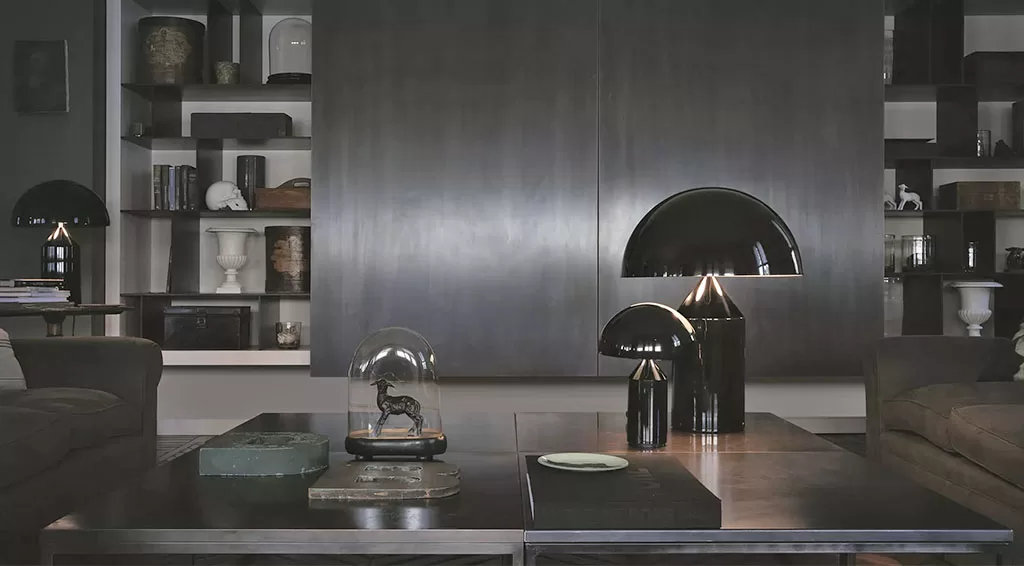

Oluce Italian Designer Lighting
Oluce creates Italian designer lighting in which function, technology, and sculptural form become inseparable. Founded in Milan in 1945 by Giuseppe Ostuni, Oluce is the oldest Italian design company still active exclusively in the field of lighting.
Across eight decades, the company has built a collection that reads like a history of modern Italian design. Groundbreaking lamps by Joe Colombo and Vico Magistretti appear alongside contemporary work by an international group of designers. Although created in different periods, these designs share clarity of purpose, refined materials, and the ability to transform light into a defining element of an interior.
The Oluce collection includes table lamps, floor lamps, pendant lights, chandeliers, wall and ceiling fixtures, and outdoor lighting. Available through Scott + Cooner, Oluce lighting brings authentic Italian design to homes, offices, restaurants, hotels, and other architecturally considered spaces.
Italian Lighting Since 1945
Oluce was established during a transformative period for Italian architecture, industry, and design. From its earliest years, the company explored how new technology and production methods could expand the expressive possibilities of light.
Its relationship with the wider design community developed quickly. Oluce participated in the IX Milan Triennale in 1951 and attracted international attention through influential design publications and exhibitions. Collaborations with architects and designers allowed the company to treat lighting as an area of cultural and technological research rather than simply as product manufacturing.
This openness to experimentation has remained central to Oluce. Historical designs continue to be produced because their ideas remain relevant, while new collections build upon the company’s knowledge of optics, materials, proportion, and atmosphere.
Lighting as Architecture and Art
An Oluce lamp does more than illuminate a surface. It establishes a relationship between light, architecture, furniture, and the people who occupy the room.
Some designs use pure geometry to create a calm, recognizable presence. Others employ adjustable shades, directional reflectors, or exposed structures that reveal how light is produced and controlled. Materials such as metal, blown glass, opaline glass, and polycarbonate help shape both the appearance of the object and the quality of its illumination.
This combination of performance and artistic identity allows Oluce lighting to function at several levels. A lamp may provide task illumination, create ambient light, define a seating area, or become the principal sculptural object within a room.
Atollo Table Lamp
Designed by Vico Magistretti in 1977, Atollo has become an archetype of the modern table lamp. Its composition is reduced to three essential geometric forms: a cylinder, a cone, and a hemisphere.
This carefully balanced arrangement completely reinterpreted the familiar lamp-and-shade format. The shade appears to float over the conical body, while the absence of conventional supporting elements gives Atollo the presence of a luminous sculpture.
Atollo received the Compasso d’Oro in 1979 and entered the permanent collections of major design museums. Its enduring significance comes from an ability to feel immediately recognizable without being tied to a particular decorative period.
The collection includes metal and opaline glass interpretations in multiple sizes and finishes. Used on a console, side table, desk, or nightstand, Atollo adds both atmospheric illumination and an unmistakable icon of Italian design.
Joe Colombo’s Spider Lamp
Joe Colombo designed the Spider lamp in 1965. Its structure consists of a metal reflector mounted on a chromed vertical stem and supported by a simple metal base.
The reflector can be positioned to direct the light, giving the lamp a clear functional purpose while allowing the user to alter its appearance. This relationship between movement, technology, and form reflects Colombo’s forward-looking approach to design.
Spider received Oluce’s first Compasso d’Oro in 1967. It was later included in the landmark 1972 exhibition “Italy: The New Domestic Landscape” at New York’s Museum of Modern Art.
Available in table and floor versions, Spider remains relevant for reading areas, desks, living rooms, and interiors that value authentic examples of 20th-century Italian design.
Coupé Lighting Collection
Joe Colombo developed Coupé in 1967 as an evolution of the Spider family. It retained the original design’s base and stem while introducing a long curved support and an adjustable shade.
The elegant arc gives Coupé a strong graphic profile and allows light to be positioned where it is needed. Depending on the version, the shade takes a semi-cylindrical or semi-spherical form.
Coupé received the International Design Award from the American Institute of Interior Designers in 1968 and is represented in important museum collections. The family has expanded over time to include floor, table, and wall-mounted versions.
Its combination of adjustability, slender structure, and visual clarity makes Coupé suitable for reading areas, executive offices, living spaces, bedrooms, and hospitality interiors.
Colombo and the First Halogen Lamp
The Colombo lamp demonstrates Oluce’s longstanding interest in technological innovation. Introduced at the beginning of the 1970s, it was among the first domestic lighting designs developed around a halogen source.
Its structure makes the technical components part of the lamp’s visual identity rather than hiding them behind a conventional shade. Direct and indirect light could be controlled within a single freestanding object, creating flexibility for different activities and atmospheres.
The lamp embodies Joe Colombo’s fascination with adaptable environments and new ways of living. Even as lighting technology has evolved, its functional concept and industrial character continue to feel remarkably contemporary.
Sonora Pendant Light
Designed by Vico Magistretti in 1976, Sonora is an exploration of the hemisphere as a pure geometric form. Its broad dome defines a volume within the larger volume of the room, giving the pendant an architectural presence.
Sonora provides direct and diffused illumination and is available in several sizes, materials, and finishes. Versions include opaline blown glass and other diffuser options capable of producing different visual and atmospheric effects.
Suspended above a dining table, reception desk, kitchen island, or conference table, Sonora creates a clear center within the space. Its simple form allows it to work in both minimal interiors and rooms with richer combinations of art, color, and furniture.
Lyndon Lighting Collection
Vico Magistretti designed Lyndon in 1977. The collection combines a candelabra-like metal structure with transparent spherical diffusers, creating a meeting between historical references and modern industrial design.
The frame bends and branches according to the requirements of each model, holding the luminous spheres in a balanced composition. Indoor versions include suspension, floor, and wall lamps, while selected outdoor models adapt the same design language for exterior use.
Lyndon can serve as an elegant chandelier above a dining table or within an entryway, while floor and wall variations bring its recognizable geometry to lounges, corridors, terraces, and hospitality spaces.
Alba Lighting
Designed by Mariana Pellegrino Soto, the Alba collection draws inspiration from a drop of water. Its opaline glass diffusers appear as luminous droplets resting upon or suspended from precisely composed metal structures.
The table lamp places its glass forms against an asymmetrical metal profile, creating a composition that changes when viewed from different angles. Pendant variations suspend single or multiple diffusers beneath refined structural elements.
Alba combines soft, diffused illumination with a strong decorative identity. Its balance of glass, brass-toned finishes, and asymmetry makes it well suited to living rooms, bedrooms, dining areas, and sophisticated hospitality environments.
Berlin Lighting
Designed by Christophe Pillet, the Berlin collection brings together thin metal structures and sandblasted wired-glass diffusers. The design combines the visual familiarity of a decorative fixture with the precision and efficiency of contemporary lighting technology.
Berlin includes wall, ceiling, pendant, floor, and outdoor interpretations. Its disc-like forms can appear architectural when mounted closely to a surface or more sculptural when extended into a freestanding or suspended composition.
The combination of black, brass-toned finishes, textured glass, and controlled LED illumination gives Berlin a refined character suitable for residential and contract interiors.
Table Lamps
Oluce table lamps range from historic icons to contemporary designs. They can provide focused illumination for reading and work, gentle ambient light, or a decorative focal point on a console, shelf, nightstand, or side table.
Atollo creates a broad atmospheric glow and a strong sculptural presence. Spider and Coupé offer adjustability, while Alba explores soft light through opaline glass. Other collections use different combinations of metal, glass, geometry, and directional control.
Choosing the right table lamp requires attention to height, glare, light direction, switching or dimming options, and the scale of the supporting furniture. A bedside lamp may prioritize gentle diffusion, while a desk or reading lamp generally benefits from more controlled illumination.
Floor Lamps
Oluce floor lamps can establish task, ambient, or indirect illumination without requiring permanent ceiling installation. Their freestanding format also allows them to define a reading corner, seating group, or architectural transition.
Many Oluce floor lamps have distinctive silhouettes even when switched off. The arched structure of Coupé, the exposed technical character of Colombo, and the branching composition of Lyndon each contribute a different visual language.
Placement should consider furniture arrangement, walking paths, electrical access, and viewing angles. An adjustable floor lamp can support reading beside a lounge chair, while an indirect fixture can brighten a room by reflecting light from nearby walls or ceilings.
Pendant and Suspension Lighting
Oluce suspension lamps range from restrained geometric pendants to large decorative compositions. They can organize space above dining tables, kitchen islands, staircases, reception desks, meeting tables, and hospitality seating areas.
Sonora creates a strong central volume through its hemispherical shade. Lyndon uses multiple transparent globes to build a more open composition, while contemporary collections explore glass, metal, and integrated LED technology.
Fixture scale and suspension height should be coordinated with ceiling height, furniture dimensions, and sightlines. In open-plan interiors, a pendant can visually define an activity area without constructing a physical boundary.
Wall and Ceiling Lights
Wall and ceiling fixtures provide ambient, accent, or directional illumination while preserving floor and table space. Oluce offers surface-mounted designs for corridors, bedrooms, living areas, hospitality spaces, and architectural applications.
Collections such as Berlin use material and geometry to give wall and ceiling lights a strong decorative presence. Fresnel focuses attention on its distinctive lens, creating a compact fixture suitable for both indoor and selected outdoor applications.
Wall lighting can highlight architectural texture, support wayfinding, or add a comfortable layer of illumination beside beds and seating. Ceiling fixtures can provide practical light where pendant suspension is not appropriate.
Outdoor Lighting
Oluce extends its approach to material, form, and atmosphere into outdoor environments. The exterior collection includes wall lights, table lamps, floor lamps, path lights, and decorative designs for terraces, gardens, pathways, and hospitality settings.
Vico Magistretti’s Lyndon has been adapted into outdoor floor, table, and wall versions. Berlin-out brings the refined atmosphere of the indoor Berlin family to exterior spaces, while designs such as Otto, Amanita, Niwa, Stones, and Fresnel address a range of outdoor applications.
Otto uses an adjustable reflector to direct indirect LED light along a path or through a landscape. Stones creates glowing organic forms inspired by nature, while Niwa recalls a portable shipboard lamp.
Outdoor fixture selection must account for exposure, mounting location, ingress-protection requirements, electrical conditions, and applicable codes. Scott + Cooner can help clients review current technical specifications for the intended installation.
Vico Magistretti and Oluce
The relationship between Vico Magistretti and Oluce became especially important during the 1970s, when the company passed from Giuseppe Ostuni to the Verderi family. Magistretti served for many years as art director and became one of the most influential figures in Oluce’s history.
His designs demonstrate how elementary geometry can produce objects with powerful symbolic meaning. Atollo, Sonora, Lyndon, Kuta, Lester, Pascal, Dim, and other collections helped establish an enduring visual language for the company.
Magistretti’s work remains contemporary because it depends on proportion, geometry, and light rather than ornament or passing fashion.
Joe Colombo and Lighting Innovation
Joe Colombo brought a more experimental and technological energy to Oluce during the 1960s and early 1970s. His designs explored adjustability, exposed construction, specialized light sources, and new relationships between people and domestic objects.
Spider, Coupé, and Colombo became milestones in modern lighting. Each challenged established typologies while remaining understandable and useful.
Colombo’s work helped move Oluce in a more revolutionary direction and demonstrated how lighting could respond to rapidly changing ideas about interiors and everyday life.
Contemporary Designers
Oluce’s historical collection remains in active dialogue with work by contemporary designers. Christophe Pillet, Mariana Pellegrino Soto, Federica Farina, Victor Vasilev, Nendo, Sam Hecht, Francesco Rota, Gordon Guillaumier, Laudani & Romanelli, and others have contributed to the company’s evolving catalog.
These designers bring different cultural perspectives and approaches to technology, but their work reflects Oluce’s commitment to clarity, elegance, and purposeful innovation.
New designs are not expected to imitate historical icons. Instead, they extend the company’s tradition of using light as a medium for architectural and emotional expression.
Authentic Italian Design
The popularity of Atollo, Sonora, Coupé, and other Oluce icons has led to extensive imitation. Authentic products preserve the intended proportions, materials, finishes, electrical components, and quality standards of the original design.
Choosing an authorized source also provides access to current product specifications, approved finish options, installation documentation, and appropriate support.
For historically significant lighting, authenticity is essential to both performance and design integrity. Scott + Cooner can help clients identify and specify genuine Oluce products.
Residential and Contract Lighting
Oluce lighting is suitable for private residences, offices, restaurants, hotels, retail spaces, and other commercial interiors. The diversity of the collection makes it possible to address decorative focal lighting, task illumination, ambient light, and selected outdoor applications.
Residential projects may combine an Atollo table lamp with Sonora pendants and Coupé reading lamps. A hospitality project might use Lyndon in an entrance, Berlin in circulation areas, and outdoor fixtures across terraces and pathways.
Contract specification should consider light output, color temperature, dimming, mounting, certification, accessibility, maintenance, and replacement requirements. Current technical data should always be reviewed for the exact model and market.
Selecting the Right Oluce Lamp
Begin by identifying what the light must accomplish. Task lighting should provide controlled illumination where an activity takes place. Ambient lighting establishes overall brightness and atmosphere, while accent lighting draws attention to architecture, artwork, or material surfaces.
Next, evaluate scale and placement. A large Sonora pendant can anchor a dining area, while Atollo can provide a luminous focal point on a console. Coupé and Spider are suited to spaces where adjustability is valuable.
Material and finish should relate to the broader interior without requiring an exact match. Black metal can create graphic definition, opaline glass produces visual softness, and satin gold or brass-toned finishes add warmth and reflection.
Discover Oluce at Scott + Cooner
Explore Oluce Italian lighting at Scott + Cooner and discover historic icons alongside contemporary table lamps, floor lamps, pendants, wall lights, ceiling fixtures, and outdoor lighting.
Our experienced team can help homeowners, architects, and interior designers compare collections, review dimensions and technical specifications, coordinate finishes, and obtain current pricing and availability.
Contact Scott + Cooner or visit one of our showrooms to experience authentic Oluce lighting and eight decades of Italian design innovation.