

Poliform Luxury Italian Furniture, Kitchens, Closets & Complete Interior Systems
Poliform creates sophisticated Italian interiors through an unusually complete collection of luxury furniture, kitchens, closets, wardrobes, architectural systems, sofas, tables, beds, storage, and outdoor furniture. Defined by understated elegance, exceptional materials, architectural precision, and extensive customization, Poliform allows designers to approach the home as a unified environment rather than a collection of unrelated objects.
From a custom Poliform kitchen and Senzafine wardrobe to a modular sofa, dining table, bedroom, bookcase, or architectural wall system, each element can participate in a consistent material and visual language. This comprehensive approach has made Poliform an important resource for architects and interior designers creating refined contemporary residences in which architecture, cabinetry, furniture, and daily life are carefully integrated.
What Is Poliform Known for in Contemporary Italian Design?
Poliform is known for luxury Italian furniture, highly customizable kitchens, wardrobes and walk-in closets, sophisticated modular systems, contemporary sofas, and complete interior solutions.
Its collection extends across virtually every major area of the home, including kitchens, living rooms, dining rooms, bedrooms, closets, storage, architectural systems, outdoor spaces, and accessories.
This breadth allows Poliform to create something more ambitious than individual furniture pieces: a coordinated vision of contemporary living.
How Does Poliform Create a Complete Interior?
Poliform approaches the home as an interconnected architectural environment.
Kitchens can relate materially to adjacent living areas. Wardrobes and walk-in closets can become part of the bedroom architecture. Bookcases and storage systems can define walls. Paneling and architectural elements can establish continuity between rooms.
Freestanding sofas, armchairs, tables, chairs, beds, and accessories then complete the environment.
The result is a highly integrated interior in which architecture and furniture share a common language.
Poliform Brings Italian Elegance to Contemporary Architecture
Poliform’s aesthetic is sophisticated without being visually excessive.
Clean lines, precise proportions, luxurious materials, subtle detailing, and restrained palettes allow the furniture and systems to complement architecture rather than compete with it.
This makes Poliform particularly relevant to contemporary residences where spatial clarity and material continuity are fundamental to the design.
Poliform Furniture Is Defined by Understated Luxury
Luxury at Poliform is expressed through materials, proportion, detailing, comfort, and customization rather than ornament.
Wood, marble, glass, metal, leather, lacquer, and textiles are combined with careful attention to texture and finish.
This creates interiors that feel rich and sophisticated while remaining visually calm.
Poliform Systems Blur the Boundary Between Furniture & Architecture
Systems are at the heart of the Poliform design philosophy.
Rather than treating storage as an object placed against architecture, Poliform can integrate wardrobes, shelving, bookcases, wall paneling, doors, and storage into the architectural composition itself.
This approach gives architects and interior designers significant freedom to shape rooms through furniture.
How Do Poliform Furniture Systems Work?
Poliform systems are modular families of components that can be configured according to the dimensions, function, and architecture of a particular space.
Shelves, cabinets, drawers, doors, panels, display elements, lighting, and accessories can be combined in numerous ways.
Different materials and finishes then allow the system to coordinate with surrounding furniture, kitchens, wardrobes, and architectural surfaces.
The result can feel highly custom while benefiting from the engineering and consistency of a sophisticated manufactured system.
Poliform Day Systems Transform Storage into Architecture
Poliform’s day systems include bookcases, shelving, storage units, and wall compositions designed for living areas.
Rather than simply storing objects, these systems can organize an entire wall and establish relationships between books, art, media, decorative objects, and architecture.
Systems such as Code, Lexington, and Wall System offer different interpretations of contemporary storage.
Code Creates Highly Customized Living Environments
Code is a versatile Poliform system capable of combining shelving, storage, display, and architectural elements.
It can create compositions that are minimal and quiet or more complex and layered.
Materials, proportions, lighting, and storage can be coordinated with the surrounding interior, allowing the system to become part of the architecture rather than an isolated bookcase.
Lexington Combines Architectural Structure with Refined Storage
The Lexington system uses a strong vertical structure to organize shelves, cabinets, and other elements.
Its architectural rhythm can define open-plan living spaces while maintaining visual transparency.
Lexington can also extend into night environments, reinforcing Poliform’s ability to create continuity between different areas of the home.
Wall System Creates Sophisticated Custom Storage
Wall System provides another highly flexible approach to shelving and storage.
Bookcases, display areas, media components, closed cabinets, and integrated lighting can be composed according to the needs of a particular room.
The system can occupy an entire architectural wall or become a more restrained element within the space.
Poliform Architectural Systems Extend Beyond Conventional Furniture
Poliform’s architectural collection expands the brand’s role within the interior.
Wall paneling, openings, doors, and related architectural elements allow materials and detailing to continue beyond cabinetry and furniture.
This can create a much stronger sense of continuity throughout a residence.
Surface Turns Wall Paneling into an Architectural Element
The Surface system allows walls, cabinet backs, partitions, and related surfaces to be clad in coordinated materials.
Rather than treating wall covering as decoration, Surface can become an active architectural component.
Corner configurations and furnished walls can be developed while maintaining material continuity throughout the interior.
Poliform Kitchens Combine Architecture, Function & Italian Design
Kitchens are one of the most important parts of the Poliform collection.
Rather than approaching the kitchen as an isolated utility room, Poliform treats it as an architectural environment connected to the larger home.
Cabinetry, islands, work surfaces, storage, appliances, lighting, materials, and adjacent furniture can all participate in one coherent composition.
What Makes a Poliform Kitchen Different?
A Poliform kitchen combines sophisticated Italian design with extensive customization and architectural planning.
Layouts can respond to the dimensions and circulation of a particular residence.
Cabinetry and islands can be configured around the client’s functional requirements.
A broad material palette allows the kitchen to coordinate with surrounding architecture and furniture.
The result is a kitchen designed not only for cooking, but as a central part of contemporary living.
Poliform Kitchens Are Designed Around Individual Architecture
Every residence presents different conditions.
Ceiling heights, windows, structural columns, views, circulation, plumbing, appliance requirements, and relationships with adjacent rooms all influence the kitchen.
Poliform’s flexible approach allows cabinetry and components to respond to these conditions rather than forcing every project into a predetermined layout.
Phoenix Offers Exceptional Kitchen Design Freedom
Phoenix represents Poliform’s emphasis on flexibility and customization.
The system supports numerous layout possibilities and a wide range of finishes, giving designers considerable freedom to coordinate the kitchen with the surrounding interior.
This adaptability has made Phoenix an important option for architects and designers working on highly individualized residences.
Poliform Kitchens Can Become the Center of Open-Plan Living
In many contemporary homes, the kitchen is no longer separated from the rest of the residence.
It may open directly into dining and living areas, making its visual character as important as its functionality.
Poliform’s ability to coordinate cabinetry, furniture, systems, and materials helps create a seamless transition between these spaces.
Kitchen Islands Become Architectural Furniture
A Poliform island can function simultaneously as workspace, storage, gathering place, and architectural centerpiece.
Its scale and materiality can establish the center of an open-plan interior.
Stone, wood, lacquer, metal, and other surfaces allow the island to relate directly to the broader material palette of the residence.
Poliform Kitchens Balance Storage with Visual Calm
A sophisticated kitchen needs considerable storage, but that storage does not need to create visual clutter.
Integrated cabinetry can conceal appliances, pantry items, cookware, and everyday necessities behind carefully proportioned surfaces.
The result is a kitchen that remains functional while preserving the calm associated with contemporary architecture.
Poliform Closets Transform Storage into Personal Architecture
Closets are another major area of Poliform expertise.
Wardrobes and walk-in closets are conceived as highly customizable systems that can respond to the dimensions, storage requirements, materials, and character of a particular bedroom or dressing room.
Rather than simply providing a row of cabinets, these systems can create complete environments for dressing and organization.
What Makes Poliform Closets & Wardrobes Highly Customizable?
Poliform closet systems are built around modular structures that can be configured with different doors, shelves, hanging components, drawers, display elements, accessories, materials, and lighting.
This flexibility allows designers to create storage according to the client’s wardrobe and daily routine.
The exterior can then be coordinated with the architecture while the interior is developed around practical organization.
Senzafine Is Poliform’s Signature Wardrobe System
Senzafine is more than a conventional wardrobe.
Its modular structure can be adapted to many architectural conditions and configured with different types of doors, internal fittings, drawers, shelves, and accessories.
Materials range from understated melamine surfaces to glass and other sophisticated finishes, giving designers significant control over both appearance and function.
Senzafine Wardrobes Can Be Designed Around the Architecture
Hinged, sliding, coplanar, and other door solutions allow Senzafine to respond to different room conditions.
Internal components can then be selected according to storage needs.
This makes the system suitable for everything from a refined bedroom wardrobe to a large dressing room.
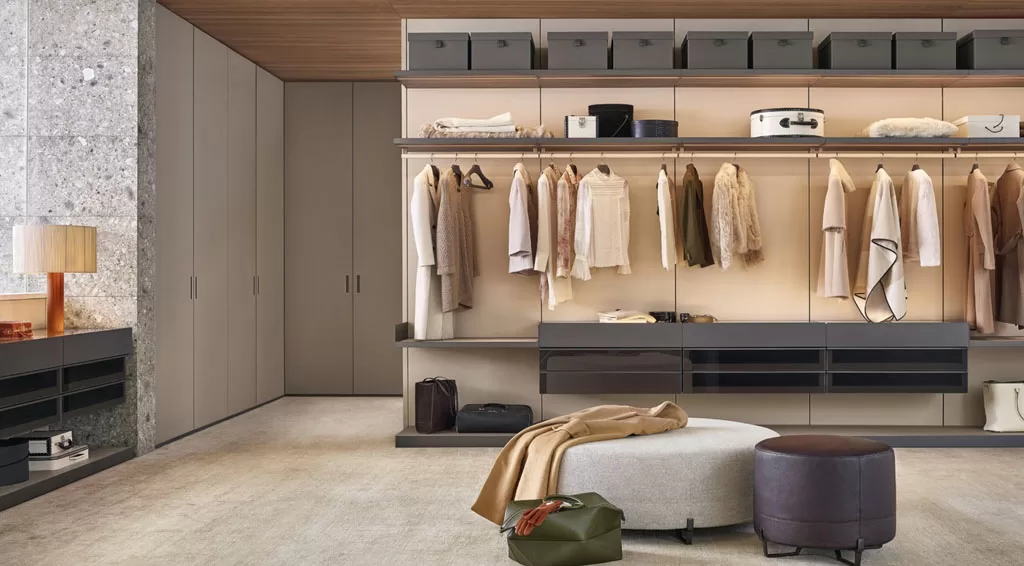
Poliform Walk-In Closets Create Complete Dressing Environments
A walk-in closet can become one of the most personal spaces in a residence.
Poliform’s night systems allow hanging storage, shelving, drawers, display cases, islands, lighting, mirrors, and accessories to be coordinated within a single design language.
The result is an environment that combines organization with the atmosphere of a luxury interior.
Senzafine Walk-In Closets Combine Display & Organization
The Senzafine system can move from enclosed wardrobes into open walk-in closet configurations.
Glass, wood, metal, integrated lighting, and specialized accessories allow clothing and personal objects to be organized with varying levels of display and concealment.
This creates a dressing environment tailored to the client’s preferences.
Ubik Offers an Architectural Approach to the Walk-In Closet
Ubik provides another interpretation of the contemporary dressing room.
Open storage elements create visual accessibility while sophisticated materials and careful detailing keep the environment refined.
The system can be planned according to clothing, shoes, bags, accessories, and other individual storage requirements.
Lexington Extends Poliform’s System Thinking into the Night Area
Lexington demonstrates how a single architectural vocabulary can extend across different parts of the residence.
Its structural character can be adapted to bedroom and wardrobe applications, creating storage while maintaining a sense of openness and architectural rhythm.
Closet Islands Add Function to Large Dressing Rooms
In larger walk-in closets, a central island can provide drawers, trays, display surfaces, and additional organization.
The island also helps establish the dressing room as a complete interior rather than simply a storage space.
Materials can coordinate with the surrounding wardrobe system for visual continuity.
Integrated Lighting Makes Poliform Closets More Functional
Lighting is essential to a well-designed closet.
Integrated illumination improves visibility while highlighting materials and creating a more luxurious atmosphere.
Glass shelves, display compartments, drawers, and hanging areas can be considered together with lighting as part of the overall design.
Poliform Sofas Bring Tailored Comfort to Contemporary Living
Poliform’s sofa collection combines generous comfort with refined Italian detailing.
Modular elements allow many collections to be configured according to the dimensions and circulation of the room.
Tailored upholstery, leather, integrated surfaces, and carefully designed proportions create seating that feels luxurious without becoming visually heavy.
How Do Poliform Modular Sofas Adapt to Contemporary Living?
Modular sofa systems allow designers to compose seating according to the architecture.
A traditional linear arrangement may suit one room, while another may benefit from a corner configuration, chaise longue, double-sided island, or freestanding composition.
This flexibility is especially valuable in large open-plan interiors where furniture helps define different zones.
Westside Creates a Flexible Living Landscape
Designed by Jean-Marie Massaud, Westside is a multifunctional modular sofa system designed around freedom of composition.
Upholstered modules can create configurations ranging from conventional corner sofas to double-sided islands.
Chaise longues, movable backrests, shelves, and small tables add additional functionality.
This makes Westside particularly effective in open-plan architecture where the sofa needs to support multiple orientations and activities.
Saint-Germain Combines Soft Form with Sophisticated Comfort
Saint-Germain expresses a softer interpretation of the contemporary sofa.
Generous upholstered volumes create an inviting character while refined proportions keep the overall composition elegant.
The system works particularly well in interiors where comfort should feel luxurious but informal.
Brera Brings Architectural Elegance to the Living Room
Brera combines generous seating with precise detailing.
Integrated surfaces and refined materials can help connect the sofa to the surrounding architecture.
The design demonstrates Poliform’s ability to balance softness with strong architectural definition.
Ernest Explores a More Organic Sofa Composition
Ernest introduces curved and organic forms into the living environment.
Rather than relying exclusively on rectilinear modules, softer geometry can create more conversational arrangements.
This approach is especially effective in large rooms where furniture needs to establish intimacy.
Poliform Armchairs Create Individual Moments within Larger Rooms
An armchair can provide a more personal seating experience within a larger furniture composition.
Poliform’s collection ranges from understated lounge chairs to more sculptural designs.
Placed beside a sofa, in a bedroom, near a window, or within a reading area, these pieces create smaller destinations within the architecture.
Le Club Reinterprets the Traditional Leather Club Chair
Le Club reduces the visual weight associated with the traditional club chair while preserving its sense of comfort.
Its refined form allows it to work particularly well in contemporary interiors where designers want the richness of leather without excessive bulk.
Mad Chair Brings Expressive Form to Poliform Interiors
The Mad collection introduces a more playful and sculptural character.
Its distinctive silhouette can provide contrast within an otherwise restrained room.
Color and upholstery can make the chair either a quiet complement or a deliberate focal point.
Poliform Dining Tables Create Architectural Centers for Gathering
Dining tables have an important spatial role.
They establish places for meals, conversation, work, and entertaining while often occupying prominent positions within open-plan interiors.
Poliform tables combine sophisticated materials with strong forms capable of anchoring these environments.
How Do Poliform Dining Tables Complement Contemporary Architecture?
Poliform dining tables often use refined geometry and rich materials rather than decorative ornament.
Wood, marble, glass, and metal can establish connections with architectural surfaces elsewhere in the home.
The table therefore becomes part of the material composition of the room while retaining its identity as an important piece of furniture.
Poliform Dining Chairs Balance Comfort & Visual Lightness
Dining seating must remain comfortable without becoming visually overwhelming when repeated around a table.
Poliform chairs combine ergonomic form with upholstery, leather, wood, and carefully detailed structures.
This allows dining rooms to feel elegant while supporting long meals and entertaining.
Poliform Coffee Tables Add Material Layers to the Living Room
Coffee and side tables provide opportunities to introduce stone, wood, glass, metal, and lacquer alongside upholstered furniture.
Different heights and forms can be combined to create layered compositions.
These smaller elements often help connect sofas, armchairs, rugs, and surrounding architecture.
Poliform Beds Extend the Brand’s Design Language into the Bedroom
Poliform bedrooms combine upholstered beds, storage, night tables, wardrobes, and other furniture within a coherent environment.
Beds range from understated architectural designs to softer upholstered forms.
The breadth of materials makes it possible to coordinate the bedroom with closets and other areas of the residence.
Poliform Night Furniture Creates Calm Contemporary Bedrooms
Bedrooms benefit from visual calm.
Carefully proportioned beds, bedside tables, dressers, and storage can create a restful environment without unnecessary visual complexity.
Wood, textiles, leather, and subtle finishes introduce warmth while maintaining the precision associated with Poliform.
Poliform Creates Continuity Between Bedroom & Dressing Room
One of Poliform’s greatest strengths is the ability to coordinate bedroom furniture with wardrobe and walk-in closet systems.
Rather than designing these areas independently, materials and proportions can flow from the sleeping area into the dressing environment.
This creates a more complete architectural experience.
Poliform Materials Create a Consistent Interior Language
Material coordination is essential to the Poliform approach.
Wood tones, lacquers, metals, marble, glass, leather, and textiles can recur across different furniture and system categories.
This allows designers to create relationships between rooms without making every area identical.
Wood Brings Warmth to Poliform Interiors
Wood is particularly effective in contemporary architecture because it introduces natural variation and tactile warmth.
Used in kitchens, systems, tables, storage, and furniture, it can soften glass, metal, plaster, concrete, and stone.
Different wood expressions allow designers to control whether the interior feels light, warm, dramatic, or restrained.
Marble Adds Geological Character & Luxury
Natural stone introduces variation that cannot be perfectly replicated.
Veining, color, and texture make each surface individual.
Used on tables, kitchens, and complementary furniture, marble can become a strong material focal point while reinforcing the permanence of the interior.
Glass Creates Lightness & Visual Depth
Glass allows storage and architectural systems to feel more transparent.
In wardrobes and display cabinets, it can reveal carefully organized interiors.
Reflective, transparent, smoked, and other glass expressions also create different relationships with light.
Leather Brings Tailored Sophistication to Poliform Furniture
Leather can give sofas, chairs, beds, and other furniture a particularly refined character.
Its tactile quality adds warmth while precise tailoring reinforces the sophistication of the design.
Leather can also work effectively alongside wood, marble, and metal within a coordinated interior.
Poliform Outdoor Extends the Brand into Exterior Living
Poliform’s design philosophy now extends into outdoor environments.
Sofas, seating, tables, and complementary pieces allow terraces, gardens, and poolside areas to participate in the same broader vision of contemporary living.
This is particularly valuable in architecture where interior and exterior spaces are visually connected.
Poliform Outdoor Furniture Supports Indoor-Outdoor Continuity
When large areas of glass connect a living room with a terrace, furniture on both sides contributes to the same architectural composition.
Related forms, proportions, and materials can create continuity without requiring identical pieces.
Poliform’s indoor and outdoor collections make this relationship easier to develop.
Poliform Works with Leading International Designers
The Poliform collection reflects collaborations with internationally recognized designers whose work contributes different perspectives to the brand’s broader vision.
Jean-Marie Massaud has played an especially important role in Poliform’s contemporary furniture collection, while designers including Emmanuel Gallina, Marcel Wanders Studio, Carlo Colombo, and others have contributed across different categories.
The diversity of these collaborations gives Poliform breadth while the company’s material and manufacturing language creates consistency.
Jean-Marie Massaud Has Shaped the Contemporary Poliform Collection
Jean-Marie Massaud’s work for Poliform includes sofas, seating, tables, and other furniture.
His designs often combine generous comfort with architectural clarity and refined detailing.
Collections such as Westside demonstrate how furniture can support changing ways of living while maintaining a strong visual identity.
Emmanuel Gallina Brings Refined Elegance to Poliform
Emmanuel Gallina’s work reflects a sensitivity to proportion, material, and understated detail.
This approach aligns naturally with Poliform’s preference for sophisticated furniture that reveals its quality gradually rather than through excessive decoration.
Poliform Furniture Supports Residential & Contract Interiors
The collection’s breadth makes Poliform relevant beyond the private home.
Furniture and systems can be specified for hospitality, workplace, development, and other contract environments.
This gives architects and designers access to a consistent contemporary vocabulary across many project types.
Poliform Contract Expertise Supports Complex Projects
Larger projects require coordination between design intent, technical requirements, materials, manufacturing, and installation.
Poliform’s experience with systems and customized interiors makes it particularly relevant to projects where furniture and architectural elements need to work together.
Poliform Is an Exceptional Resource for Architects & Interior Designers
Few furniture brands offer the same ability to coordinate kitchens, closets, architectural systems, sofas, tables, dining furniture, bedrooms, storage, outdoor furniture, and accessories.
For design professionals, this creates opportunities to establish continuity across an entire residence while still giving individual rooms their own character.
Why Choose Poliform for a Complete Contemporary Interior?
Poliform is especially compelling when a project requires more than individual pieces of furniture.
A kitchen can relate to the dining room.
A living-room storage system can coordinate with architectural paneling.
A bedroom can transition into a Senzafine walk-in closet.
Sofas, tables, chairs, beds, and accessories can then complete the same environment.
This ability to work at multiple scales—from architecture to cabinetry to furniture—is one of Poliform’s defining strengths.
How Do You Begin Designing a Poliform Interior?
Begin with the architecture and the client’s daily life.
Determine how rooms connect, where storage is needed, how the kitchen functions, how clothing should be organized, how people gather, and which views or architectural features should remain prominent.
From there, major Poliform systems such as kitchens, wardrobes, walk-in closets, and living systems can establish the framework.
Furniture, upholstery, tables, beds, lighting, rugs, and accessories can then complete the environment.
Where Can You Experience Poliform at Scott + Cooner?
Scott + Cooner represents Poliform through our Dallas and Austin showrooms, providing architects, interior designers, builders, developers, and design-conscious clients with local resources for sophisticated Poliform projects in North and Central Texas.
Our teams can assist with Poliform furniture as well as more complex kitchen, closet, wardrobe, and system projects where dimensions, layouts, materials, finishes, appliances, storage requirements, and architectural coordination must all be carefully considered.
Where Can You Find Poliform Furniture in Dallas?
Scott + Cooner Dallas represents Poliform for architects, interior designers, builders, and clients throughout Dallas and North Texas.
The collection is particularly well suited to sophisticated Dallas residences where generous architecture creates opportunities for complete living environments rather than isolated furniture selections.
From modular sofas and dining furniture to kitchens, closets, wardrobes, and architectural storage systems, Poliform can establish continuity throughout the home.
Scott + Cooner Dallas Brings Poliform Italian Design to North Texas
Dallas architecture frequently provides the scale needed to explore Poliform’s complete-interior philosophy.
Large kitchens can become architectural centers for entertaining.
Generous dressing rooms can incorporate highly customized wardrobe systems.
Open living areas can use modular sofas and storage systems to create more intimate zones within larger volumes.
Scott + Cooner Dallas provides a local resource for coordinating these elements into a unified project.
Poliform Kitchens Are an Exceptional Resource for Dallas Homes
Luxury Dallas residences often place significant emphasis on the kitchen as a place for cooking, entertaining, and daily gathering.
Poliform’s customizable kitchen systems allow designers to respond to generous floor plans, sophisticated appliance packages, architectural materials, and adjacent living spaces.
Cabinetry and islands can be planned to support function while maintaining a refined visual relationship with the rest of the residence.
Poliform Closets & Walk-In Wardrobes Bring Custom Organization to Dallas
Large primary suites create opportunities for dressing rooms that function as complete interiors.
Poliform systems such as Senzafine can incorporate hanging storage, drawers, glass display, shelving, integrated lighting, accessories, and islands according to individual requirements.
Scott + Cooner Dallas can help clients and design professionals navigate these options as part of the broader project.
Poliform Sofas Work Beautifully in Large Dallas Living Rooms
Expansive living areas need furniture with enough presence to establish comfortable gathering spaces.
Modular sofas such as Westside can create islands within an open plan, while lounge chairs, tables, rugs, and storage systems add additional layers.
This creates intimacy without compromising the scale of the architecture.
Poliform Furniture Complements Dallas Contemporary Architecture
Stone, glass, plaster, steel, wood, and other architectural materials provide a sophisticated backdrop for Poliform.
The brand’s controlled palette and refined detailing can reinforce the architecture while upholstery and natural materials add comfort and warmth.
Dallas Architects & Interior Designers Can Specify Poliform Through Scott + Cooner
Scott + Cooner Dallas can work with architects and interior designers on Poliform furniture, kitchens, closets, wardrobes, living systems, bedrooms, and other applications.
Our team can help evaluate layouts, dimensions, configurations, materials, upholstery, finishes, and technical requirements in relation to the overall project.
Where Can You Find Poliform Furniture in Austin?
Scott + Cooner Austin represents Poliform for architects, interior designers, builders, and clients throughout Austin and Central Texas.
Poliform’s emphasis on architectural integration, natural materials, visual calm, and flexible contemporary living aligns particularly well with Austin’s sophisticated residential design culture.
The collection can complement the limestone, wood, concrete, glass, steel, plaster, and strong indoor-outdoor relationships common to Central Texas architecture.
Scott + Cooner Austin Connects Central Texas with Poliform Italian Design
Austin homes frequently emphasize architecture and landscape over decoration.
Poliform’s restrained design language is especially compatible with this approach.
Kitchens, closets, systems, and furniture can provide extensive function while maintaining the visual clarity of the architecture.
Scott + Cooner Austin offers a local resource for developing these sophisticated interior relationships.
Poliform Kitchens Complement Austin’s Open-Plan Architecture
Open kitchens are common in contemporary Central Texas residences.
Because the kitchen may be visible from living and dining areas, its materials and proportions become part of the larger architectural composition.
Poliform cabinetry can be coordinated with adjacent furniture and storage to create a seamless transition through the space.
Poliform Closets Create Refined Austin Dressing Rooms
Poliform wardrobe and walk-in closet systems allow storage to become part of the architecture.
Senzafine and other night systems can be customized around the client’s clothing, accessories, and daily routines.
Natural woods, glass, metal, integrated lighting, and carefully detailed storage can create dressing environments that feel luxurious without excessive ornament.
Poliform Furniture Fits Austin’s Warm Modern Interiors
Austin interiors often combine contemporary geometry with natural materials and relaxed living.
Poliform’s furniture works particularly well within this balance.
Architectural sofas and systems provide clarity, while upholstery, wood, leather, and stone introduce warmth and tactility.
Poliform Supports Austin’s Indoor-Outdoor Lifestyle
Large windows, covered terraces, courtyards, and pools often create strong relationships between interior and exterior spaces in Central Texas homes.
Poliform’s indoor and outdoor collections allow designers to develop a coherent visual language across these boundaries.
Austin Architects & Interior Designers Can Specify Poliform Through Scott + Cooner
Scott + Cooner Austin can assist design professionals with Poliform furniture, kitchens, wardrobes, walk-in closets, living systems, bedrooms, outdoor furniture, materials, finishes, dimensions, and technical information.
Our team can help coordinate the specification according to the architecture and functional requirements of the project.
Scott + Cooner Represents Poliform in Dallas & Austin
Scott + Cooner’s representation of Poliform in Dallas and Austin gives architects, interior designers, builders, developers, and design-conscious clients access to one of Italy’s most comprehensive contemporary interior collections through experienced local showroom teams.
In Dallas, Poliform’s kitchens, closets, architectural systems, modular sofas, and furniture are particularly well suited to sophisticated residences where scale allows complete environments to be developed.
In Austin, Poliform’s architectural clarity, natural materials, customizable systems, and indoor-outdoor approach align naturally with contemporary Central Texas design.
Across both markets, Scott + Cooner can help develop Poliform specifications according to the architecture, dimensions, storage requirements, material palette, and lifestyle of each project.
Discover Poliform Luxury Italian Furniture, Kitchens & Closets at Scott + Cooner
Scott + Cooner represents Poliform in Dallas and Austin as part of our curated collection of exceptional contemporary furniture and international design.
Since 1995, Scott + Cooner has worked with architects, interior designers, builders, developers, and design-conscious clients seeking extraordinary modern furniture, lighting, kitchens, closets, rugs, accessories, textiles, and architectural products for sophisticated residential and contract interiors.
Our Dallas and Austin teams can help you explore Poliform kitchens, wardrobes, walk-in closets, day and night systems, architectural systems, modular sofas, armchairs, dining tables, chairs, beds, storage, outdoor furniture, and accessories.
For North Texas projects, Scott + Cooner Dallas provides a local resource for Poliform furniture, kitchens, closets, and complete interior systems.
For Central Texas projects, Scott + Cooner Austin provides a local Poliform resource for sophisticated residential and contract environments.
Whether you are planning a custom Poliform kitchen, designing a Senzafine walk-in closet, creating a modular living room, furnishing a contemporary bedroom, or developing a complete residence in which architecture and furniture share one coherent language, Scott + Cooner can help bring Poliform’s sophisticated vision of contemporary Italian living to the project.