
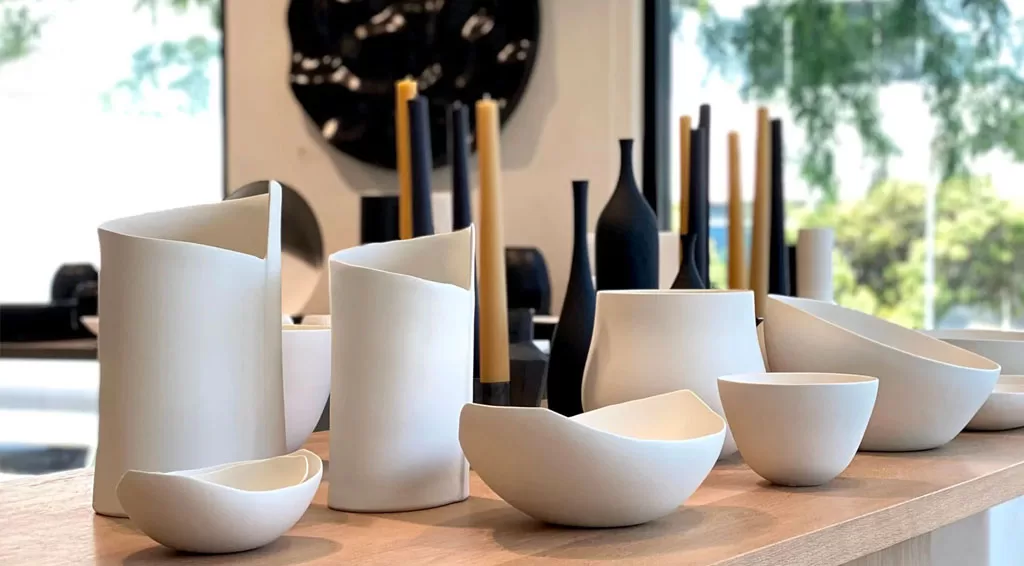

Rina Menardi Handmade Italian Ceramics, Sculptural Objects & Contemporary Design
Rina Menardi creates handmade Italian ceramics distinguished by organic forms, extraordinary color, and a deeply personal approach to clay. Working from her studio in Italy, Menardi transforms an ancient material into contemporary bowls, vessels, vases, centerpieces, sculptural objects, and decorative ceramics that bring quiet beauty and individuality to modern interiors.
Rather than approaching ceramics simply as functional objects, Rina Menardi explores clay as a means of expression. Soft curves, asymmetrical silhouettes, tactile surfaces, and carefully developed colors give each design an emotional presence. The resulting collection exists somewhere between art, craft, and design—objects intended to be touched, used, arranged, and appreciated over time.
Rina Menardi Has Spent Decades Exploring the Expressive Possibilities of Clay, Color, and Form
Rina Menardi began her research into ceramics in 1980, developing a highly personal approach to traditional working techniques while continually experimenting with color and purity of form.
In 1995, she and her husband, Valter Milanese, established the Rina Menardi company, transforming her artistic exploration into a collection of handmade Italian ceramics with an international audience.
Yet the work has remained remarkably personal.
For Menardi, clay is more than a material. It is a way of translating an internal state into physical form. Her creative process is instinctive rather than rigidly rational, allowing shapes to develop naturally through the interaction between hand, material, and emotion.
That philosophy gives the collection its distinctive serenity. Forms may be expressive, but they are rarely excessive. Color may be rich, but it serves the object rather than overwhelming it. Each piece seeks a balance between structure and softness, mind and intuition, presence and quiet.
Every Rina Menardi Ceramic Is Handmade in Italy Through a Process That Preserves the Presence of the Artist’s Hand
Handcraftsmanship is fundamental to Rina Menardi ceramics.
Every stage of production is carried out by hand in Italy with exceptional care. Rather than using manual processes merely to reproduce perfectly identical objects, Menardi embraces the subtle individuality that comes from working directly with clay.
Small variations in shape, surface, and finish become part of the character of the finished piece.
This handmade quality is especially important in contemporary interiors, where natural materials and individually crafted objects can provide a counterpoint to precise architecture and manufactured surfaces.
A Rina Menardi vessel can soften a minimal room. A group of ceramic forms can introduce rhythm and color to shelving. A large centerpiece can give a dining table or console an expressive focal point without relying on elaborate ornament.
The human quality of the ceramics allows them to feel both sophisticated and approachable.
Organic Forms and Sculptural Silhouettes Give Rina Menardi Ceramics Their Quietly Recognizable Identity
Rina Menardi’s ceramics are immediately recognizable for their relationship to organic form.
Some pieces appear elongated and delicate; others are broad, low, or generously rounded. Edges may rise and fall rather than following a rigid horizontal line. Openings narrow unexpectedly. Bowls and vessels can resemble petals, shells, seeds, leaves, stones, or forms shaped slowly by water and wind.
Collections including Ellissi, Baccelli, Fiaccole, Barchette, Campanelle, Cenote, Clio, Conche, Fonti, Laguna, Noci, Petali, Steli, Torri, Trottole, Wind, Flauti, and Triangoli Centerpiece demonstrate the remarkable breadth of this vocabulary.
Although nature can be felt throughout the collection, the forms are rarely literal representations. Instead, they capture qualities found in nature—movement, irregularity, softness, growth, balance, and change.
This abstraction allows the ceramics to work beautifully within both minimalist and richly layered interiors.
Rina Menardi’s Extraordinary Approach to Color Gives Contemporary Ceramics an Emotional and Architectural Presence
Color is one of the defining characteristics of Rina Menardi’s work.
Decades of research have allowed her to develop a sophisticated relationship between color, clay, shape, and surface. Rather than applying color as decoration after a form has been created, Menardi uses it as an integral component of the object itself.
Subtle neutrals can emphasize silhouette and shadow. Earth-inspired hues reinforce the elemental nature of clay. More saturated tones introduce an expressive accent within a room.
This makes Rina Menardi ceramics especially compelling for architects and interior designers.
A single monochromatic piece can provide a restrained accent within a neutral interior, while several forms in related or contrasting colors can create a more dynamic composition. Because the silhouettes remain refined, even stronger colors retain a sense of sophistication.
The result is decorative color that feels architectural rather than ornamental.
Bowls, Vases, Vessels, and Centerpieces Blur the Boundary Between Functional Object and Contemporary Sculpture
One of the most appealing qualities of the Rina Menardi collection is its resistance to simple categorization.
A bowl can serve a practical purpose while also functioning as a sculptural centerpiece. A tall vessel can hold flowers or stand beautifully on its own. A group of smaller forms can become an installation when arranged together on a table, shelf, or console.
This versatility allows the ceramics to change character depending on their setting.
On a dining table, a low organic bowl creates a quiet focal point without interrupting sightlines. On a console, a tall sculptural vessel can emphasize verticality. On open shelving, pieces of different heights and shapes can create rhythm and depth.
Because the designs are intentionally restrained, they complement rather than compete with furniture, lighting, art, and architecture.
They are functional objects with the presence of sculpture.
Collections Such as Cenote, Clio, Conche, Petali, Steli, and Wind Reveal an Ever-Evolving Language of Contemporary Ceramics
The breadth of Rina Menardi’s collection demonstrates how many expressions can emerge from a seemingly simple combination of earth, hand, form, and color.
Cenote and Cenote Alto explore vessel-like silhouettes and sculptural volume. Petali suggests the softness and opening movement of petals. Steli introduces elongated vertical forms, while Wind captures a sense of movement and organic transformation.
Clio, Conche, Barchette, Noci, Vortici, and other collections continue the exploration through bowls, vessels, and sculptural forms with distinct personalities.
Rather than creating unrelated objects, Menardi develops an evolving family of shapes.
Individual pieces can therefore stand alone, but they become particularly compelling when combined. Differences in scale, height, silhouette, and color allow designers to build compositions that feel collected rather than matched.
This ability to create relationships between objects is one reason Rina Menardi ceramics work so naturally within sophisticated residential and hospitality interiors.
Limited-Series Ceramic Artworks Reveal the Most Personal and Sculptural Side of Rina Menardi’s Creative Practice
Alongside the broader ceramic collection, Rina Menardi creates unique numbered pieces in limited series.
These works move even closer to sculpture. Forms continually evolve, with each object becoming a mutation of the piece that preceded it rather than an exact repetition.
The absence of duplication makes these limited-series works particularly expressive examples of Menardi’s philosophy.
They reveal an artist responding directly to clay through the physical act of shaping it, allowing intuition and emotion to determine the direction of the finished form.
For collectors and interior designers, these pieces offer another dimension of Rina Menardi’s work: ceramic objects that can occupy the space traditionally reserved for art while maintaining the tactile connection to material and handcraft that defines her larger collection.
Rina Menardi Wall Pieces Extend the Artist’s Ceramic Language from Objects into the Architecture of a Room
Rina Menardi’s exploration of ceramics now extends beyond vessels and tabletop objects to pieces conceived for the wall.
Collections such as Oblò and Portali transform ceramic material into dimensional wall compositions, introducing form, texture, shadow, and subtle variation to vertical surfaces.
This expansion feels natural within Menardi’s creative language. The same qualities that distinguish her vessels—organic geometry, tactile surfaces, restrained color, and the visible character of handmade clay—can now interact more directly with architecture.
For designers, ceramic wall pieces provide an alternative to conventional framed artwork. They introduce dimensionality without the visual weight of a large painting and can establish a compelling dialogue with furniture, lighting, stone, plaster, wood, and other architectural materials.
The result is another way to experience ceramics not simply as decoration, but as an integral part of the interior.
Handmade Italian Ceramics Bring Warmth, Individuality, and Material Contrast to Modern Residential Interiors
Rina Menardi ceramics are particularly well suited to contemporary interiors because of their ability to introduce warmth without visual clutter.
Modern architecture often emphasizes clean lines, expansive surfaces, glass, stone, wood, and carefully controlled palettes. Against that precision, a handmade ceramic object introduces subtle irregularity and evidence of the human hand.
A Menardi vessel on a Poliform console, a sculptural bowl on a contemporary dining table, or a composition of ceramics within open shelving can create an important moment of contrast.
The pieces are equally effective in more layered interiors, where their organic forms can coexist with art, books, textiles, furniture, and collected objects.
Whether used individually or in groups, the ceramics add character without demanding that the room be designed around them.
Architects and Interior Designers Can Use Rina Menardi Ceramics as Sculptural Accents in Residential, Hospitality, and Contract Projects
The collection’s range of forms, dimensions, and colors gives designers considerable freedom in specifying Rina Menardi for different environments.
In residential interiors, ceramics can animate dining tables, coffee tables, kitchen islands, consoles, bookshelves, bedrooms, and entryways. In hospitality and contract settings, larger vessels and grouped compositions can introduce a handcrafted element to restaurants, hotels, reception areas, executive spaces, and other public interiors.
The ceramics can also provide an important final layer in a completed project.
After the major furniture, lighting, rugs, and architectural finishes have been selected, carefully chosen objects give a space personality and make it feel inhabited rather than simply furnished.
Rina Menardi’s combination of expressive form and visual restraint makes the collection particularly effective for this purpose.
Discover Rina Menardi Handmade Italian Ceramics and Sculptural Objects at Scott + Cooner
Scott + Cooner offers Rina Menardi as part of our curated collection of exceptional contemporary furniture, lighting, accessories, and international design.
Since 1995, Scott + Cooner has worked with architects, interior designers, and design-conscious clients seeking extraordinary modern furniture, lighting, kitchens, closets, rugs, and accessories for residential and contract interiors.
Our experienced team can help you explore Rina Menardi ceramic bowls, vessels, vases, centerpieces, sculptural objects, wall pieces, colors, dimensions, and collections to find pieces that complement your project.
Whether you’re searching for a singular handmade Italian ceramic centerpiece, a sculptural vase, a composition of contemporary ceramic objects, or distinctive accessories to complete an interior, Scott + Cooner can help you discover the expressive beauty of Rina Menardi.