

Safar Rugs Handmade Luxury Rugs, Custom Carpets & Contemporary Textile Design
Safar Rugs creates exceptional handmade carpets and custom rugs that bring centuries of weaving knowledge into sophisticated contemporary interiors. Working with skilled artisans and an extraordinary range of renewable natural fibers, Safar combines traditional rug-making techniques with modern color, texture, pattern, and scale to create pieces that feel both timeless and distinctly personal.
From luxurious silk and wool rugs to richly textured natural-fiber carpets and completely bespoke designs, Safar approaches each rug as an opportunity to unite craftsmanship, material, and interior architecture. Size, fiber, color, pattern, weave, texture, and pile can be customized, allowing architects, interior designers, and clients to develop rugs specifically for the spaces they are creating.
Generations of Carpet-Making Knowledge Give Safar Rugs an Authentic Connection to the Art of Handmade Rugs
Safar was founded by Shiraz Ansari, whose relationship with rug making began long before the creation of the company.
Born in Varanasi in northern India, Ansari grew up within a multigenerational family of carpet and rug manufacturers. For nearly a century, his family has been involved in the creation of handmade carpets, giving him an intimate understanding of the materials, artisans, production methods, and traditions behind exceptional rug making.
His own creative education eventually took him far beyond India.
After studying in the Himalayan Mountains and Mumbai, Ansari continued his education in Paris, where his interest in art, fashion, culture, and design developed further. Experiences with international fashion houses including Rick Owens and Hermès helped refine his understanding of materials, proportion, detail, and contemporary aesthetics.
Today, that combination of Eastern craft heritage and Western design perspective gives Safar its distinctive identity.
w are Safar handmade rugs made? Safar Handmade Rugs Connect Centuries-Old Weaving Traditions with Contemporary Interior Design
The beauty of a handmade rug begins with knowledge.
Warp and weft, fiber direction, loom construction, knotting and weaving techniques, pile height, material combinations, and surface treatments all influence how a rug ultimately looks and feels.
Safar draws upon both ancient and advanced techniques to create carpets that respect this tradition while remaining relevant to contemporary interiors.
Traditional craftsmanship does not require traditional aesthetics.
Through changes in scale, pattern, color, texture, pile, and fiber, time-honored techniques can produce rugs that feel remarkably modern.
This balance allows Safar rugs to work within a broad range of interiors—from minimal contemporary architecture to layered residential spaces, sophisticated hospitality environments, and interiors where art, furniture, and textiles coexist in a more eclectic composition.
Custom Safar Rugs Allow Designers to Specify Size, Fiber, Color, Pattern, Weave, Texture, and Pile
Customization is one of Safar’s greatest strengths.
Rather than requiring an interior to conform to predetermined rug dimensions and colors, Safar can develop a rug around the specific requirements of a project.
Size can respond to the architecture and furniture plan. Color can coordinate with upholstery, artwork, stone, wood, and surrounding finishes. Pattern can be adjusted to establish the appropriate level of visual energy, while fiber and pile influence both appearance and tactile experience.
Safar’s in-house looms accommodate different weaving techniques, textures, and custom requirements.
This makes the collection particularly valuable for architects and interior designers.
A rug can be conceived not as a finishing accessory selected at the end of the project, but as an integral component of the interior—one designed specifically for the scale, palette, function, and atmosphere of the room.
Silk Rugs Bring Exceptional Luster, Softness, and Visual Depth to Luxury Interiors
Silk occupies a special place within the world of luxury rugs.
Safar’s silk rugs use naturally pure silk yarn, woven and hand-twisted to create surfaces with exceptional refinement.
Silk interacts with light in a way that can dramatically change the appearance of a rug throughout the day. Depending on the direction of the pile and the viewer’s position, colors can appear deeper, lighter, richer, or more luminous.
This movement gives silk rugs an extraordinary sense of visual depth.
Used alone, silk can create a highly refined surface with remarkable softness and sheen. Combined with other fibers, it can highlight particular areas of a pattern or introduce subtle variations in texture and reflectivity.
For formal living rooms, bedrooms, private lounges, and other sophisticated interiors, a Safar silk rug can function almost like a textile artwork beneath the furniture.
Wool, Mohair, Jute, Hemp, Linen, Aloe, Sisal, Cotton, and Seagrass Create an Extraordinary Natural-Fiber Palette
Safar works with an unusually broad selection of natural fibers.
Wool provides warmth, resilience, softness, and versatility. Mohair introduces another tactile quality, while silk can create areas of luminosity and refinement.
Jute, hemp, linen, aloe, sisal, cotton, and seagrass offer different textures and visual characteristics, ranging from finely woven surfaces to more organic and highly tactile expressions.
The ability to combine these fibers gives designers considerable creative freedom.
A rug does not need to have one uniform texture. Differences in fiber, weave direction, and pile height can create subtle dimensional effects even within a restrained monochromatic design.
These natural materials also establish an important relationship with contemporary furniture and architecture.
Wood, stone, metal, glass, leather, and upholstery can feel more inviting when balanced by the tactile softness and natural irregularity of a beautifully handmade rug.
Texture and Pile Height Give Safar Rugs a Sculptural Dimension Beyond Pattern and Color
A rug can create visual interest without relying exclusively on graphic pattern.
Safar’s understanding of weave construction, fiber direction, and pile height allows texture itself to become a design element.
Higher and lower areas can create relief across the surface. Different fibers can reflect light differently. Changes in weaving direction can produce tonal variation even when the same color is used throughout the rug.
The effect can be subtle or dramatic.
In a minimalist interior, a highly textured neutral rug can introduce richness without disrupting the architectural restraint of the room. In a more expressive space, texture can work together with pattern and color to create a stronger visual statement.
For designers, this additional dimension makes a custom rug particularly powerful.
The surface can be developed almost like a landscape, with materials and pile creating depth that changes as people move through the room.
Contemporary Patterns, Lines, Shapes, and Forms Allow Safar Rugs to Establish the Mood of an Interior
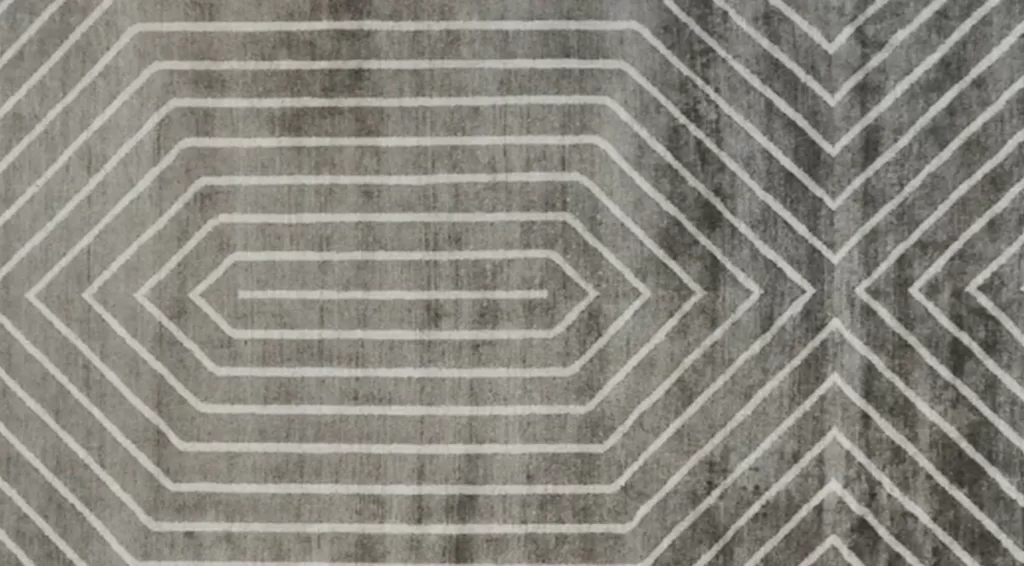
Safar’s Line Design collection explores the expressive potential of geometry.
Lines, shapes, and forms can give a rug a sense of movement, structure, rhythm, or balance. Depending on their scale and arrangement, these graphic elements can make an interior feel modern, playful, sophisticated, calm, or energetic.
Pattern also provides a way to connect different elements within a room.
A line might echo the geometry of architecture. A curve can soften rectilinear furniture. Repeated shapes can establish rhythm beneath a seating arrangement, while an oversized graphic composition can turn the entire floor into a visual statement.
Because Safar offers customization, these ideas can be adapted rather than treated as fixed formulas.
Scale, color, texture, and material can change the personality of a pattern dramatically, allowing designers to create a rug appropriate to the specific character of the project.
Safar’s Nature-Inspired Rugs Translate Organic Patterns and Textures into Contemporary Textile Design
Nature provides another important source of inspiration for Safar.
Organic patterns, animal-inspired markings, irregular textures, and forms drawn from the natural world are interpreted through fiber and weaving rather than reproduced literally.
The resulting rugs can introduce an elemental quality into contemporary interiors.
This is particularly effective within architecture dominated by clean lines and hard surfaces. A nature-inspired rug can provide visual movement and softness while maintaining the sophistication of the overall composition.
Material reinforces this connection.
Wool, silk, jute, hemp, linen, sisal, and other natural fibers have their own inherent variations and textures. When these characteristics are allowed to become part of the design, the rug feels less like a manufactured surface and more like an organic element within the room.
Classic Handmade Rug Techniques Can Move Effortlessly from Traditional Patterns to Modern Minimalism
Safar’s Classic collection demonstrates how traditional rug-making knowledge can support a remarkably broad range of aesthetics.
Ancient and advanced weaving techniques, subtle changes in weave direction, and variations in pile height provide the technical foundation.
What happens on that foundation can range from traditional pattern to highly contemporary design.
This makes Safar especially relevant for interiors that resist simple stylistic categories.
A historic residence may benefit from a rug with traditional references interpreted in a quieter palette. A modern home may use the same depth of craftsmanship to create an abstract or minimal surface.
In both cases, the quality comes from the same place: carefully selected fibers, knowledgeable artisans, sophisticated weaving techniques, and close attention to the finished surface.
Bespoke Rugs Can Be Designed Around the Architecture Rather Than Forcing a Room to Accommodate Standard Sizes
One of the most important advantages of a custom rug is architectural freedom.
Standard rug sizes often create compromises. A rug may be slightly too small for a seating arrangement, extend awkwardly into a circulation path, or fail to respond appropriately to an unusually proportioned room.
Safar’s custom capabilities allow the rug to be developed around the architecture instead.
In a living room, dimensions can respond precisely to a sectional sofa, lounge chairs, and coffee tables. A dining rug can accommodate the table and chairs with the appropriate border. A runner can follow a long hallway or gallery, while a large-scale custom carpet can unify an expansive room.
Custom shapes provide even greater possibilities.
When appropriate, the perimeter of a rug can respond to curves, angles, furniture arrangements, or other architectural conditions, allowing the floor covering to become part of the spatial composition rather than simply an object placed within it.
Safar Rugs Bring Warmth, Acoustics, Texture, and Visual Structure to Contemporary Interiors
A beautifully designed rug performs several roles simultaneously.
Visually, it can anchor a furniture composition and help establish relationships between sofas, chairs, tables, and surrounding architecture.
Tactilely, it introduces softness beneath the feet and balances harder materials such as stone, concrete, glass, and metal.
Rugs can also contribute to the acoustic character of a room by helping absorb sound, an increasingly important consideration in large open-plan interiors.
Color and pattern provide another layer.
A rug can establish the palette of the entire room or quietly connect colors already present in furniture, art, and accessories.
For this reason, Safar rugs can be considered part of the architecture of an interior rather than merely decoration.
The right rug defines territory, influences movement, creates intimacy, and changes how a room feels.
Fair Trade Practices and Responsible Handmade Production Support the People Behind Safar Rugs
The human element of handmade production is inseparable from the finished rug.
Safar works directly with Care & Fair, an organization dedicated to eliminating child labor within the rug industry and supporting rehabilitation and education initiatives for former child weavers.
The company also supports improved work and living standards for weavers and equal-opportunity policies intended to encourage women to participate throughout the organization.
These commitments are particularly meaningful within an industry built upon specialized manual skills.
A handmade rug may represent many hours of work by people with knowledge passed between generations. Responsible production therefore means recognizing not only the value of natural materials but also the value of the people whose expertise transforms those materials into finished carpets.
Renewable Natural Fibers and Hand Production Shape Safar’s Approach to More Sustainable Luxury Rugs
Environmental responsibility is closely connected to Safar’s material philosophy.
The company prioritizes renewable natural fibers including wool, cotton, silk, mohair, linen, aloe, jute, hemp, sisal, and seagrass.
These materials provide extraordinary aesthetic and tactile possibilities while reducing dependence on purely synthetic surfaces.
Safar also emphasizes production by hand, which can minimize the environmental impact associated with highly industrialized manufacturing processes.
The company’s sustainability practices include attention to environmental legislation, waste disposal, and recycling measures.
Longevity is equally important.
A finely made rug created from high-quality materials and tailored to a particular interior has the potential to remain relevant for many years. Rather than functioning as a disposable decorative layer, it can become a lasting part of the room and the life that unfolds around it.
Custom Safar Rugs Give Architects and Interior Designers Exceptional Creative Freedom for Residential and Contract Projects
Safar’s combination of material knowledge, customization, and handmade production makes the company especially valuable to the professional design community.
Interior designers can develop colors around a project’s palette, select fibers according to the desired texture and appearance, establish dimensions around furniture plans, and explore patterns that respond directly to the architecture.
This flexibility applies equally well to private residences and contract interiors.
Hotels, restaurants, executive spaces, private clubs, luxury retail environments, and other hospitality projects can benefit from rugs developed around specific dimensions, visual identities, and performance requirements.
The result is not simply a custom-sized version of an existing product.
At its best, a bespoke Safar rug becomes a collaboration between designer, client, artisan, and manufacturer—an original textile created specifically for one interior.
Discover Safar Handmade Rugs, Custom Carpets, Silk Rugs, and Natural-Fiber Designs at Scott + Cooner
Scott + Cooner offers Safar Rugs as part of our curated collection of exceptional contemporary rugs, furniture, lighting, and international design.
Since 1995, Scott + Cooner has worked with architects, interior designers, and design-conscious clients seeking extraordinary modern furniture, lighting, kitchens, closets, rugs, and accessories for residential and contract interiors.
Our experienced team can help you explore Safar handmade rugs, custom carpets, silk rugs, wool rugs, natural-fiber rugs, contemporary patterns, textures, colors, materials, dimensions, and bespoke possibilities to identify the right solution for your project.
Whether you’re searching for a luxurious silk rug, a richly textured natural-fiber carpet, a contemporary handmade rug, or a completely custom design developed around a specific room, Scott + Cooner can help you discover Safar Rugs and create a textile that brings craftsmanship, warmth, individuality, and exceptional material beauty to the interior.