
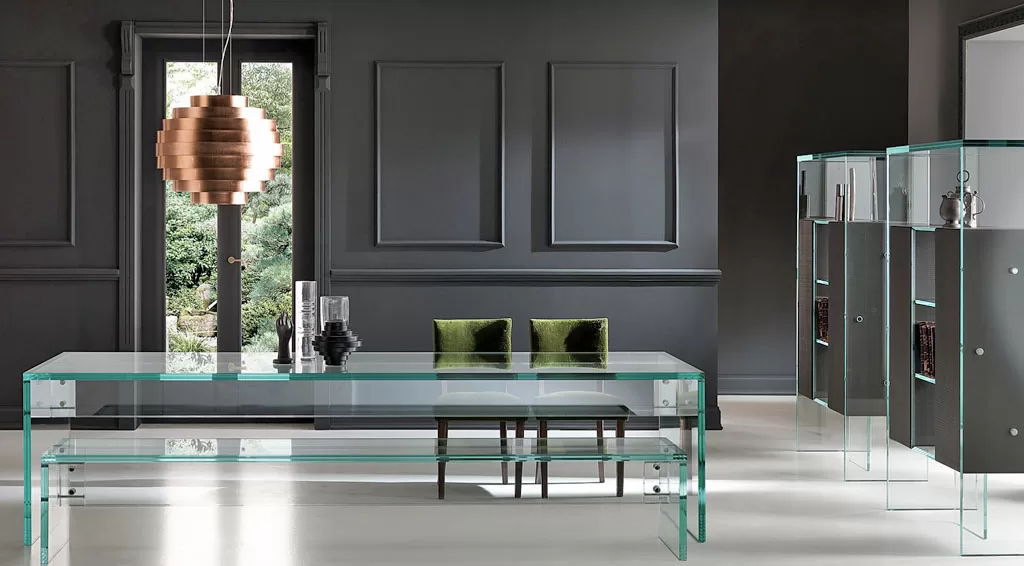

Santambrogiomilano Luxury Glass Furniture, Italian Design & Transparent Architecture
Santambrogiomilano transforms glass from a transparent surface into the substance of furniture and architecture. Founded in Milan by architect Carlo Santambrogio, the Italian design company creates extraordinary glass tables, bookcases, kitchens, beds, sofas, cabinets, game tables, lighting, architectural structures, and custom installations defined by transparency, material purity, engineering, and uncompromising minimalism.
At the center of Santambrogiomilano is a radical idea: furniture does not always need to visually occupy a room in order to shape it. By working with thick structural glass and eliminating unnecessary supports, frames, and visual interruptions, the company creates objects that have extraordinary physical presence while preserving light, views, architecture, and the surrounding environment.
What Is Santambrogiomilano Known for in Contemporary Design?
Santambrogiomilano is known for luxury Italian glass furniture and architecture in which glass becomes the primary structural and expressive material.
Rather than treating glass as an insert, tabletop, door, or decorative accent, the company pushes the material toward its architectural limits.
Tables appear almost suspended.
Bookcases define space without closing it.
Beds seem to float.
Kitchens become transparent compositions.
Architectural structures blur the distinction between interior and landscape.
The result is a distinctive form of Italian minimalism based on transparency rather than visual reduction alone.
Santambrogiomilano Was Founded by Architect Carlo Santambrogio
Carlo Santambrogio founded the company in Milan in 2003 after studying architecture at the Politecnico di Milano.
His architectural background is fundamental to the collection.
Even individual pieces of furniture are conceived spatially. Thickness, proportion, transparency, reflection, structural logic, and the relationship between an object and its surroundings are considered together.
The furniture therefore often feels closer to miniature architecture than conventional product design.
The Simplicity Project Defines Santambrogiomilano
The Simplicity project established the philosophical foundation of Santambrogiomilano.
Its goal is not minimalism for its own sake.
Instead, the company explores how removing visual barriers can change our perception of space.
Glass allows furniture to be physically present while permitting architecture, landscape, art, flooring, and other objects to remain visible through it.
How Does Santambrogiomilano Use Glass as Structure?
Santambrogiomilano works with substantial glass thicknesses and advanced fabrication methods that allow glass to perform roles conventionally assigned to wood, metal, masonry, or other structural materials.
This requires precise engineering.
Glass panels need to respond to load, scale, connections, movement, and intended use while maintaining the clarity that gives the finished object its distinctive character.
The apparent simplicity of the design is therefore supported by considerable technical sophistication.
Thickness Is Part of the Santambrogiomilano Design Language
One of the most distinctive aspects of Santambrogiomilano is its use of thick glass.
The thickness gives the material substance.
Edges become visible architectural lines.
Light refracts through the material.
The mass of the glass becomes evident without creating the opacity associated with other heavy materials.
This contradiction—visual lightness combined with physical substance—is central to the brand.
Transparency Changes the Way Furniture Occupies a Room
A conventional dining table interrupts the view across a room.
A conventional cabinet creates a solid visual mass.
A conventional bookcase divides space.
Transparent furniture behaves differently.
Sightlines continue through the object.
Flooring remains visible.
Light moves through the composition.
Art and architecture remain connected.
For open-plan interiors, this can create an extraordinary sense of continuity.
Santambrogiomilano Glass Tables Are Functional Architecture
The glass table is one of the purest expressions of the Santambrogiomilano philosophy.
Large planes of glass are joined with minimal visual interruption, allowing the structure to appear both substantial and almost immaterial.
The table becomes a meeting point between engineering, furniture, sculpture, and architecture.
How Does a Santambrogiomilano Glass Table Transform a Dining Room?
A transparent dining table changes the visual balance of the entire room.
Instead of creating a dense object at the center of the space, the table allows the architecture beneath and beyond it to remain visible.
Stone flooring continues uninterrupted.
A rug remains visually legible.
Dining chairs become more prominent.
Views toward art or landscape remain open.
The table establishes function without visually closing the room.
Large Glass Tables Create Extraordinary Architectural Presence
Santambrogiomilano has demonstrated its glass engineering through tables of exceptional scale.
These large surfaces emphasize the structural possibilities of the material while creating dramatic gathering places for residences, boardrooms, hospitality interiors, galleries, and other significant spaces.
At this scale, a table becomes architecture within architecture.
Custom Dimensions Expand the Possibilities of Glass Furniture
Santambrogiomilano’s ability to customize dimensions is particularly important for architects and interior designers.
A table can respond to a specific dining room.
A bookcase can relate to ceiling height.
A cabinet can address an architectural opening.
A large custom piece can be developed around the proportions of a particular project.
This allows the collection to become integrated with the interior rather than simply placed inside it.
Color Changes the Emotional Character of Glass
Transparent glass may be the purest expression of the Santambrogiomilano concept, but color creates another dimension.
Tinted glass can introduce warmth, drama, or contrast while preserving the material’s ability to interact with light.
Color can also connect the furniture with artwork, upholstery, rugs, architecture, or a broader interior palette.
Glass Responds Constantly to Light
Unlike an opaque material, glass changes according to its environment.
Daylight passes through it.
Artificial light catches the edges.
Reflections shift as people move through the room.
Colors from nearby objects appear within its surfaces.
A glass object is therefore never visually static.
Its appearance evolves throughout the day.
Santambrogiomilano Glass Bookcases Preserve Openness
Bookcases traditionally create visual barriers because shelves and vertical supports form a dense grid.
Santambrogiomilano reinterprets the category through transparency.
The structure can organize books, art, and objects while maintaining visual connections between spaces.
This makes a glass bookcase especially valuable in open-plan architecture.
How Does a Glass Bookcase Work in an Open Interior?
A glass bookcase can define a zone without constructing an opaque wall.
Placed between a living and dining area, it establishes a subtle boundary while allowing both spaces to remain visually connected.
Used against a wall, the transparent structure emphasizes the objects displayed rather than competing with them.
In either application, the architecture remains legible.
Objects Appear to Float within a Glass Bookcase
Transparency shifts attention from the shelving structure toward the collection it contains.
Books, ceramics, sculpture, and decorative objects seem to occupy the space with less visual support.
This can make a Santambrogiomilano bookcase particularly effective in art-focused interiors where the display itself should remain primary.
The Simplicity Kitchen Reinvents Kitchen Architecture
The kitchen is normally one of the most visually dense areas of a home.
Cabinetry, appliances, counters, storage, hardware, and equipment create substantial visual mass.
Santambrogiomilano asks what happens when much of that mass becomes transparent.
The Simplicity Kitchen turns one of the home’s most functional environments into an exploration of glass, light, food, color, and architecture.
What Makes the Santambrogiomilano Glass Kitchen Different?
The Simplicity Kitchen uses glass not merely as a cabinet door or worktop but as the defining material of the composition.
Transparency reveals rather than conceals.
Food, objects, light, and surrounding architecture become part of the visual experience.
The kitchen therefore challenges the conventional assumption that storage and function must always be hidden behind opaque cabinetry.
A Transparent Kitchen Changes the Experience of Cooking
Cooking is inherently visual.
Ingredients introduce color.
Flame creates movement.
Glassware reflects light.
Food preparation transforms raw materials into finished dishes.
A transparent kitchen allows these activities to become more visible, turning everyday function into part of the architecture.
Santambrogiomilano Glass Cabinets Explore Transparency & Storage
Storage typically depends on concealment.
Santambrogiomilano offers another possibility.
Glass cabinets and sideboards allow the structure and selected contents to participate in the room while combinations with wood and other materials introduce warmth and contrast.
The resulting pieces balance display and storage.
Glass & Wood Create a Powerful Material Contrast
Wood and glass possess almost opposite visual qualities.
Glass is transparent, reflective, precise, and visually cool.
Wood is opaque, tactile, organic, and naturally varied.
When the two are combined carefully, each material becomes more expressive because of the contrast.
This dialogue is especially effective in contemporary interiors seeking both architectural clarity and warmth.
Santambrogiomilano Glass Beds Create the Illusion of Floating
The Glass Bed applies the company’s transparency philosophy to one of the most intimate furniture categories.
Glass structural elements reduce the visual weight of the bed, allowing the mattress and textiles to appear almost suspended within the room.
The result can be particularly dramatic in bedrooms with significant architecture or views.
How Does a Glass Bed Work in a Luxury Bedroom?
A glass bed preserves sightlines beneath and around the sleeping surface.
This can make a substantial bed appear lighter while emphasizing surrounding materials such as stone, wood, plaster, rugs, and textiles.
Soft bedding then creates an intentional contrast with the precision and transparency of glass.
The bedroom becomes a composition of softness and structure.
The Glass Sofa Challenges Expectations of Upholstered Furniture
A sofa is traditionally associated with visual mass.
Upholstered bases, arms, and backs create a large opaque object.
Santambrogiomilano’s Glass Sofa explores how transparent structural components can reduce this mass while still supporting an inviting upholstered experience.
The result brings the company’s architectural language into soft seating.
Transparency Can Make Upholstered Furniture Feel Lighter
When the supporting structure becomes visually quiet, upholstery appears more independent.
Cushions and seating elements can seem to float.
This creates an unusual tension between comfort and immateriality—a theme that runs throughout the Santambrogiomilano collection.
The Glass Bench Brings Minimalism to Seating
A bench is already one of furniture’s most elemental forms.
Santambrogiomilano reduces it further through transparent structure and carefully controlled geometry.
The result can work in entries, galleries, bedrooms, dressing rooms, corridors, commercial interiors, and other environments where seating is needed without creating unnecessary visual weight.
Santambrogiomilano Reimagines the Luxury Game Room
Game tables often become some of the largest visual objects in a room.
Santambrogiomilano applies transparency to billiards and table tennis, creating pieces that retain recreational function while participating in sophisticated contemporary interiors.
Play and architectural design no longer need to occupy separate visual worlds.
The Glass Pool Table Appears to Float
The Santambrogiomilano Glass Pool Table uses transparent structure to create an extraordinary illusion of weightlessness.
A billiard table normally has considerable visual mass because of the large playing surface and substantial base required for stability.
Replacing much of that visual structure with glass transforms the relationship between the table and the room.
How Does a Glass Pool Table Work in a Contemporary Interior?
A glass pool table can become the centerpiece of a game room, lounge, private club, hospitality environment, or entertainment space without visually overwhelming the architecture.
Its transparent structure preserves flooring and sightlines.
Color at the playing surface can then become a strong graphic element within the room.
The table is both recreation and sculpture.
The Glass Ping Pong Table Combines Design & Play
Santambrogiomilano’s Ping Pong Glass Table brings the same approach to table tennis.
The transparent structure gives a familiar recreational object an entirely different architectural presence.
Depending on configuration, the table can also participate in dining, office, or multipurpose environments, making it particularly relevant to spaces designed for flexible use.
Multipurpose Furniture Supports Contemporary Living
Homes and workplaces increasingly need rooms to perform multiple functions.
Dining can become work.
Work can become entertainment.
A social space can support games.
Furniture that moves comfortably among these activities allows architecture to remain flexible.
Santambrogiomilano’s transparent designs are particularly effective because they do not visually dominate the room when their function changes.
The Glass Counter Bar Turns Entertaining into Architecture
A bar can become an important social center within a residence or hospitality interior.
Santambrogiomilano’s glass interpretation gives the category a lighter, more architectural presence.
Bottles, glassware, light, and color become visible components within the composition rather than elements hidden inside opaque cabinetry.
Santambrogiomilano Glass Bathrooms Explore Water & Transparency
Glass and water share important visual characteristics.
Both interact with light.
Both can appear transparent.
Both create reflections and shifting perceptions.
Santambrogiomilano’s exploration of the bathroom uses these relationships to create an environment where architecture, furniture, water, and light become closely connected.
Glass Lighting Makes the Material Itself Luminous
Lighting offers a particularly natural application for glass.
Rather than merely surrounding the light source, Santambrogiomilano allows illumination to activate the material.
Edges glow.
Surfaces reflect.
Transparency carries light through the object.
The fixture becomes both illumination and an exploration of glass itself.
How Does Santambrogiomilano Use Light as a Design Material?
Light reveals glass.
Without illumination, transparency can become visually quiet.
With carefully controlled natural or artificial light, thickness, edges, reflections, color, and internal depth become more apparent.
For this reason, lighting design should be considered early when specifying significant Santambrogiomilano pieces.
The Glass House Extends Furniture into Architecture
Santambrogiomilano’s most radical exploration of transparency moves beyond furniture entirely.
The Glass House investigates what happens when structural glass becomes the primary substance of the dwelling.
Walls, floors, stairs, and other architectural elements can become transparent, allowing landscape and interior to visually merge.
How Does the Santambrogiomilano Glass House Work?
The Glass House concept uses structural glass to minimize conventional visual boundaries between interior and exterior.
Rather than framing isolated views through windows, transparency becomes continuous.
Landscape surrounds the occupant.
Light penetrates deeply into the architecture.
Interior objects remain connected with the world beyond the enclosure.
The concept turns the company’s furniture philosophy into an architectural system.
Architecture & Furniture Become One Continuous Idea
Within the Santambrogiomilano philosophy, the distinction between container and content becomes less rigid.
A glass house and a glass table can share the same conceptual language.
A staircase and a bookcase can both be understood as transparent structures.
Furniture does not decorate the architecture.
It participates in it.
La Pergola Extends Glass into Outdoor Architecture
La Pergola demonstrates how Santambrogiomilano applies its glass expertise to exterior structures.
Substantial transparent elements create shelter and architectural definition while preserving views and visual openness.
The structure can establish an outdoor room without introducing the heaviness associated with conventional opaque construction.
Glass Can Connect Interior & Landscape
Contemporary residential architecture increasingly seeks continuity between inside and outside.
Large windows alone do not always achieve this.
Furniture and architectural structures also affect visual flow.
Transparent elements can reinforce that connection by allowing landscape to remain present through the objects occupying the space.
Santambrogiomilano Is Designed for Customization
Customization is fundamental to the brand’s approach.
Dimensions, colors, finishes, and configurations can be adapted to project requirements while preserving the distinctive character of the collection.
This makes Santambrogiomilano especially relevant to significant residential and contract projects where standard dimensions may not adequately respond to the architecture.
How Does Custom Santambrogiomilano Furniture Work?
The process begins with the space.
Architectural dimensions, intended use, circulation, material palette, desired scale, and technical requirements establish the framework.
A piece can then be developed around appropriate dimensions, glass treatment, color, finish, and configuration.
The objective is not arbitrary customization but a more precise relationship between object and architecture.
Made in Italy Is Fundamental to Santambrogiomilano
Santambrogiomilano’s collection is produced in Italy, bringing together advanced glass technology and Italian craftsmanship.
This combination is essential.
Large structural glass requires precision, engineering, specialized fabrication, careful finishing, and experienced handling.
The finished simplicity depends on complexity behind the scenes.
Technology Makes Visual Simplicity Possible
The cleaner an object appears, the less room there is to hide technical compromises.
Connections become visible.
Edges matter.
Alignment matters.
Surface quality matters.
Santambrogiomilano’s minimalist language therefore places enormous demands on engineering and production.
Technology is not separate from the aesthetic—it makes the aesthetic possible.
Glass Offers a Different Approach to Material Sustainability
Santambrogiomilano emphasizes glass as a recyclable material and connects material research with environmental awareness.
For architects and designers, this adds another dimension to the appeal of glass beyond transparency and structural possibility.
Durability, material longevity, and recyclability can become part of the specification conversation.
Santambrogiomilano Works Beautifully with Natural Stone
Stone and glass create a particularly powerful dialogue.
Stone is opaque, geological, textured, and visually heavy.
Glass is transparent, precise, reflective, and seemingly weightless.
A Santambrogiomilano table placed over expressive stone flooring allows the stone to remain visible while introducing an entirely different material quality.
Glass & Wood Create Warm Contemporary Interiors
In interiors dominated by wood, transparent furniture can prevent the room from becoming visually heavy.
Glass allows grain and craftsmanship in floors, walls, cabinetry, and ceilings to remain prominent.
The contrast also makes both materials feel more intentional.
Santambrogiomilano Complements Concrete Architecture
Concrete and glass are natural architectural partners.
Concrete provides mass and solidity.
Glass introduces lightness and reflection.
A transparent table, bookcase, or bench can inhabit a concrete interior without competing with the strength of the architecture.
Transparent Furniture Is Ideal for Art-Focused Interiors
Collectors frequently need furniture that can coexist with significant artwork without adding unnecessary visual competition.
Glass offers an unusual advantage.
The furniture can have strong design integrity while allowing paintings, sculpture, photography, and architectural surfaces to remain dominant.
Santambrogiomilano is therefore particularly compelling for art-focused residences and galleries.
Glass Furniture Can Preserve Important Views
In residences with city, landscape, lake, mountain, or garden views, furniture placement can unintentionally interrupt the visual connection.
Transparent pieces help reduce this problem.
A table or bookcase can perform its function while allowing the eye to continue toward the view beyond.
Santambrogiomilano Is a Resource for Architects
Architects can approach Santambrogiomilano as more than a furniture manufacturer.
The company’s experience with structural glass, custom dimensions, large-scale fabrication, architectural systems, and transparent environments creates opportunities for deeper integration with a project.
Furniture and architecture can be considered together.
Santambrogiomilano Is a Resource for Interior Designers
For interior designers, the collection offers a way to introduce strong design without necessarily introducing strong visual mass.
Glass can preserve sightlines, emphasize other materials, showcase art, and create unexpected relationships among furniture, light, and architecture.
Customization further expands the possibilities for highly individual interiors.
Santambrogiomilano Works in Luxury Residential Interiors
Dining rooms, living rooms, bedrooms, kitchens, game rooms, libraries, bars, bathrooms, terraces, and outdoor spaces can all become settings for Santambrogiomilano.
The collection is especially powerful when the interior itself has architectural significance and furniture needs to respect rather than obscure that character.
Santambrogiomilano Works in Hospitality & Contract Environments
Hotels, restaurants, private clubs, executive offices, galleries, boutiques, and other contract environments can use transparent furniture to create memorable experiences while maintaining openness.
Large custom tables, bars, bookcases, game tables, and architectural glass installations can become defining elements of the project.
Why Choose Santambrogiomilano Glass Furniture?
Santambrogiomilano offers something genuinely unusual within contemporary furniture.
The company does not simply make familiar furniture in glass.
It uses transparency to reconsider how objects occupy space.
A table becomes less visually solid.
A bookcase defines without closing.
A bed appears suspended.
A kitchen reveals rather than conceals.
A house becomes a transparent frame for landscape.
This conceptual consistency gives the collection an identity far beyond material novelty.
Where Can You Experience Santambrogiomilano at Scott + Cooner?
Scott + Cooner represents Santambrogiomilano through our Dallas and Austin showrooms, connecting architects, interior designers, collectors, hospitality professionals, and design-conscious clients in Texas with the company’s extraordinary all-glass furniture and architectural concepts.
Our teams can help clients explore glass tables, bookcases, kitchens, beds, sofas, cabinets, game tables, lighting, custom dimensions, colors, finishes, and project-specific applications.
Where Can You Find Santambrogiomilano Furniture in Dallas?
Scott + Cooner Dallas represents Santambrogiomilano for architects, interior designers, collectors, hospitality professionals, and design-conscious clients throughout Dallas and North Texas.
The collection is particularly relevant to sophisticated Dallas residences where significant architecture, art collections, generous proportions, and carefully selected materials require furniture with presence but not excessive visual weight.
Transparent furniture allows these elements to remain connected.
Santambrogiomilano Is Ideal for Dallas Art-Focused Residences
Dallas has a sophisticated culture of architecture, art, and collectible design.
Within an art-focused home, transparent furniture can provide an important visual advantage.
A glass table does not compete with a painting beyond it.
A transparent bookcase can display objects without becoming the dominant object itself.
A glass bench can provide function while maintaining the clarity of a gallery-like interior.
Large Glass Tables Suit Generous Dallas Interiors
Substantial Dallas dining rooms and entertaining spaces can accommodate tables of significant scale.
Santambrogiomilano’s expertise in large glass panels makes the brand especially compelling when a dining or conference table needs to become an architectural centerpiece.
Transparency allows even a large piece to retain visual lightness.
Santambrogiomilano Complements Contemporary Dallas Architecture
Stone, plaster, concrete, steel, glass, and fine woods frequently appear in contemporary Dallas residences.
Santambrogiomilano can interact with these materials without concealing them.
A transparent table reveals stone flooring.
Glass furniture reflects natural light.
Wood accents introduce warmth.
The result can feel highly architectural without becoming austere.
Santambrogiomilano Can Transform Dallas Entertainment Spaces
Glass pool tables, ping pong tables, bars, and large dining tables create opportunities to bring the brand into entertainment-oriented interiors.
Instead of hiding recreation in a conventional game room, these objects can participate directly in a sophisticated lounge, bar, club room, or open-plan living environment.
Dallas Architects & Interior Designers Can Specify Santambrogiomilano Through Scott + Cooner
Scott + Cooner Dallas can assist architects, interior designers, hospitality professionals, collectors, and clients with Santambrogiomilano for residential and contract projects throughout Dallas and North Texas.
Our team can help explore scale, dimensions, glass colors, finishes, custom configurations, furniture applications, game tables, architectural relationships, and integration with art and surrounding materials.
Where Can You Find Santambrogiomilano Furniture in Austin?
Scott + Cooner Austin represents Santambrogiomilano for architects, interior designers, collectors, hospitality professionals, and design-conscious clients throughout Austin and Central Texas.
The brand’s focus on transparency, architecture, landscape, technological experimentation, and customization connects naturally with Austin’s contemporary design culture and the strong relationship many Central Texas residences establish with their natural surroundings.
Santambrogiomilano Complements Austin & Hill Country Architecture
Austin and Hill Country residences frequently emphasize views, landscape, natural light, and material relationships.
Limestone, concrete, steel, glass, plaster, and wood often form the architectural palette.
Transparent furniture allows these materials to remain visible.
A glass table can reveal limestone beneath it.
A transparent bookcase can define space without blocking a view.
A glass bench can provide function without interrupting architectural continuity.
Transparent Furniture Preserves Central Texas Views
Many Central Texas homes are oriented toward hills, trees, water, courtyards, or carefully designed landscapes.
Furniture positioned near glazing can either support or obstruct those relationships.
Santambrogiomilano offers an unusual solution because transparent pieces can perform substantial functions while allowing important sightlines to continue through them.
Santambrogiomilano Supports Austin’s Indoor-Outdoor Lifestyle
The company’s interest in glass architecture, terraces, pergolas, and transparent structures is especially relevant to Austin.
Covered terraces and outdoor rooms are often fundamental parts of Central Texas homes.
Glass can provide architectural definition while preserving daylight, views, and a sense of connection with landscape.
Santambrogiomilano Creates a Dialogue with Austin’s Natural Materials
The contrast between transparent glass and regional materials can be particularly compelling.
Against limestone, glass feels precise and almost immaterial.
Beside natural wood, it emphasizes warmth and grain.
With concrete, it creates contrast between mass and transparency.
Against landscape, the object can nearly disappear.
Santambrogiomilano Is Ideal for Austin Collectors & Design-Driven Clients
Clients who collect contemporary art, furniture, or design often seek objects with a strong conceptual identity.
Santambrogiomilano offers exactly that.
Its furniture is immediately recognizable not through decorative branding but through a radical commitment to transparency, engineering, and material exploration.
Austin Architects & Interior Designers Can Specify Santambrogiomilano Through Scott + Cooner
Scott + Cooner Austin can assist architects, interior designers, hospitality professionals, collectors, and clients with Santambrogiomilano for residential and contract projects throughout Austin and Central Texas.
Our team can help explore glass tables, bookcases, kitchens, beds, seating, game tables, architectural structures, custom dimensions, glass colors, finishes, and the relationship of each piece to architecture and landscape.
Scott + Cooner Represents Santambrogiomilano in Dallas & Austin
Scott + Cooner’s representation of Santambrogiomilano in Dallas and Austin gives architects, interior designers, hospitality professionals, collectors, and design-conscious clients access to one of Italy’s most distinctive specialists in luxury glass furniture and architecture through experienced local showroom teams.
In Dallas, Santambrogiomilano can bring transparency and sculptural precision to significant residences, art-focused interiors, large dining rooms, entertainment spaces, hospitality projects, and sophisticated contract environments.
In Austin, the brand’s relationship with transparency, landscape, light, architecture, and natural materials makes it particularly compelling for contemporary city residences, Hill Country homes, hospitality environments, and projects emphasizing indoor-outdoor continuity.
Across both markets, Scott + Cooner can help clients explore Santambrogiomilano according to architecture, scale, dimensions, glass color, finish, intended use, views, surrounding materials, and custom project requirements.
Discover Santambrogiomilano Luxury Glass Furniture at Scott + Cooner
Scott + Cooner represents Santambrogiomilano in Dallas and Austin as part of our curated collection of extraordinary contemporary furniture, lighting, kitchens, closets, rugs, accessories, outdoor furniture, and international design.
Since 1995, Scott + Cooner has worked with architects, interior designers, hospitality professionals, collectors, and design-conscious clients seeking exceptional modern furniture and architectural products for sophisticated residential and contract interiors.
Our Dallas and Austin teams can help you explore Santambrogiomilano glass dining tables, bookcases, kitchens, beds, sofas, benches, cabinets, glass pool tables, ping pong tables, bars, lighting, architectural glass structures, custom dimensions, colors, and finishes.
Whether you are selecting a monumental glass dining table for a Dallas residence, developing a transparent bookcase for an art collection, creating an Austin or Hill Country interior designed around landscape and views, or exploring a custom glass installation for a significant residential or hospitality project, Scott + Cooner can help you discover Santambrogiomilano’s extraordinary combination of Italian design, luxury glass furniture, structural engineering, customization, transparency, and architecture.