
Stickbulb Modern Wood Lighting, Sustainable Design & Sculptural LED Chandeliers
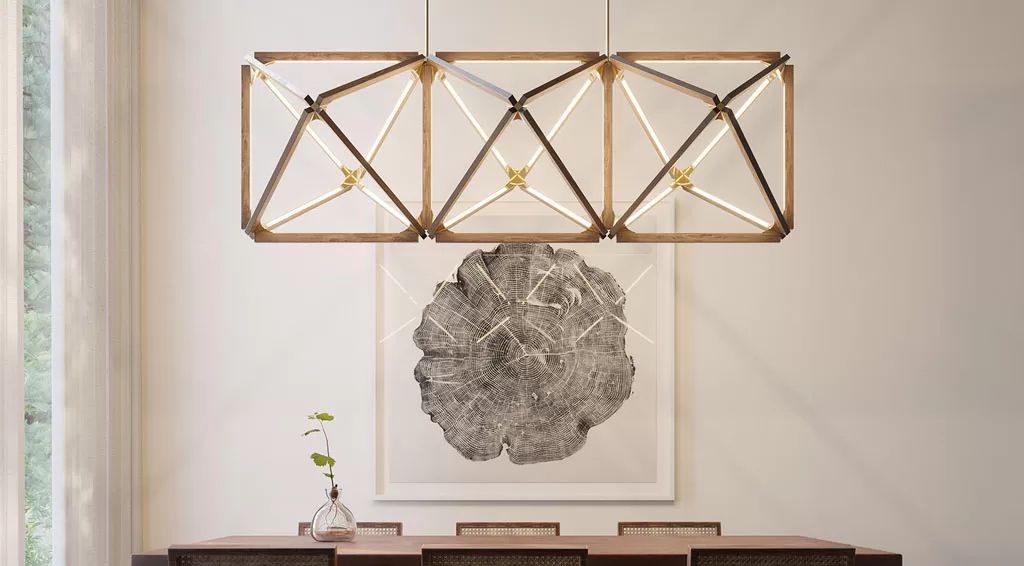
Stickbulb creates contemporary lighting from one of architecture’s oldest and most familiar materials: wood. Designed and made in New York City, the collection combines slender solid-wood elements, integrated LED technology, precision metalwork, and a highly adaptable modular system to create chandeliers, pendant lights, sconces, linear lighting, floor lamps, table lamps, architectural lighting, and custom installations.
What makes Stickbulb particularly distinctive is the story behind the material. Reclaimed heart pine from demolished New York buildings, old-growth redwood salvaged from decommissioned rooftop water towers, wood recovered from New York City’s urban forest, and responsibly sourced American hardwoods transform material that already has a history into sophisticated modern lighting. The result brings the natural warmth and grain of wood into contemporary interiors while demonstrating how thoughtful material choices can become an essential part of good design.
Stickbulb Transforms Simple Wooden Beams and Integrated LED Light into a Distinctive Modern Lighting System
The fundamental Stickbulb idea is remarkably simple.
A slender length of solid wood becomes a source of light.
From that basic element, Stickbulb has developed an extensive vocabulary of contemporary lighting capable of moving from a minimal wall sconce or linear pendant to a dramatic chandelier or monumental custom installation.
This simplicity is part of the collection’s strength.
Rather than hiding wood beneath decorative layers, Stickbulb allows grain, color, knots, reclaimed markings, and natural variation to remain visible. Integrated LED illumination introduces a precise technological counterpoint.
The result feels simultaneously natural and architectural.
Wood provides warmth and individuality. Metal connections provide structure and precision. Light transforms the entire composition.
Reclaimed Wood Gives Stickbulb Lighting a Material History That New Materials Cannot Replicate
Reclaimed wood is central to the Stickbulb story.
The company sources old-growth heart pine from demolished buildings in and around New York City and redwood from decommissioned New York water towers.
These materials have already lived remarkable lives.
Heart pine may retain nail holes, discoloration, dense grain, and other evidence of the building in which it once served. Water tower redwood can reveal deep color and dark veining created through years of exposure to water and the elements.
Stickbulb does not attempt to erase this history.
Instead, these characteristics become part of the finished light.
A contemporary fixture may therefore contain timber that spent decades supporting a New York building or holding water high above the city.
This relationship between past and present gives reclaimed wood lighting an emotional richness that cannot be created through surface decoration alone.
New York City’s Urban Forest Provides Stickbulb with a New Source for Sustainable Contemporary Lighting
Stickbulb has expanded its material research beyond architectural salvage into New York City’s urban forest.
Thousands of trees are removed from the city each year because of age, storms, disease, construction, and other conditions. Historically, much of this material has been chipped or otherwise removed from the useful material stream.
Stickbulb sees another possibility.
Its TREELINE architectural lighting system uses salvaged trees from New York City’s urban forest, turning local material that might otherwise become waste into a sophisticated architectural product.
This creates an unusually direct relationship between place and object.
A tree that once grew along a New York street or within a city park can ultimately become lighting installed in another building within the same city.
The supply chain becomes shorter, more visible, and more meaningful.
Reclaimed Heart Pine, Water Tower Redwood, Maple, Walnut, and Ebonized Oak Give Stickbulb Lighting Distinct Material Personalities
Wood selection dramatically changes the character of a Stickbulb fixture.
Reclaimed heart pine offers red-to-golden-brown coloration, dense old-growth grain, and occasional marks that reveal its architectural past.
Reclaimed water tower redwood brings rich reddish color and the distinctive character of timber exposed to the elements for decades.
Maple has a lighter, more minimal appearance, making it particularly appropriate for pale and restrained interiors.
Walnut introduces a classic deep brown with naturally expressive grain.
Ebonized oak creates an altogether different effect. Its dark finish emphasizes the pronounced grain of American red oak while allowing the fixture to establish a stronger graphic presence within the room.
These choices make wood more than a finish specification.
Material becomes an essential part of the personality of the light.
The Stickbulb Bang and Skybang Collections Turn Linear Wooden Elements into Explosive Sculptural Chandeliers
Bang demonstrates how dramatically Stickbulb’s basic wooden light element can be transformed through composition.
Multiple solid-wood sticks radiate outward from a central connection, creating an energetic chandelier that appears almost to capture an explosion in wood and light.
Boom expands the idea into another dynamic chandelier configuration, while Skybang develops related geometry into suspended compositions with an architectural presence.
The contrast is compelling.
Each individual element is remarkably simple, but when several are brought together the composition becomes complex and sculptural.
This makes Bang and Skybang particularly effective in spaces where lighting needs to become a visual focal point.
Entry halls, dining rooms, staircases, living spaces, hotel lobbies, restaurants, and commercial environments can use the fixtures almost as illuminated sculpture.
The Boom Chandelier Demonstrates How Stickbulb Combines Dramatic Scale with Efficient Flat-Pack Construction
Boom uses twelve solid-wood sticks held by a central steel socket and stem to create a chandelier that casts warm illumination in multiple directions.
Depending on size, its span can reach approximately six feet, giving the fixture enough presence for significant residential and commercial spaces.
Yet the design retains Stickbulb’s emphasis on modular construction.
Boom ships flat-packed, demonstrating how the structural logic of the fixture can simplify transportation as well as assembly.
This combination of drama and efficiency reflects the larger Stickbulb philosophy.
A sustainable approach to lighting is not limited to the origin of the wood. Decisions about components, packaging, transportation, assembly, customization, and eventual disassembly can all influence the environmental impact of a product.
The result is a statement chandelier whose visual complexity grows from a highly rational system.
Chime Combines Repeated Wood Elements and a Curved Steel Ring to Create a Contemporary Chandelier with Natural Rhythm
Chime introduces a softer and more curvaceous expression to Stickbulb’s normally linear vocabulary.
Multiple solid-wood sticks hang from a shaped steel ring, creating a chandelier that feels both architectural and organic.
The repeated wooden elements establish rhythm while casting warm illumination in multiple directions.
Seen from different angles, the composition continually changes as individual sticks overlap, separate, and interact with the surrounding architecture.
Chime can be used individually or combined into double, triple, and larger cascading configurations.
This scalability allows the concept to move from residential dining rooms into larger staircases, hotel lobbies, restaurants, and other significant spaces.
It is a compelling example of how repetition can transform an extremely simple element into a sophisticated lighting composition.
Bough and Branching Bough Translate the Organic Structure of Tree Branches into Modern Wood Lighting
Bough explores one of the most natural references for a lighting company working primarily in wood: the branching structure of a tree.
Slender wood and metal elements extend through space in dynamic compositions, creating fixtures that feel organic without literally imitating nature.
Branching Bough develops the concept further through arrangements reminiscent of limbs extending from a central branch.
The relationship between material and form is particularly effective.
Because the elements are made from real wood, the reference to trees feels inherent rather than decorative.
At the same time, precision connections and integrated illumination keep the fixtures distinctly contemporary.
Bough works particularly well over dining tables, kitchen islands, conference tables, and other spaces where a linear chandelier can establish a strong architectural presence without becoming visually heavy.
Stickbulb Linear Pendants Bring Warm Wood and Minimal LED Lighting to Dining Tables, Kitchen Islands, and Workspaces
The Linear collection reduces Stickbulb to its most elemental architectural expression.
A long wooden light source creates a clean horizontal line within the interior.
This simplicity makes linear Stickbulb pendants especially useful over dining tables, kitchen islands, desks, conference tables, bars, reception counters, and other elongated surfaces.
The wood softens what might otherwise feel like a purely technical lighting solution.
Instead of an anonymous aluminum extrusion, the fixture introduces natural grain, warmth, and subtle material variation.
Different lengths allow the scale of the light to respond to the furniture and architecture.
For interior designers, this makes the Linear collection an effective way to combine the visual restraint of architectural lighting with the tactile character of natural material.
Ray Sconces Reduce Stickbulb Lighting to a Minimal Expression of Wood, Metal, and Light
Ray demonstrates how little material is required to create a compelling wall light.
A small precision metal component holds a solid wooden LED element either vertically or horizontally against the wall.
The design intentionally minimizes everything except the wood itself.
With the hardware visually restrained, attention shifts to grain, proportion, finish, and the warm illumination surrounding the fixture.
Ray is offered in multiple lengths, allowing it to operate as a compact accent or a much stronger architectural line.
This flexibility makes the sconce particularly useful in hallways, bedrooms, bathrooms, living spaces, hospitality interiors, and commercial environments.
Installed in multiples, Ray can also create rhythm across a large wall or corridor.
The result is architectural lighting reduced to its essentials.
Torch Table and Floor Lamps Bring Stickbulb’s Modern Wood Lighting into Portable Residential Applications
Stickbulb’s Torch collection translates the brand’s architectural vocabulary into freestanding lighting.
Table and floor versions bring the illuminated wood element closer to furniture and everyday life, allowing Stickbulb to create atmosphere without requiring a permanent ceiling or wall installation.
This makes Torch particularly useful in living rooms, bedrooms, reading areas, hospitality lounges, and other spaces where softer layers of illumination are important.
The form remains unmistakably Stickbulb.
Wood is both structure and visual focus, while integrated LED technology allows the profile to remain clean and minimal.
Portable lighting also demonstrates the versatility of the original Stickbulb concept.
The same basic relationship between solid wood and light can move from a compact table lamp to a chandelier spanning several feet without losing its identity.
The Pleat Collection Combines Salvaged New York Wood with Traditional Japanese Kozo Paper
Pleat introduces a fascinating new material dialogue into the Stickbulb collection.
The modular lighting system brings together two materials derived from trees but shaped by very different cultural traditions: salvaged wood from New York City’s urban forest and traditional Kozo paper made from mulberry tree bark in Yoshinogawa, Japan.
Angular wooden frames provide structure while bands of light glow through the organic texture of the Kozo paper.
The paper is carefully folded by hand in Stickbulb’s New York City studio.
The resulting fixtures balance opposites.
Their structure can feel strong and architectural, while the illuminated paper creates warmth, softness, and atmosphere.
Pleat demonstrates how Stickbulb’s exploration of sustainable materials continues to evolve beyond reclaimed timber alone, introducing traditional craft into dialogue with contemporary lighting technology and New York manufacturing.
Pillar Expands Stickbulb’s Modular Lighting Language Through Wood Grain and Concentrated Points of Light
The Pillar collection offers another evolution of Stickbulb’s modular approach.
Rather than emphasizing a continuous line of illumination, Pillar brings concentrated points of light together with richly grained wood.
The relationship creates a different visual rhythm from Stickbulb’s earlier linear systems.
Wood remains essential, but light becomes a series of precise moments within the larger composition.
Because Pillar is modular, individual elements can be organized into configurations suited to different architectural conditions.
This makes the collection particularly relevant for designers who appreciate Stickbulb’s material philosophy but want another way to introduce scale, repetition, and pattern.
Pillar reinforces an idea that runs throughout the brand: a relatively small number of carefully designed components can create an extraordinary range of lighting experiences.
TREELINE Architectural Lighting Brings Salvaged Urban Wood into High-Performance Commercial Interiors
Stickbulb’s TREELINE collection moves the company’s material philosophy directly into architectural lighting.
Developed using salvaged pin oak from New York City’s urban forest, TREELINE turns locally recovered wood into a linear architectural lighting system.
The collection offers direct, indirect, and combined lighting possibilities, allowing wood to become part of the functional lighting infrastructure of offices, hospitality spaces, commercial interiors, and other architectural projects.
This represents an important development in sustainable lighting.
Reclaimed and salvaged materials are often associated primarily with decorative products. TREELINE demonstrates that recovered wood can also become part of a technically sophisticated architectural system.
For architects and lighting designers, it creates an alternative to conventional linear fixtures while introducing natural material and a compelling local supply-chain story into commercial interiors.
Custom Stickbulb Lighting Can Be Configured to Respond to Architecture at Almost Any Scale
Modularity gives Stickbulb extraordinary custom potential.
The company compares its collection of wooden light elements to a large-scale construction set: individual components can be combined and configured according to the requirements of a particular space.
Wood stain, color, and length can be customized, while larger bespoke compositions can respond directly to architecture.
This is particularly valuable in double-height rooms, staircases, hotel lobbies, restaurants, offices, galleries, and significant residential interiors where a standard chandelier may not provide the appropriate scale.
Custom installations can expand horizontally, descend vertically, cluster densely, or create more open compositions.
Rather than placing a predetermined object into the architecture, designers can use Stickbulb’s modular language to create lighting that belongs specifically to the space.
Stickbulb Gives Architects and Lighting Designers the Digital Resources Needed for Professional Specification
Successful architectural lighting requires more than an appealing photograph.
Designers need accurate technical information to understand scale, performance, installation, and the relationship between a fixture and the surrounding architecture.
Stickbulb supports professional specification with technical resources for many of its decorative and architectural products, including specification sheets and digital models.
Selected collections provide 3D and Revit resources, while architectural products such as TREELINE include additional photometric and specification information.
These resources make the collection easier to integrate into architectural and interior design workflows.
For Scott + Cooner’s professional clients, this combination of expressive design and specification support is particularly valuable.
A fixture can be considered not only as a decorative object but as part of the larger lighting, furniture, and architectural plan.
Stickbulb’s Climate-Conscious Design Philosophy Begins with Material Selection and Extends Through the Entire Product
Sustainability is not treated as a separate aesthetic category at Stickbulb.
It is embedded in the design process.
The brand works extensively with reclaimed and salvaged wood, local suppliers, modular construction, and flat-pack design to reduce its overall environmental footprint.
Stickbulb has also worked with Climate Neutral to track, reduce, and offset emissions and became a Certified B Corporation in 2022.
The company’s New York City location further supports its hyper-local approach.
Its showroom, studio, and workshop operate together in a century-old factory building in Long Island City, bringing design and production into close proximity.
This allows sustainability to become tangible.
The history of the wood, location of fabrication, efficiency of components, and adaptability of the finished fixture can all become part of the same design decision.
Made in New York City Gives Stickbulb Lighting a Distinct Connection to Local Materials and Craftsmanship
Stickbulb’s identity is inseparable from New York City.
The company designs and constructs its lighting in Long Island City, working within a network of local craftspeople and suppliers.
Even more unusually, some of its materials come directly from the city itself.
Reclaimed timber may originate in demolished New York buildings or rooftop water towers. Urban wood can come from trees removed from city streets and parks.
This creates a remarkably local material loop.
Instead of designing in one country, sourcing material in another, manufacturing elsewhere, and shipping through multiple intermediaries, Stickbulb has developed opportunities to connect design, material recovery, craftsmanship, and production within the same city.
For clients interested in American-made contemporary lighting, that local story gives Stickbulb a particularly distinctive identity.
Stickbulb Chandeliers and Pendants Create Sculptural Focal Points for Contemporary Residential Interiors
Stickbulb lighting can change character dramatically according to scale.
A Linear pendant can provide restrained illumination over a dining table or kitchen island. A Ray sconce can almost disappear into the architecture while emphasizing the natural grain of the wood.
At the other extreme, Boom, Skybang, Chime, Bough, and larger multi-fixture compositions can become defining sculptural elements.
This flexibility makes Stickbulb particularly appropriate for contemporary residences.
Fixtures can complement natural materials such as stone, concrete, metal, glass, and wood while adding warmth to minimalist architecture.
The collection can also provide an effective counterpoint to upholstered furniture and textiles.
Because the designs are visually strong but materially straightforward, they can coexist with significant furniture and artwork without requiring the entire room to follow a particular decorative style.
Restaurants, Hotels, Offices, and Contract Interiors Use Stickbulb Lighting to Combine Identity with Natural Material
Wood can introduce an important sense of warmth into commercial environments.
In restaurants and hospitality spaces, it helps soften hard architectural materials and create a more welcoming atmosphere. Within offices, natural material can provide a counterpoint to technology, glass, metal, and standardized workplace systems.
Stickbulb adds light to that equation.
Decorative chandeliers can become memorable focal points in lobbies, restaurants, reception areas, and gathering spaces, while linear and architectural systems can address more functional lighting requirements.
Custom configurations provide another advantage.
Designers can adjust scale and composition to suit the architecture rather than relying exclusively on standard fixtures.
For commercial interiors seeking distinctive contemporary lighting with an environmental and material story, Stickbulb provides an unusually coherent combination of design, craft, technology, and sustainability.
Discover Stickbulb Modern Wood Lighting, Reclaimed Wood Chandeliers, Pendants, and Custom Installations at Scott + Cooner
Scott + Cooner offers Stickbulb as part of our curated collection of exceptional contemporary lighting and international design.
Since 1995, Scott + Cooner has worked with architects, interior designers, and design-conscious clients seeking extraordinary modern furniture, lighting, kitchens, closets, rugs, and accessories for sophisticated residential and contract interiors.
Our experienced team can help you explore Stickbulb chandeliers, pendants, sconces, linear lighting, table lamps, floor lamps, architectural lighting, reclaimed woods, sustainably sourced hardwoods, metal finishes, dimensions, configurations, and custom possibilities for your project.
Whether you’re searching for a dramatic Skybang or Boom chandelier, a Chime installation, Bough pendant, minimal Ray sconce, Linear pendant, TREELINE architectural system, or a completely custom lighting composition, Scott + Cooner can help you discover Stickbulb and bring the warmth of wood, modern LED technology, and thoughtful sustainable design into your interior.