

Tacchini Luxury Italian Furniture, Iconic Design Re-Editions & Contemporary Living
Tacchini creates luxury Italian furniture that brings the great history of modern design into conversation with contemporary living. Founded in Brianza in 1967, the company combines Made in Italy craftsmanship, sophisticated upholstery, exceptional materials, archival research, and collaborations with leading international designers to create sofas, armchairs, chairs, tables, lighting, rugs, accessories, and collectible design pieces with lasting relevance.
What makes Tacchini particularly distinctive is the relationship it creates between memory and innovation. Contemporary furniture by designers such as Faye Toogood, Studiopepe, Jonas Wagell, PearsonLloyd, and others exists alongside carefully researched re-editions of important works by Mario Bellini, Gianfranco Frattini, Tobia Scarpa, Joe Colombo, Achille and Pier Giacomo Castiglioni, Vico Magistretti, Martin Eisler, Gastone Rinaldi, Carlo De Carli, Cini Boeri, and Umberto Riva. Together, these pieces create an evolving portrait of Italian design in which the past is not preserved behind glass but returned to everyday life.
Tacchini Has Created Timeless Italian Furniture in Brianza Since 1967
Tacchini was founded by Antonio Tacchini in 1967 in Seveso, at the heart of Brianza, one of Italy’s most important furniture-making regions.
The company began as a carpentry workshop before evolving into an internationally recognized furniture brand.
That origin remains meaningful.
Brianza developed an extraordinary network of woodworkers, upholsterers, furniture makers, suppliers, craftspeople, and specialist manufacturers over generations. Tacchini continues to draw upon this local culture of making, combining traditional knowledge with contemporary manufacturing and design.
The company has grown dramatically since its beginnings, but its fundamental values remain closely connected to craftsmanship, material quality, innovation, and careful execution.
This foundation gives Tacchini the ability to create contemporary furniture while also understanding the techniques and construction required to faithfully return important historical designs to production.
Made in Italy Craftsmanship Gives Tacchini Furniture Its Distinctive Material and Upholstered Character
Made in Italy at Tacchini represents more than a geographic label.
It reflects a relationship between design and the specialized craft knowledge required to turn an idea into an exceptional piece of furniture.
This is particularly visible in upholstery.
The curves of a sofa, tension of fabric across a seat, softness of a cushion, precision of stitching, construction of an internal frame, and relationship between upholstery and exposed structure all contribute to the finished object.
Tacchini combines these skills with carefully selected wood, metal, stone, glass, leather, textiles, and other materials.
The result is furniture that rewards close inspection.
A Tacchini sofa may first be recognized for its silhouette, but its long-term appeal comes from the relationship between proportion, comfort, material, and detail.
Tacchini Brings Iconic Italian Design Re-Editions Back into Contemporary Interiors
Re-editions have become one of the defining elements of Tacchini’s identity.
Rather than treating historic furniture as museum pieces, Tacchini researches significant designs and returns selected works to production so they can become part of contemporary life again.
The program began around 2010 and has developed into an extraordinary collection of furniture by some of the most important figures in 20th-century design.
Mario Bellini, Gianfranco Frattini, Tobia Scarpa, Joe Colombo, Achille Castiglioni, Pier Giacomo Castiglioni, Vico Magistretti, Cini Boeri, Gastone Rinaldi, Umberto Riva, Martin Eisler, Carlo De Carli, and others are represented.
Each re-edition creates a dialogue across generations.
The original design retains its historical identity while renewed materials, production knowledge, and contemporary context allow it to be experienced anew.
Giusi Tacchini Has Turned Archival Research and Design History into an Essential Part of the Tacchini Identity
Under CEO and Art Director Giusi Tacchini, the company has developed an unusually personal approach to design history.
Her interest in archaeology and historical research informs the search for forgotten or underappreciated furniture.
Archives, drawings, photographs, prototypes, and the stories surrounding individual objects become starting points for rediscovery.
This gives Tacchini’s re-edition program intellectual depth.
The objective is not simply to identify recognizable vintage forms and manufacture them again.
Instead, the company considers the designer, period, original intention, construction, materials, and cultural context of each piece.
The resulting furniture allows important ideas from the history of design to circulate again—not as nostalgia, but as active participants in contemporary interiors.
Mario Bellini’s Le Mura Sofa Returns a Radical 1970s Italian Design to Contemporary Living
Le Mura by Mario Bellini is one of the most significant designs within the Tacchini re-edition collection.
Originally conceived in the 1970s, the modular seating system takes its name from the large stones used in ancient Roman walls.
Individual upholstered elements are brought together to form larger compositions, transforming the sofa into a kind of soft domestic architecture.
The concept remains remarkably contemporary.
Modules allow the seating arrangement to respond to different rooms and changing ways of living, while the generous upholstered forms create a powerful sculptural presence.
Tacchini’s re-edition brings Bellini’s original idea into a new generation of interiors while preserving the strength that made the design important in the first place.
The expanded Le Mura XL further develops the concept with increased depth and an even more relaxed interpretation of comfort.
Gianfranco Frattini’s Sesann Sofa Has Become One of Tacchini’s Most Recognizable Italian Design Re-Editions
Sesann by Gianfranco Frattini embodies the tension between softness and structure that makes many great upholstered designs memorable.
Generous cushions appear to be held within a visible architectural framework, allowing the sofa’s construction to become part of its identity.
The contrast is both functional and visual.
Soft upholstery communicates comfort, while the surrounding structure gives the composition definition and rhythm.
Tacchini has extended the Sesann language across seating while preserving the qualities that connect the collection to Frattini’s original vision.
Grand Sesann further explores the scale and expressive possibilities of the design.
For contemporary interiors, Sesann provides something increasingly valuable: unmistakable personality without dependence on a passing trend.
Joe Colombo’s Additional System Demonstrates the Radical Flexibility of 20th-Century Italian Furniture Design
Joe Colombo imagined interiors that could adapt to changing human behavior.
The Additional System reflects this experimental approach through modular upholstered elements that can be combined into different seating configurations.
Rather than treating a sofa as a fixed object with a predetermined front, back, and composition, the design approaches seating as a flexible landscape.
Tacchini’s re-edition allows this forward-looking idea to return to contemporary interiors.
The concept feels particularly relevant today.
Open-plan spaces, informal living, hospitality environments, and multifunctional rooms increasingly require furniture capable of adapting rather than simply occupying a fixed position.
Additional System demonstrates how radical ideas from 20th-century Italian design can remain remarkably useful decades after they were conceived.
Tobia Scarpa’s Furniture for Tacchini Connects Architectural Thinking with Italian Craftsmanship
Tobia Scarpa occupies an important position within Tacchini’s exploration of historic Italian design.
Pieces including Africa and Sempronia, together with newly reintroduced designs such as Artona, Dialogo, Basilan, and Pigreco, reveal a designer deeply attentive to structure, material, and construction.
Wood plays a particularly important role.
Rather than functioning merely as a decorative finish, it often communicates how a chair is built and how individual components relate to one another.
This structural clarity gives Scarpa’s furniture an architectural character.
The designs can appear straightforward from a distance, yet their proportions, joints, profiles, and material transitions reveal remarkable sophistication when examined more closely.
Tacchini’s re-editions allow these details to be appreciated by a new generation of architects, designers, collectors, and clients.
Tacchini Re-Editions by Achille Castiglioni, Vico Magistretti, Martin Eisler, and Other Masters Expand the History of Modern Design
Tacchini’s archival collection extends well beyond a single period or design movement.
Babela by Achille and Pier Giacomo Castiglioni played an important role in initiating the company’s re-edition program.
Sancarlo represents Achille Castiglioni’s unconventional approach to seating, while works by Vico Magistretti, Cini Boeri, Gastone Rinaldi, Carlo De Carli, Martin Eisler, and other designers broaden the historical conversation.
Brazilian-born Martin Eisler’s Costela and Reversível, for example, bring another cultural perspective into the collection.
Lighting by Umberto Riva and other historic designs further expand Tacchini beyond conventional upholstery.
Together, these works create something more meaningful than a catalog of vintage furniture.
They form a living archive of ideas about comfort, structure, materials, technology, and domestic life.
Contemporary Tacchini Sofas Combine Sculptural Form, Material Richness, and Exceptional Comfort
Tacchini’s contemporary sofas are as important to its identity as its historical re-editions.
The company approaches the sofa as both a place of comfort and a defining element within the architecture of a room.
Collections such as Julep, Roma, Roma Nuvola, Solar, Butter, Victoria, Quilt, Montevideo, and others explore very different silhouettes and ways of sitting.
Some are soft and curvaceous.
Others use stronger architectural lines or modular structures. Upholstery can emphasize volume, while visible frames and bases create contrast.
What connects them is a search for furniture capable of remaining visually relevant while supporting everyday life.
The sofa is not treated as sculpture at the expense of comfort.
Instead, Tacchini attempts to bring the two together.
Faye Toogood Brings Expressive Softness and Sculptural Form to Contemporary Tacchini Furniture
Faye Toogood’s work for Tacchini introduces an especially expressive contemporary voice.
Her furniture often begins with form and physical sensation rather than conventional furniture typologies.
Softness becomes sculptural.
Volumes feel generous and almost elemental, while rounded profiles create furniture with an immediate emotional presence.
The Solar collection demonstrates this approach, and the expanded Solar XL develops its generous seating experience further.
Butter evolves the idea into a broader modular furniture family, bringing Toogood’s characteristic softness into sofas, armchairs, ottomans, tables, and storage.
These pieces create an intriguing dialogue with Tacchini’s historic re-editions.
Both contemporary and archival furniture can be bold, but their boldness emerges from different cultural moments and design languages.
Studiopepe Brings Contemporary Milanese Design, Material Research, and Expressive Color to Tacchini
Studiopepe contributes a distinctly contemporary Milanese perspective to the Tacchini collection.
Founded by Arianna Lelli Mami and Chiara Di Pinto, the multidisciplinary studio works across interiors, products, installations, and creative direction.
Its furniture often combines geometric clarity with unexpected materials, colors, and references.
For Tacchini, Studiopepe has developed pieces that extend across different furniture categories, allowing individual objects to become part of a larger interior vocabulary.
The collaboration also includes rugs, introducing another layer of texture, geometry, and materiality into the Tacchini world.
This is important to the brand’s evolution.
Tacchini is no longer simply a producer of upholstered furniture.
It increasingly creates a complete environment in which seating, tables, lighting, rugs, objects, and accessories interact.
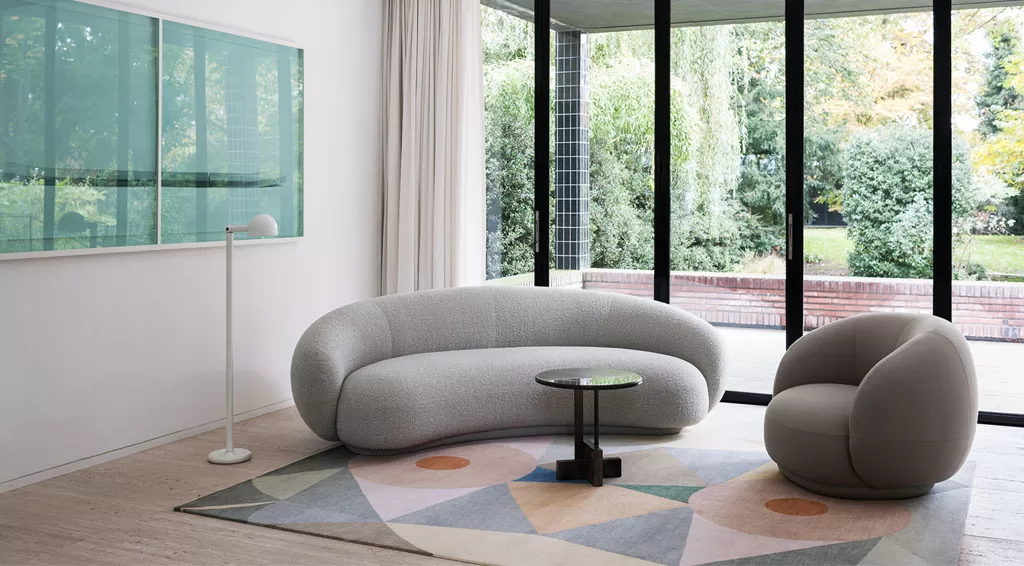
Julep by Jonas Wagell Demonstrates the Soft and Welcoming Side of Contemporary Italian Upholstery
Julep by Jonas Wagell has become one of Tacchini’s most recognizable contemporary seating collections.
Its generous curves and continuous upholstered forms create an inviting silhouette with very little visual hardness.
The design feels relaxed but controlled.
Its softness is balanced by carefully considered proportions, allowing the sofa to work in sophisticated residential and hospitality interiors without becoming visually heavy.
Julep demonstrates how Tacchini can create contemporary furniture with a strong personality while avoiding unnecessary complexity.
The silhouette is immediately recognizable, yet the design remains flexible enough to coexist with very different architecture, art, materials, and surrounding furniture.
This balance between identity and versatility is one of the collection’s greatest strengths.
Tacchini Armchairs Turn Comfort, Upholstery, and Design History into Sculptural Seating
The armchair is one of Tacchini’s richest categories.
Historic re-editions and contemporary designs sit side by side, creating a remarkable range of approaches to individual seating.
Le Mura, Additional System, Costela, Reversível, Sancarlo, Sella, Agnese, Orsola, and other archival designs represent different moments in the evolution of modern seating.
Contemporary pieces introduce new ideas about softness, material, volume, and comfort.
Because an armchair occupies less visual territory than a sofa, it can often take greater formal risks.
A distinctive Tacchini chair can become a focal point within a living room, bedroom, library, hotel suite, lobby, or executive interior.
Used in pairs or groups, these designs can establish intimate conversation areas within larger architectural spaces.
Tacchini Chairs and Stools Bring Italian Design History to Dining and Contemporary Living Spaces
Dining chairs reveal another side of the Tacchini collection.
Designs such as Babela, Africa, Sempronia, Dialogo, Basilan, Pigreco, and others emphasize structure, proportion, woodcraft, and the relationship between the body and frame.
Compared with upholstered lounge furniture, dining chairs are often visually lighter.
This makes every line and joint more important.
Tacchini’s historic re-editions demonstrate how designers such as Achille and Pier Giacomo Castiglioni and Tobia Scarpa approached these challenges with very different ideas.
Contemporary additions allow the category to continue evolving.
For architects and interior designers, these chairs offer an opportunity to introduce significant design history into everyday spaces without turning the interior into a museum.
They are objects meant to be used.
Tacchini Tables and Side Tables Explore the Boundary Between Functional Furniture and Sculpture
Tables give Tacchini another opportunity to explore material and form beyond upholstery.
Dining tables, coffee tables, side tables, consoles, and occasional pieces can introduce stone, wood, metal, glass, lacquer, and other surfaces into an interior.
Some designs remain deliberately restrained, providing quiet support to more expressive seating.
Others move closer to sculpture.
Limited-edition pieces and experimental collections demonstrate Tacchini’s interest in objects that exist somewhere between furniture, art, and micro-architecture.
This tension is particularly effective in contemporary interiors.
A sculptural side table can introduce material contrast beside a soft sofa, while a substantial dining table can establish the architectural center of a room.
The furniture remains functional, but function does not limit expression.
Tacchini Lighting, Rugs, and Accessories Create a More Complete Vision of Contemporary Italian Living
Tacchini’s collection increasingly extends beyond furniture into a wider world of interior objects.
Lighting includes both contemporary designs and historical re-editions, allowing illumination to participate in the same dialogue between past and present found throughout the furniture collection.
Rugs introduce pattern, geometry, texture, and softness at the architectural scale of the floor.
Accessories and decorative objects provide more intimate opportunities for material experimentation.
Together, these categories allow Tacchini to create complete environments rather than isolated pieces of furniture.
This broader approach is expressed particularly clearly through Casa Tacchini in Milan, where re-editions and contemporary pieces coexist within the setting of a private residence.
The result presents Tacchini not simply as furniture to purchase, but as a culture of living.
Casa Tacchini in Milan Presents Furniture, Lighting, and Objects as Part of a Complete Domestic World
Located in Milan’s Brera district, Casa Tacchini presents the collection within the intimate atmosphere of a home.
This context is important.
Furniture is experienced differently in a domestic environment than in a conventional showroom.
A sofa relates to a rug, table, lamp, artwork, wall, and neighboring chair. Historic designs can sit beside contemporary pieces, revealing unexpected relationships across decades.
Casa Tacchini makes the company’s central idea tangible.
The past and present do not need to occupy separate rooms.
A Mario Bellini sofa, a contemporary Faye Toogood design, a historic lamp, and a new table can all participate in the same interior when connected through material, proportion, color, and atmosphere.
This layered approach makes Tacchini particularly relevant to sophisticated residential design.
Tacchini Flock Replaces Conventional Upholstery Foam with Sheep’s Wool in a New Approach to Sustainable Furniture
Tacchini’s sustainability work is especially compelling when it becomes part of the physical construction of furniture.
The Tacchini Flock project, developed with Formafantasma, reconsiders what happens beneath the upholstery.
Inspired by traditional mattress-making techniques, the project uses surplus sheep’s wool as a natural alternative to conventional industrial foam in selected seating designs.
The innovation is largely invisible.
The exterior character of an iconic piece can remain familiar while the internal material system is reconsidered.
This makes Flock particularly significant.
Sustainable design does not always require furniture to look overtly ecological or experimental.
Sometimes the most important changes occur inside the object, where material choices can be improved without sacrificing the design that made the furniture valuable in the first place.
Environmental Responsibility, Local Craftsmanship, and Material Research Shape Tacchini’s Approach to Sustainable Design
Tacchini connects sustainability to the larger responsibilities of furniture production.
The company emphasizes local resources and the specialist knowledge of the Brianza furniture district while continually researching materials and manufacturing methods.
Its environmental management system is ISO 14001 certified, providing a structured framework for reducing environmental impact across production.
Projects such as Tacchini Flock demonstrate how this philosophy can lead to specific material innovation.
Re-editions offer another perspective on sustainability.
Returning an exceptional historical design to production reinforces the idea that furniture can possess cultural and aesthetic value for generations rather than becoming obsolete with each new trend.
Longevity, repairability, material quality, and enduring design all contribute to a more thoughtful relationship with objects.
Limited Editions Transform Selected Tacchini Furniture into Collectible Contemporary Design
Tacchini’s limited-edition program occupies a fascinating space between furniture and collectible design.
Selected historical and contemporary pieces are produced in restricted quantities, allowing unusual materials, finishes, or interpretations to be explored at a level that differs from standard production.
Grand Sesann, for example, has been presented in a limited re-edition, while pieces such as Torso and special interpretations of Tobia Scarpa’s Pigreco demonstrate other approaches to collectibility.
Limited editions emphasize the cultural dimension of Tacchini’s work.
A chair or table remains functional, but rarity, provenance, designer significance, and material execution introduce another layer of meaning.
For collectors and highly considered interiors, these pieces can operate simultaneously as usable furniture and significant design objects.
Tacchini Furniture Creates Distinctive Residential, Hospitality, and Contract Interiors
Tacchini’s combination of comfort, design history, material sophistication, and strong visual identity makes the collection particularly adaptable to professional interiors.
In residential projects, sofas and armchairs can establish highly personal living environments.
Dining chairs and tables bring significant design into spaces used every day, while lighting, rugs, and accessories create additional layers.
Hospitality environments benefit from the collection’s emotional character.
A memorable lounge, hotel suite, restaurant, or reception area often depends upon furniture that feels different from standardized contract products.
Tacchini provides designers with pieces that possess recognizable identities while remaining functional and comfortable.
Historic re-editions can introduce cultural depth, while contemporary designs provide an opportunity to create interiors that feel firmly connected to the present.
Discover Tacchini Luxury Italian Furniture, Iconic Sofas, Armchairs, and Design Re-Editions at Scott + Cooner
Scott + Cooner offers Tacchini as part of our curated collection of exceptional contemporary Italian furniture and international design.
Since 1995, Scott + Cooner has worked with architects, interior designers, and design-conscious clients seeking extraordinary modern furniture, lighting, kitchens, closets, rugs, and accessories for sophisticated residential and contract interiors.
Our experienced team can help you explore Tacchini sofas, armchairs, lounge chairs, dining chairs, tables, side tables, lighting, rugs, accessories, upholstery, materials, finishes, contemporary collections, historic re-editions, and limited-edition designs for your project.
Whether you’re searching for Mario Bellini’s Le Mura, Gianfranco Frattini’s Sesann, Joe Colombo’s Additional System, a Tobia Scarpa re-edition, Jonas Wagell’s Julep, contemporary furniture by Faye Toogood or Studiopepe, or simply exceptional Italian furniture that brings together craftsmanship and design history, Scott + Cooner can help you discover Tacchini and create an interior where past, present, comfort, and culture exist in conversation.