

Tom Dixon British Designer Lighting, Contemporary Furniture & Extraordinary Objects
Tom Dixon creates distinctive British lighting, contemporary furniture, and extraordinary objects defined by experimentation, material innovation, sculptural form, and an unmistakable industrial sensibility. Established in 2002, the London-based design brand has grown from the singular vision of designer Tom Dixon into an internationally recognized collection spanning pendant lights, chandeliers, floor and table lamps, portable lighting, sofas, lounge chairs, dining chairs, tables, outdoor furniture, rugs, glassware, accessories, and objects for contemporary living.
From the molten appearance of Melt and the hand-beaten brass surfaces of Beat to sculptural furniture such as Wingback, Slab, and Fat, Tom Dixon transforms familiar materials through unexpected processes and bold ideas. Brass, copper, steel, marble, glass, polycarbonate, wood, and textiles become the foundation for products that feel simultaneously industrial and luxurious, experimental and functional, distinctly British and internationally relevant.
Tom Dixon Has Built a Distinctive British Design Language Around Experimentation, Materials, and the Unexpected
Tom Dixon’s career did not begin through a conventional path into industrial design.
He emerged in London during the 1980s as a self-taught designer experimenting with welded salvage furniture. This unconventional beginning established an attitude toward making that continues to influence the brand today.
Materials are rarely accepted at face value.
Metal can be hammered, polished, pressed, plated, spun, or transformed into highly reflective surfaces. Polycarbonate can resemble molten glass. Marble becomes illumination. Traditional craft techniques can be combined with contemporary industrial processes.
The objective is not novelty for its own sake.
Experimentation is used to reveal something unexpected about an otherwise familiar material or object.
This approach has allowed Tom Dixon to create a design language that remains recognizable even as individual collections differ dramatically in form.
Established in 2002, Tom Dixon Has Grown into an International British Lighting and Furniture Brand
The Tom Dixon brand was established in 2002 and has developed into a global design company specializing in lighting, furniture, and accessories.
Its British identity remains central.
The collection is designed from the company’s London studio, yet its influences, materials, craftspeople, production methods, and audience are international.
This balance gives Tom Dixon an unusual position within contemporary design.
The brand can draw inspiration from Britain’s industrial history, club culture, engineering, architecture, and decorative traditions while working with craftspeople and manufacturing technologies around the world.
The result is a collection that does not attempt to define British design through nostalgia.
Instead, it continually asks what British design can become next.
Tom Dixon Lighting Transforms Functional Illumination into Sculptural Objects for Contemporary Interiors
Lighting has become one of the most recognizable parts of the Tom Dixon collection.
The studio approaches a light fixture as both a source of illumination and a physical object with its own material, silhouette, reflection, and presence.
This creates lighting that remains visually compelling even when switched off.
A Melt pendant becomes a mirrored organic sculpture.
Beat reveals the marks of traditional metalworking. Copper captures and distorts its surroundings through a highly reflective surface, while Stone uses the extraordinary translucency and natural pattern of marble.
These qualities allow Tom Dixon lighting to operate at several levels simultaneously.
It illuminates the room, contributes to the architecture, introduces material richness, and often becomes a focal point in its own right.
The Iconic Melt Collection Creates the Appearance of Molten Glass Through Advanced Manufacturing Technology
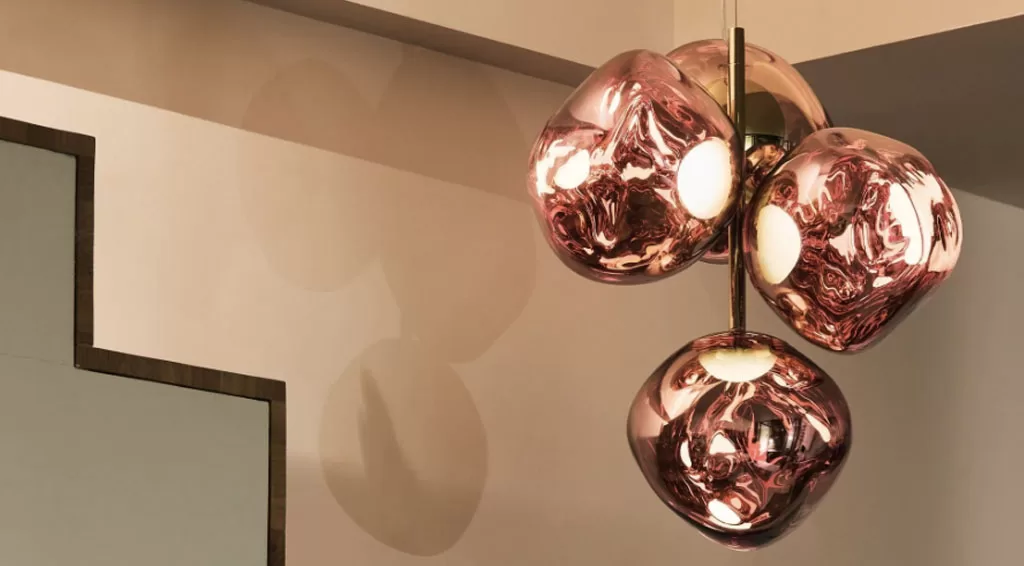
Melt has become one of Tom Dixon’s most recognizable lighting families.
Its distorted organic form appears almost as though a sphere of molten material has been frozen in the middle of transformation.
The effect changes dramatically with illumination.
When switched off, many Melt finishes have a highly reflective, mirror-like appearance. When illuminated, the surface becomes translucent and reveals a rich internal glow.
Despite its resemblance to hot-blown glass, Melt is produced using advanced polycarbonate manufacturing and finishing techniques.
This contrast between appearance and reality is fundamental to the design.
The material looks fluid and handmade, yet its creation depends upon sophisticated contemporary technology.
The collection has expanded into pendants, chandeliers, surface lights, floor lights, table lights, and portable lamps, allowing the same distinctive optical effect to work at many different scales.
Melt Chandeliers and Pendant Lights Create Dramatic Sculptural Focal Points Through Reflection and Organic Form
The expressive form of Melt becomes particularly powerful when multiple lights are grouped together.
Individual pendants can provide a concentrated moment above a dining table, kitchen island, bedside table, or seating area.
Larger chandeliers transform repeated Melt forms into luminous compositions.
Because each shade is reflective when unlit and glowing when illuminated, clusters create an unusually complex interaction between the individual fixtures and the room surrounding them.
Reflections multiply.
Adjacent shades appear within one another. Furniture, architecture, and people become temporarily visible across the polished surfaces.
This makes Melt particularly effective in spaces where lighting is expected to create drama: dining rooms, double-height living areas, staircases, hotel lobbies, restaurants, bars, and hospitality interiors.
Beat Lighting Combines Contemporary British Design with Traditional Indian Brass Craftsmanship
Beat demonstrates another side of Tom Dixon’s fascination with making.
The collection is closely associated with traditional brass-working techniques in northern India, where skilled artisans shape and finish the metal by hand.
Rather than eliminating the marks of production, the design celebrates them.
The dark exterior creates a strong graphic silhouette, while the warm metallic interior reflects illumination and reveals the material character of the shade.
Different Beat shapes can be used individually or combined into clusters.
Tall, wide, fat, and other profiles establish different proportions while retaining a recognizable family resemblance.
This makes Beat especially useful above dining tables, kitchen islands, bars, reception desks, and hospitality spaces where designers want repeated forms without complete uniformity.
Copper Lighting Turns a Familiar Industrial Metal into a Highly Reflective Contemporary Pendant
Copper has been fundamental to Tom Dixon’s material vocabulary.
The Copper lighting family transforms the warm metal into a highly reflective surface that captures the surrounding environment.
Instead of behaving like a conventional opaque shade, the polished form interacts continuously with the room.
Architecture, furniture, light, and movement appear across its curved surface in distorted reflections.
This gives Copper unusual visual depth.
The object changes depending upon where it is installed and what surrounds it.
Used individually, the pendant provides a strong metallic accent.
Grouped together, multiple Copper lights create a more immersive field of reflection and warm color.
The result demonstrates Tom Dixon’s ability to make material itself the primary decorative element.
Mirror Ball Reinterprets the Familiar Reflective Sphere Through an Industrial Design Perspective
Mirror Ball takes an immediately recognizable form and transforms it through contemporary manufacturing and reflective technology.
Its spherical silhouette is elemental, but its polished surface creates a constantly changing visual experience.
Like many Tom Dixon lights, Mirror Ball is as concerned with reflection as illumination.
The room becomes part of the object.
Its surroundings appear across the curved surface, giving the fixture a different character in every interior.
Multiple sizes allow Mirror Ball to be used individually or arranged into clusters and chandeliers.
The simple geometry makes these compositions especially effective because repetition strengthens rather than complicates the design.
Mirror Ball can therefore move comfortably between residential interiors, restaurants, hotels, retail environments, and larger architectural spaces.
Stone Lighting Uses Marble to Create a Soft and Unexpected Expression of Illumination
Stone explores one of architecture’s oldest materials through the contemporary language of lighting.
Marble is normally associated with mass, permanence, and opacity.
Tom Dixon focuses instead on its ability to transmit light when cut appropriately.
The natural veining becomes even more pronounced when illuminated, turning each piece into a unique material composition.
This relationship between stone and light gives the collection a quiet richness that contrasts with the more reflective character of Melt, Copper, and Mirror Ball.
Stone works particularly well where designers want warmth and material sophistication without excessive visual complexity.
It can complement marble surfaces elsewhere in an interior or provide a natural counterpoint to wood, metal, plaster, and textiles.
Press Lighting Celebrates the Optical Qualities and Physical Weight of Thick Pressed Glass
Press explores the industrial process of shaping glass under pressure.
Rather than attempting to make the material appear weightless, the collection celebrates its physical substance.
Ridges, thickness, and surface texture interact with illumination to create refraction and visual depth.
The result is simultaneously industrial and decorative.
Press demonstrates a recurring Tom Dixon principle: the manufacturing process itself can become the source of beauty.
Instead of disguising how an object is made, the design exaggerates the characteristics created by production.
Available across pendant and surface-light configurations, Press gives architects and interior designers another way to introduce glass lighting without relying upon conventional decorative forms.
Spring Turns a Flexible Metal Ribbon into a Sculptural Contemporary Pendant Light
Spring explores movement through a series of stainless-steel ribbons arranged around an integrated light source.
The semi-transparent structure allows light to pass through and around the metal, creating an effect that changes according to viewpoint.
Its form can also be adjusted, giving the object an unusual degree of physical expression.
This sense of movement distinguishes Spring from more rigid pendant forms.
It can appear compressed and dense or more open and elongated.
The polished metallic finish reinforces the relationship between structure and illumination.
Spring is particularly compelling within contemporary interiors where a light fixture needs to provide sculptural presence without becoming a completely opaque volume.
Void Uses Double-Walled Metal to Create a Mysterious Contemporary Light with Hidden Illumination
Void explores another characteristic Tom Dixon tension: a simple exterior concealing a more complex internal effect.
The design uses a double-walled metal form to hide the light source within a highly polished sculptural shell.
The illumination appears to emerge mysteriously from the object rather than from an obvious bulb.
This allows Void to retain a strong metallic identity while producing a softer atmospheric effect.
Its form is compact enough for repeated installations, making clusters particularly effective over dining tables, counters, stairwells, and hospitality environments.
Metal finishes introduce additional variation while maintaining the essential geometry.
Portable Tom Dixon Lights Bring Sculptural Design and Rechargeable LED Illumination Anywhere It Is Needed
Portable lighting has become an increasingly important part of contemporary interiors.
Rechargeable lamps free illumination from electrical outlets and fixed furniture arrangements, allowing light to move according to the way a space is actually being used.
Tom Dixon has extended several recognizable design languages into portable formats.
Melt, Bell, Stone, Pose, and other collections combine rechargeable LED technology with compact sculptural forms.
These lights can move from dining table to bedside, bookshelf to terrace, or living room to covered outdoor environment.
Their usefulness is especially apparent in hospitality, where portable lights can create intimate pools of illumination without requiring electrical work at every table.
The category demonstrates how technology can increase flexibility without sacrificing design identity.
Bell Portable and Table Lights Use Highly Reflective Metal to Mirror the Colors and Architecture Around Them
Bell reduces the lamp to a strong, almost archetypal silhouette.
Its polished surface gives that simplicity unexpected visual complexity.
Rather than adding pattern or ornament, the design allows the surrounding environment to decorate the lamp through reflection.
Colors, furniture, architecture, and movement appear across the metallic surface.
The portable version adds another dimension by allowing the object to move throughout the interior.
Placed on a dining table, side table, console, shelf, or outdoor setting, Bell creates a concentrated pool of illumination while maintaining a highly sculptural presence.
Its simplicity makes it especially adaptable to interiors where materials and reflections are more important than decorative detail.
Pose Lighting Brings Precision, Adjustability, and Contemporary Color to Task and Portable Illumination
Pose introduces a more directional approach to the Tom Dixon lighting collection.
Where Melt and Bell emphasize atmospheric illumination and reflection, Pose is designed around control and adaptability.
Task and portable versions allow light to be positioned where it is needed, making the collection appropriate for desks, reading areas, bedside use, hospitality settings, and flexible contemporary interiors.
The geometry remains distinctly sculptural.
A controlled mechanical language and expressive finish options allow Pose to feel technical without becoming anonymous.
This balance between performance and personality reflects the larger Tom Dixon philosophy: functional objects can solve practical problems while still contributing strongly to the visual identity of a room.
Tom Dixon Floor and Table Lamps Create Layers of Sculptural Light Throughout Contemporary Interiors
Pendant lighting may be the most immediately recognizable part of the Tom Dixon collection, but floor and table lamps allow the same material experimentation to operate closer to the human scale.
Melt floor lights create dramatic reflective forms beside sofas and lounge chairs.
Beat floor lamps bring hand-worked metal into reading areas, while Bell, Stone, Pose, and other table designs introduce illumination to consoles, desks, nightstands, restaurant tables, and shelving.
Layering these light sources can dramatically improve the atmosphere of an interior.
Ceiling lights provide larger architectural gestures, while floor and table lamps create more intimate zones.
For residential and hospitality interiors, this combination makes it possible to shift from brighter functional illumination to softer evening atmosphere.
Tom Dixon Furniture Extends the Brand’s Material Experimentation Beyond Lighting
Although lighting has become synonymous with the Tom Dixon name, furniture has been fundamental to the designer’s career from the beginning.
The current collection includes sofas, lounge chairs, dining chairs, work chairs, stools, dining tables, coffee tables, side tables, and outdoor furniture.
Many pieces explore familiar British furniture archetypes through contemporary proportions and materials.
Others reveal the same industrial curiosity found in the lighting collection.
Wood may be deeply brushed to emphasize grain. Upholstery becomes sculptural volume. Marble and metal turn tables into material studies.
This creates a furniture collection capable of standing independently while remaining naturally compatible with Tom Dixon lighting and accessories.
The Wingback Chair Reinterprets a Classic British Furniture Archetype for Contemporary Interiors
Wingback takes one of the most recognizable forms in traditional British furniture and reconsiders it for contemporary life.
The familiar high back and protective wings remain conceptually present, but proportions and upholstery transform the historic typology into a more sculptural modern object.
The chair provides a sense of enclosure without becoming visually cumbersome.
Its strong silhouette makes it particularly effective as an individual statement chair, while pairs can establish conversation areas within larger rooms.
Wingback demonstrates how Tom Dixon engages with British design history.
Rather than reproducing historic furniture, the studio identifies an archetype and asks how it can be altered through contemporary scale, manufacturing, upholstery, and attitude.
Slab Furniture Celebrates the Grain, Texture, and Structural Character of Solid Oak
Slab explores wood with the same curiosity that Tom Dixon applies to metal and polycarbonate.
The collection emphasizes the tactile character of oak, allowing grain and texture to remain visually prominent.
Dining chairs, lounge chairs, stools, and tables combine straightforward construction with carefully shaped forms.
The result feels robust without becoming rustic.
Slab is especially useful in interiors where designers want natural material to counterbalance polished metal, glass, stone, or highly reflective lighting.
A Slab chair beneath a Melt or Copper pendant, for example, creates a compelling contrast between matte natural wood and technologically transformed surfaces.
Fat Seating Uses Generous Upholstered Forms to Create a Softer Side of Tom Dixon Furniture
Fat explores upholstery through generous curves and substantial volumes.
Dining chairs, lounge chairs, stools, and other pieces use rounded forms to create a sense of comfort and visual softness.
The collection provides an important contrast within the broader Tom Dixon universe.
Reflective lighting and hard materials can be dramatic, but interiors also need tactile surfaces and places that invite the body to relax.
Fat provides that softness while retaining a clear sculptural identity.
Used around a dining table or as lounge seating, the pieces can introduce color, texture, and comfort without losing the bold personality associated with the brand.
Tom Dixon Sofas and Modular Seating Bring Sculptural Comfort to Contemporary Living Rooms
Tom Dixon’s furniture collection extends into sofas and modular seating designed for contemporary residential and commercial spaces.
The approach balances visual identity with the practical requirements of comfort, durability, and flexible planning.
Modular configurations are particularly useful within open-plan architecture.
Individual elements can be combined to define larger seating landscapes, divide zones, or respond to changing room proportions.
Upholstery introduces texture and softness while strong silhouettes prevent the furniture from disappearing into the architecture.
For designers, these pieces provide a way to combine Tom Dixon’s expressive lighting with seating conceived through the same London studio and broader design philosophy.
Dining Chairs, Stools, and Tables Bring Tom Dixon’s Contemporary British Design into Social Spaces
Dining spaces provide an ideal environment for the Tom Dixon collection because they bring together several of the brand’s strengths.
A table establishes material and proportion.
Dining chairs introduce comfort and repetition. Pendants provide illumination while glassware, tableware, and accessories complete the setting at a smaller scale.
Collections such as Slab and Fat allow different furniture personalities to emerge, from the natural texture of oak to more upholstered and sculptural seating.
Side tables and occasional tables introduce marble, polished metal, mirrored surfaces, and other materials.
The result can be layered without becoming stylistically uniform.
Each object has its own character while participating in a recognizable material world.
Tom Dixon Outdoor Furniture Extends Bold Contemporary Design into Terraces, Gardens, and Hospitality Spaces
Outdoor living has become increasingly important within contemporary residential and hospitality design.
Tom Dixon extends its furniture vocabulary beyond the traditional interior with pieces engineered for exterior use.
Outdoor tables and seating bring the studio’s interest in strong form, color, texture, and industrial manufacturing into terraces, patios, gardens, pool environments, restaurants, and hospitality projects.
These designs allow indoor and outdoor spaces to share a common creative language.
A contemporary residence can therefore move from expressive lighting and furniture inside to equally considered pieces outdoors without abruptly changing design identity.
Tom Dixon Accessories Turn Everyday Objects into Opportunities for Material Experimentation
The Tom Dixon collection extends far beyond major furniture and lighting.
Glassware, vessels, candles, cushions, rugs, tableware, objects, and other accessories allow the studio to explore materials at a smaller and often more intimate scale.
This is where the idea of the “extraordinary object” becomes particularly clear.
A drinking glass, candleholder, bowl, or decorative object may be familiar in function, but unusual material, proportion, surface, or manufacturing technique changes how it is experienced.
These smaller pieces also provide an accessible way to introduce Tom Dixon’s design language into an existing interior.
A room does not need to be entirely furnished by one brand for a distinctive object to have an impact.
Tank Glassware Turns Mouth-Blown Glass into a Distinctive Contemporary Tabletop Collection
Tank demonstrates Tom Dixon’s interest in transforming functional objects through proportion, color, and craftsmanship.
The collection uses mouth-blown glass to create drinking vessels and decorative forms with a recognizable contemporary identity.
Smoky coloration, strong silhouettes, and carefully controlled proportions distinguish the pieces from conventional glassware.
Used on a dining table or bar, Tank allows the Tom Dixon aesthetic to continue from furniture and lighting down to the objects held in the hand.
This attention to multiple scales is one reason the brand can create such complete environments.
Architecture may establish the room, furniture organizes it, lighting creates atmosphere, and accessories bring design into direct everyday interaction.
Rugs and Textiles Introduce Tactile Craftsmanship and Softness into the Tom Dixon Material World
Textiles provide an important counterpoint to the harder materials frequently associated with Tom Dixon.
Rugs, cushions, and upholstered furniture introduce softness, acoustic comfort, color, and tactile depth.
The brand’s rugs draw upon the character of fibers and weaving, allowing the construction of the textile to contribute to its visual identity.
Within an interior dominated by polished metal, marble, glass, or wood, these softer materials become particularly valuable.
They prevent the room from feeling overly industrial while reinforcing the studio’s fascination with how things are made.
British Industrial Heritage Continues to Influence Tom Dixon’s Approach to Contemporary Design
Tom Dixon’s work often feels connected to Britain’s history of engineering, manufacturing, and industry.
Metal is especially important.
Brass, copper, steel, aluminum, and other metals appear throughout the collection in forms that reveal processes such as pressing, spinning, hammering, casting, and polishing.
But the relationship to industry is not nostalgic.
The studio is equally interested in digital manufacturing, advanced plastics, LED technology, and new production techniques.
This creates a productive tension between old and new.
A traditional hand-beaten brass process can sit beside sophisticated vacuum metallization. Marble can coexist with polycarbonate, and a familiar British chair typology can be manufactured for contemporary global interiors.
Innovative Manufacturing Techniques Allow Familiar Materials to Produce Unexpected Visual Effects
One of Tom Dixon’s greatest strengths is the ability to make familiar materials appear unfamiliar.
Melt is an obvious example.
Its glowing organic form resembles molten glass, yet the shade is created from polycarbonate using sophisticated manufacturing and finishing processes.
Press takes thick glass and makes the production method visible through ridges and optical distortion.
Beat preserves the marks of hand-hammered brass.
Stone reveals the translucency of marble, while reflective metal collections transform the surrounding room into part of the product.
These experiments are important because they prevent material innovation from becoming purely technical.
The process ultimately serves an emotional result: surprise, reflection, warmth, tactility, movement, or atmosphere.
Designed in London Gives Tom Dixon Furniture and Lighting a Distinctive Creative Identity
The London studio remains central to the Tom Dixon brand.
London provides a particularly appropriate environment for this kind of design practice.
Historic architecture coexists with contemporary construction. Traditional craft exists beside advanced technology, while fashion, music, art, food, nightlife, and multicultural influences continuously overlap.
Tom Dixon’s work reflects this mixture.
The products can feel industrial and glamorous, raw and polished, familiar and strange.
That duality is difficult to reduce to a single style.
It is better understood as an attitude toward design: curious, experimental, material-driven, and willing to challenge assumptions about how everyday objects should look.
Tom Dixon Lighting and Furniture Create Memorable Residential Interiors Through Material Contrast and Sculptural Form
Within residential interiors, Tom Dixon products can be used either as individual focal points or as part of a more complete composition.
A Melt chandelier can define a dining room.
Beat pendants can establish rhythm above a kitchen island. Wingback can create a sculptural reading chair, while Slab introduces the warmth of oak and Fat adds upholstered softness.
Stone, Bell, or Pose can bring intimate lighting to bedrooms and side tables.
Accessories then provide smaller material accents throughout the room.
The collection is particularly effective when contrasts are allowed to remain visible.
Polished metal becomes more dramatic beside matte plaster. Reflective lighting intensifies the warmth of wood, while marble gains softness when paired with textiles.
Hotels, Restaurants, Bars, Offices, and Commercial Interiors Use Tom Dixon to Create a Strong Sense of Identity
Tom Dixon lighting and furniture are especially effective in hospitality because they are immediately recognizable without requiring excessive ornament.
Restaurants can use pendant lighting to establish intimacy and rhythm above tables.
Bars can exploit the reflective character of Copper, Melt, or Mirror Ball. Hotel lobbies can use chandeliers and furniture to create memorable first impressions, while portable lights provide atmospheric illumination on tables and terraces.
The furniture collection supports lounge, dining, reception, and collaborative environments.
For architects and interior designers, this breadth allows a project to develop a coherent material story across several categories without every object looking identical.
Tom Dixon Creates Extraordinary Objects That Bring Art, Industry, Craft, and Everyday Life Together
The phrase “extraordinary objects” captures an essential part of the Tom Dixon philosophy.
The brand is interested in familiar things—lamps, chairs, tables, glasses, bowls, candles—but rarely accepts their familiar appearance as inevitable.
Instead, each category becomes an opportunity for experimentation.
Can polycarbonate look like molten glass?
Can marble glow?
Can a traditional British chair become contemporary sculpture?
Can industrial metalworking create something luxurious?
These questions give the collection its energy.
The products are intended to be used, but function is only the beginning.
Material, process, reflection, texture, silhouette, and emotion transform the everyday object into something memorable.
Discover Tom Dixon British Lighting, Furniture, Melt Pendants, Beat Lights, and Extraordinary Objects at Scott + Cooner
Scott + Cooner offers Tom Dixon as part of our curated collection of exceptional contemporary British and international design.
Since 1995, Scott + Cooner has worked with architects, interior designers, and design-conscious clients seeking extraordinary modern furniture, lighting, kitchens, closets, rugs, accessories, and objects for sophisticated residential and contract interiors.
Our experienced team can help you explore Tom Dixon pendant lights, chandeliers, portable lamps, floor and table lighting, sofas, lounge chairs, dining chairs, stools, tables, outdoor furniture, rugs, accessories, materials, finishes, sizes, and configurations for your project.
Whether you’re searching for an iconic Melt chandelier, Beat pendant lights, Copper or Mirror Ball lighting, Stone or Press, a Wingback chair, Slab or Fat furniture, portable lighting, or simply an extraordinary object that introduces material innovation and contemporary British design into an interior, Scott + Cooner can help you discover Tom Dixon and select the right pieces for your space.