
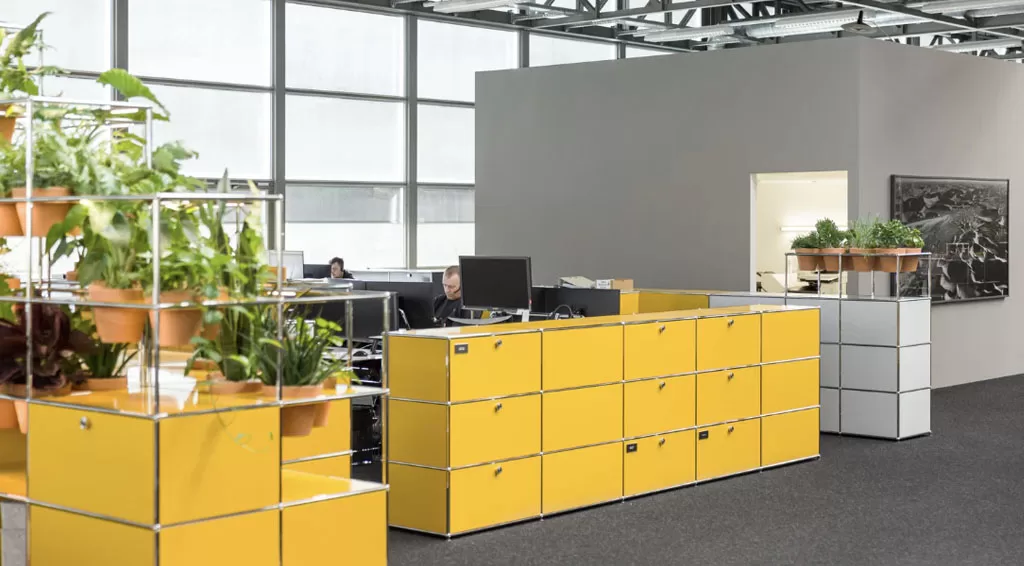

USM Haller Modular Furniture, Iconic Swiss Storage & Timeless Modern Design
USM creates iconic Swiss modular furniture designed to adapt beautifully to changing homes, workplaces, and architectural environments. Best known for the USM Haller system, the collection transforms chrome-plated steel tubes, distinctive ball connectors, and powder-coated metal panels into customizable storage, shelving, credenzas, media units, bookcases, display cabinets, desks, tables, and architectural furniture.
Defined by precision, flexibility, durability, and timeless modern design, USM furniture can begin as a compact storage piece and evolve over time as requirements change. Components can be reconfigured, expanded, reduced, and repurposed, giving the system an unusual ability to remain useful across different rooms, residences, offices, and generations.
What Is USM Haller Known for in Modern Furniture?
USM Haller is known for its distinctive modular construction system, architectural geometry, chrome-plated ball connectors, steel tubes, colorful powder-coated panels, exceptional durability, and extraordinary ability to be customized and reconfigured.
Rather than designing a fixed cabinet, bookcase, or credenza, USM developed a system.
That distinction is fundamental.
Individual components can be combined into furniture for storage, display, media, dining, home offices, bedrooms, libraries, retail environments, hospitality spaces, and professional workplaces.
USM Has Been a Swiss Family Business Since 1885
USM began in Münsingen, Switzerland, in 1885 as a family-owned metalworking and locksmith business founded by Ulrich Schärer.
The initials USM refer to Ulrich Schärer and Münsingen, establishing a direct connection between the company, its founder, and the Swiss community where its headquarters and manufacturing remain rooted.
Over generations, the company evolved from architectural metalwork into one of the most recognizable names in modern modular furniture.
How Did Architecture Inspire USM Haller?
The origins of USM Haller are inseparable from architecture.
When engineer Paul Schärer Jr. joined the family business, he wanted to modernize the company and its manufacturing facilities. He commissioned Swiss architect Fritz Haller to develop a flexible factory and office complex based on modular steel construction.
The architecture could expand and change as the company’s needs evolved.
Schärer and Haller soon applied the same idea to furniture.
Instead of creating static pieces for the new offices, they developed a modular furniture system capable of adapting just as the building could.
Furniture became architecture at a smaller scale.
Fritz Haller & Paul Schärer Created a New Furniture System
The collaboration between architect Fritz Haller and engineer Paul Schärer Jr. brought together two complementary ways of thinking.
Haller contributed an architectural understanding of modular systems.
Schärer brought engineering and manufacturing expertise.
Together, they developed furniture around a rational grid of tubes, panels, shelves, and connectors rather than conventional cabinet construction.
The resulting system was remarkably simple in appearance but almost limitless in application.
The USM Ball Connector Is the Heart of the System
One small component makes the entire USM Haller concept possible.
The chrome-plated ball connector joins tubular structural elements in multiple directions, creating a precise three-dimensional framework.
Panels, shelves, doors, drawers, and other components can then be integrated within that structure.
The connector is both engineering solution and visual signature.
Once recognized, it makes USM immediately identifiable.
How Does the USM Haller Modular System Work?
USM Haller is built from a coordinated family of standardized structural elements.
Chrome-plated steel tubes connect through the characteristic spherical joints to create the framework. Powder-coated metal panels, shelves, doors, drawers, and other components are then added according to the required function.
Because the furniture is based on a system rather than a fixed cabinet, trained USM professionals can modify its configuration.
A low credenza can potentially become a larger storage unit.
Shelving can expand.
Open compartments can become closed storage.
A residential piece can be adapted for another room or function.
The system evolves instead of becoming obsolete.
Modularity Makes USM Furniture Exceptionally Adaptable
Most furniture is purchased in a finished form.
Its dimensions and function remain essentially unchanged.
USM takes another approach.
Because the system is modular, the furniture can respond to changes in architecture, lifestyle, technology, collections, and storage needs.
This adaptability is one of the most important reasons USM has remained relevant for decades.
USM Haller Has Been a Design Icon Since 1965
The essential USM Haller concept was established in the 1960s, with elements of the system patented in 1965.
Its basic visual language remains remarkably consistent today.
This continuity demonstrates the strength of the original concept.
USM does not need continual stylistic reinvention because its identity is based on proportion, modularity, engineering, material, and function rather than decorative fashion.
Why Does USM Haller Still Look Contemporary?
Timeless furniture is difficult to create because every object belongs to the period in which it was designed.
USM Haller succeeds because its aesthetic is generated primarily by construction.
A rational grid.
A polished connector.
Thin steel panels.
Clear geometry.
Precise color.
These elements are sufficiently distinctive to create identity but sufficiently restrained to coexist with changing architecture and furniture.
USM Haller Is Part of Modern Design History
USM Haller’s importance extends beyond commercial success.
The system has been recognized as a work of applied art and is represented in the permanent collection of the Museum of Modern Art in New York.
Its cultural significance comes from the way it translates architectural modularity into furniture while maintaining exceptional practical usefulness.
USM Furniture Can Change Instead of Being Replaced
One of the most compelling aspects of modular furniture is the possibility of adaptation.
People move.
Families change.
Collections grow.
Technology evolves.
Home offices appear.
Workplaces reorganize.
A furniture system capable of responding to these changes can remain useful much longer than an object designed around only one moment in time.
How Can USM Haller Be Reconfigured Over Time?
Because USM Haller uses standardized components, trained specialists can modify existing configurations according to changing requirements.
Additional bays can increase storage.
A taller structure can provide more shelving.
Doors and drawers can change the balance between open and closed storage.
The configuration can sometimes be reorganized to suit a new room or use.
This means the furniture can have multiple lives while retaining the same fundamental components.
USM Modular Storage Creates Order without Visual Heaviness
Storage is essential, but large cabinets can easily dominate a room.
USM Haller’s rational grid and relatively thin structural elements allow substantial storage to remain visually controlled.
Open compartments introduce depth.
Closed panels conceal clutter.
The chrome framework reflects light.
Color can either integrate the piece quietly or make it a focal point.
The result is storage that participates in the architecture rather than simply occupying space.
USM Credenzas Bring Architectural Precision to Living Spaces
The low USM Haller credenza has become one of the system’s most recognizable residential applications.
Its horizontal proportions make it suitable for living rooms, dining rooms, entryways, bedrooms, offices, and media spaces.
Depending on configuration, the credenza can provide open shelving, concealed storage, drawers, display surfaces, or a combination of functions.
A USM Sideboard Can Be Quiet or Expressive
Color changes the personality of USM dramatically.
A neutral finish can allow the furniture to recede into architecture.
Black can emphasize its graphic geometry.
White can make the system feel lighter.
Stronger colors transform the same structure into a more expressive object.
This flexibility allows a USM sideboard to work within both highly restrained and more colorful interiors.
USM Haller Shelving Turns Storage into Architecture
Tall shelving emphasizes the architectural origins of the system.
Repeated modules create rhythm across a wall.
Open sections can display books, art, objects, or collections.
Closed compartments provide functional storage.
Freestanding configurations can also divide space without constructing permanent walls.
At larger scales, USM begins to feel less like individual furniture and more like micro-architecture.
How Does USM Haller Work as a Room Divider?
Open-plan interiors often need definition without complete separation.
A freestanding USM configuration can establish a boundary between living and dining, work and collaboration, entry and lounge, or other functional zones while maintaining visual connection.
Open compartments preserve light and sightlines.
Closed modules add privacy and storage.
Because the furniture is modular, the divider can also evolve if the room changes.
USM Bookcases Create Flexible Libraries
Books rarely remain static.
Collections grow and change over time.
USM Haller is particularly well suited to libraries because shelving can be configured around the scale of the collection and potentially expanded as more storage is needed.
Open shelving provides access and display while closed compartments can conceal documents, equipment, or less visually important objects.
USM Haller Display Furniture Frames Art & Objects
The regular grid of USM creates a strong framework for displaying collections.
Sculpture, ceramics, books, photography, design objects, and personal artifacts can occupy individual compartments or extend across multiple modules.
Because the furniture itself is visually disciplined, it can provide order around highly varied objects.
USM Furniture Works Beautifully with Art Collections
USM has enough identity to stand confidently beside important art without becoming unnecessarily decorative.
Its geometry can create a calm architectural foundation for painting, photography, sculpture, and collectible design.
Color can coordinate with the collection or deliberately provide contrast.
This makes USM particularly compelling for residences where furniture and art are considered together.
USM Media Units Adapt Classic Design to Contemporary Technology
Technology changes much faster than furniture.
Televisions become larger.
Components become smaller.
Streaming replaces physical media.
Audio equipment evolves.
USM Haller’s modular structure allows media storage to respond more intelligently to these changes than many fixed entertainment cabinets.
Open and closed compartments can be configured around screens, equipment, collections, and cable-management needs.
How Does USM Haller Work as a Media Console?
A low USM configuration can support or accompany a television while providing storage for media equipment and accessories.
Closed compartments help conceal visual clutter.
Open modules can accommodate equipment requiring easier access.
The system’s architectural simplicity also helps large screens feel more integrated into the room rather than surrounded by visually complicated furniture.
USM Haller Brings Modular Storage into the Dining Room
Dining rooms require storage for tableware, glassware, linens, serving pieces, and objects used for entertaining.
A USM sideboard or credenza can organize these functions while creating a clean horizontal element within the room.
The top surface can support art, lighting, flowers, or serving pieces during gatherings.
USM Storage Works in Kitchens & Adjacent Living Areas
Contemporary kitchens often flow directly into dining and living spaces.
USM can provide additional storage without looking like conventional kitchen cabinetry.
This makes it particularly useful for transitional areas where furniture needs to complement both architectural millwork and residential furnishings.
USM Haller Can Transform Entryways
Entry furniture needs to provide function without creating unnecessary visual clutter.
A compact USM configuration can organize keys, bags, mail, shoes, accessories, or other everyday items.
Closed storage keeps the entry visually controlled while an open shelf or upper surface can provide space for objects, lighting, or art.
USM Furniture Creates Sophisticated Home Offices
The home office has become a permanent part of many residences.
USM offers storage, shelving, tables, desks, and organizational solutions capable of providing professional function while maintaining the design quality expected in a sophisticated home.
Because the same system can appear elsewhere in the residence, the workspace can feel integrated rather than visually separate.
How Does USM Modular Furniture Work in a Home Office?
A home office can combine open shelving for books and reference materials with closed compartments for files, equipment, and supplies.
A USM desk or table can establish the primary work surface.
As professional requirements change, storage can potentially be modified rather than replacing the entire workspace.
This makes USM particularly appropriate for rooms that need to support both residential and professional functions.
USM Kitos Tables Bring Adjustability to the Workplace
USM’s modular philosophy extends beyond Haller storage.
The USM Kitos family applies engineering and adaptability to desks and tables, including height-adjustable solutions designed for changing work postures and professional environments.
The result complements USM Haller storage while addressing another essential workplace function.
Sit-Stand Work Supports Changing Postures
No single working posture is ideal for an entire day.
Height-adjustable tables allow users to move between seated and standing positions.
This flexibility can support more varied movement while making the workstation adaptable to different users and tasks.
USM Furniture Has Deep Roots in Workplace Design
Although USM Haller is now widely used in residential interiors, the system originated as furniture for the company’s own offices.
Workplace function is therefore not a later addition to the collection.
It is part of the original concept.
Storage, organization, flexibility, space division, and adaptation were fundamental from the beginning.
How Does USM Haller Work in Modern Offices?
Contemporary workplaces need to change more frequently than conventional built-in furniture allows.
Teams grow or shrink.
Departments move.
Individual offices become collaborative areas.
Storage requirements change.
USM Haller can support these transitions through furniture that can organize files, divide space, display objects, provide personal storage, and establish shared resources.
USM Can Create Individual Workstations
A workstation needs storage, organization, and a clear relationship between the user and surrounding space.
USM can provide personal storage near the desk while larger shared configurations organize materials for a team.
This combination allows the system to operate at both individual and architectural scales.
USM Can Organize Collaborative Work Environments
Shared offices need places for materials, equipment, presentations, personal belongings, and informal meetings.
USM configurations can help define these functions without relying entirely on permanent construction.
Furniture becomes a flexible infrastructure for the workplace.
USM Storage Works in Executive Offices
Executive furniture needs to provide function while communicating material quality and design intelligence.
USM’s precision, restrained geometry, and long design history allow it to create storage that feels sophisticated without becoming ceremonial.
A credenza, shelving system, or table can support the office while maintaining visual clarity.
USM Is Ideal for Creative Studios
Architectural studios, design offices, galleries, fashion companies, and other creative workplaces often accumulate books, samples, models, materials, and objects.
USM Haller provides a particularly appropriate framework for organizing these changing collections.
Open shelving keeps inspiration visible while closed storage controls visual clutter.
USM Works in Retail Environments
Retail interiors need displays that can change as products and merchandising strategies evolve.
USM’s modularity makes it valuable for shelving, product presentation, counters, storage, and freestanding displays.
The furniture can establish a consistent visual language while allowing individual configurations to change.
USM Haller Is Well Suited to Hospitality
Hotels, restaurants, lounges, and other hospitality spaces need furniture that balances visual quality with durability and flexibility.
USM can function as storage, display, reception furniture, service furniture, shelving, or architectural space division.
Its broad color palette also allows the system to respond to different brand identities.
USM Works in Libraries & Cultural Institutions
Libraries, galleries, museums, educational spaces, and cultural institutions often require furniture capable of organizing changing collections and public programs.
USM’s durability and modularity make it well suited to these environments.
The system can provide storage without competing visually with the material being displayed.
USM Haller Color Is an Architectural Tool
Color is one of the most recognizable dimensions of USM.
Because the structure remains consistent, changing panel color can dramatically change the furniture’s relationship with the room.
Color can blend with architecture.
It can echo artwork.
It can identify a workplace zone.
Or it can turn a small storage unit into a vivid focal point.
How Do You Choose a USM Haller Color?
Begin with the role the furniture should play.
If the piece should recede, select a finish that relates closely to walls, floors, or architectural materials.
If it should provide contrast, a darker or more saturated color can emphasize the modular grid.
For art-focused interiors, consider whether the furniture should support the collection quietly or introduce an additional color relationship.
Because USM’s form is so disciplined, even expressive colors can remain sophisticated.
USM Haller E Integrates Light & Power into the Furniture
USM Haller E extends the original modular concept by incorporating electrical functionality directly into the structure.
Lighting and USB charging can be integrated without visible external wiring disrupting the furniture’s clean geometry.
This allows shelving and display furniture to become illuminated from within while preserving the recognizable USM aesthetic.
How Does USM Haller E Work?
USM Haller E conducts low-voltage electricity through specially developed components integrated within the structure.
Compatible lighting and USB elements can be positioned within the system, allowing compartments, objects, or surrounding areas to be illuminated while charging functionality is incorporated into the furniture.
Because the technology remains modular, electrical components can be adapted as configurations change.
Integrated Lighting Changes the Way USM Displays Objects
Lighting can transform shelving from simple storage into display architecture.
A sculpture can be highlighted.
Books can receive softer illumination.
Glassware or objects can become more visually prominent.
The light originates within the furniture rather than requiring an unrelated fixture nearby.
USM Haller E Can Support Home & Workplace Technology
Integrated charging provides another layer of functionality.
Devices increasingly occupy living rooms, bedrooms, offices, hospitality spaces, and retail environments.
Bringing power into the furniture allows these devices to be supported more discreetly.
Plants Bring a Softer Dimension to USM Haller
USM’s precise steel geometry creates an interesting contrast with plants.
Leaves introduce organic shapes and movement.
The modular grid provides structure.
Integrated plant solutions can bring greenery into homes and workplaces while preserving the fundamental logic of the furniture.
USM Furniture Can Support Biophilic Interiors
Plants can soften workplaces and residential environments, create visual separation, and strengthen connections with nature.
When greenery is incorporated into modular furniture, it can become part of the spatial design rather than simply an object placed afterward.
USM’s system allows plants, storage, display, and space division to work together.
USM Haller Soft Panels Add a Tactile Layer
The modular system continues to evolve through new components and applications.
Soft elements can introduce texture, acoustic qualities, and a warmer visual character to the familiar steel architecture.
This development demonstrates how USM can expand its functional vocabulary without abandoning the essential logic of the original system.
USM Haller Can Be Minimal without Feeling Cold
Steel, chrome, and geometric forms are sometimes associated with visual austerity.
USM avoids this limitation through proportion, color, personal objects, books, art, plants, and the way the furniture is configured.
A system that begins with industrial materials can ultimately feel highly personal.
USM Works with Warm Natural Materials
The precision of USM can create particularly strong contrast with wood, stone, leather, textiles, and plaster.
A colorful metal credenza against a natural wood wall feels different from the same piece in a glass-and-concrete interior.
Because the system has a clear identity, it can participate in varied material palettes without losing its character.
USM Haller Complements Contemporary Architecture
Modern architecture often values structural clarity, proportion, repetition, and material honesty.
USM shares these qualities.
The furniture can therefore feel closely related to the architecture rather than merely placed within it.
This relationship is especially apparent in highly minimal spaces where every line and junction matters.
USM Also Works in Historic Interiors
The furniture does not require modern architecture.
Its geometric clarity can create an effective contrast within historic homes, traditional rooms, decorative interiors, and older commercial buildings.
The tension between architectural history and precise modern furniture can make both more visible.
USM Haller Can Become a Collectible Design Object
A small USM cabinet can function as much more than storage.
Its recognizable structure, design history, material precision, and color give it the presence of collectible design.
This makes USM especially attractive to clients who value furniture with cultural significance as well as everyday function.
USM Furniture Can Grow with a Collection
Art, books, records, ceramics, wine, design objects, and other collections rarely remain the same size.
Fixed storage eventually becomes insufficient.
A modular system provides the possibility of adapting the furniture as the collection evolves.
This ability to grow with its contents is one of USM’s most compelling practical advantages.
USM Is Designed for Long-Term Ownership
The strongest argument for USM is not simply appearance.
It is longevity.
The furniture is constructed from durable materials.
Its aesthetic has remained relevant for decades.
Its components can be reconfigured.
Its function can change.
Together, these qualities support a model of ownership based on adaptation rather than replacement.
How Does Modularity Make USM More Sustainable?
A modular system can extend product life because the furniture does not need to remain frozen in its original configuration.
When requirements change, components can potentially be reused within a revised piece rather than discarding the entire object.
Durable steel components, long-term availability of system elements, and timeless design all support this approach.
The most sustainable furniture is often furniture people continue to value and use.
USM Has Pursued Environmental Certification
USM’s sustainability work extends beyond modularity.
The company has pursued environmental certifications addressing product emissions and material cycles, while continuing to develop its approach to circularity.
These initiatives complement the inherently long-lived character of the Haller system.
Why Is USM Haller Considered Timeless Design?
Timelessness is not simply the absence of decoration.
A design needs enough character to remain recognizable while avoiding details tied too closely to one fashion.
USM Haller achieves this balance through a simple structural language that has remained essentially consistent for decades.
Its identity comes from the system itself.
Why Choose USM Modular Furniture?
USM offers a rare combination of qualities.
It is instantly recognizable yet highly customizable.
It has substantial design history yet remains contemporary.
It works in residential and commercial environments.
It can be expressive or quiet.
And, most importantly, its modular structure allows the furniture to evolve as requirements change.
For architects, interior designers, collectors, and design-conscious clients, that flexibility creates long-term value beyond the initial purchase.
How Do You Design the Right USM Haller Configuration?
Begin with function rather than appearance.
What needs to be stored?
What should remain visible?
What should be concealed?
Does the piece need to support media equipment?
Should it divide a room?
Will the collection grow?
Could the furniture eventually move to another location?
Once these questions are answered, dimensions, doors, drawers, open shelves, color, lighting, and other elements can be developed around the intended use.
Open or Closed USM Storage?
Open storage makes books, art, objects, and collections part of the room.
Closed storage creates visual calm.
Most sophisticated configurations combine both.
Frequently used or visually compelling items remain accessible, while documents, cables, equipment, and everyday clutter can disappear behind doors or within drawers.
Low or Tall USM Haller Furniture?
Low configurations emphasize horizontal architecture and work beautifully as credenzas, media units, and sideboards.
Tall configurations provide more storage and can create stronger architectural presence.
The appropriate height depends on wall dimensions, windows, art, ceiling height, sightlines, and the role the furniture needs to play within the room.
Freestanding or Wall-Based USM?
A configuration against a wall can maximize storage while preserving open floor area.
A freestanding piece can organize an open plan, divide space, or create circulation.
Because USM is finished as furniture rather than built-in cabinetry, freestanding applications can be particularly compelling.
USM Is an Exceptional Resource for Architects & Interior Designers
For design professionals, USM provides a system rather than a limited catalog of predetermined furniture.
Dimensions, functions, colors, storage types, and configurations can be developed according to the architecture.
This makes USM useful from a compact residential entry cabinet to extensive workplace installations.
USM Haller Supports Highly Personalized Residential Interiors
Modular does not mean generic.
A configuration can respond specifically to books, art, audio equipment, dining storage, clothing, office requirements, children’s belongings, or a personal collection.
Color and proportion add another layer of individuality.
The result can be as personal as custom millwork while retaining the adaptability of a furniture system.
USM Furniture Works Across the Entire Home
Living rooms can use media storage and shelving.
Dining rooms can use sideboards.
Bedrooms can use storage and display furniture.
Home offices can combine desks with organization.
Entries can conceal everyday items.
Children’s rooms can use furniture capable of evolving as needs change.
The consistent system can connect these rooms without requiring identical configurations.
USM Is Equally Powerful in Contract Interiors
Offices, hospitality, retail, galleries, libraries, educational environments, healthcare spaces, and other professional interiors can benefit from USM’s durability and adaptability.
Furniture can help organize changing programs while creating a consistent visual identity across a project.
Where Can You Experience USM at Scott + Cooner?
Scott + Cooner represents USM through our Dallas and Austin showrooms, connecting architects, interior designers, workplace professionals, collectors, and design-conscious clients in Texas with one of Switzerland’s most iconic modular furniture systems.
Our teams can help clients develop USM Haller storage, shelving, credenzas, media units, bookcases, room dividers, home offices, workplace configurations, USM Kitos tables, colors, doors, drawers, lighting, accessories, and custom modular solutions for residential and contract interiors.
Where Can You Find USM Haller Furniture in Dallas?
Scott + Cooner Dallas represents USM for architects, interior designers, workplace professionals, and design-conscious clients throughout Dallas and North Texas.
USM’s combination of architectural precision, modular storage, customization, and color makes the system particularly well suited to sophisticated Dallas residences, executive offices, creative workplaces, art-focused interiors, and hospitality environments.
A configuration can be developed around the specific architecture rather than selecting a generic cabinet from a predetermined catalog.
Scott + Cooner Dallas Brings Swiss Modular Design to North Texas
Dallas clients seeking modern storage furniture can use USM Haller to solve practical requirements while maintaining exceptional design quality.
A living room may need a low media console.
A dining room may require a substantial sideboard.
A library may need extensive shelving.
An office may need storage and space division.
All can be developed from the same modular language.
USM Haller Complements Dallas Art Collections
Dallas residences often bring significant art and furniture together within generous architectural spaces.
USM can provide a controlled geometric framework for these environments.
A low credenza can support sculpture or objects.
Shelving can organize a collection.
Color can create a deliberate relationship with artwork without requiring the furniture itself to become ornamental.
USM Modular Storage Works in Large Dallas Residences
Generous rooms create opportunities for larger configurations.
A substantial USM shelving system can occupy a long wall without the visual heaviness of conventional cabinetry.
Freestanding furniture can help divide open architecture.
Low storage can establish horizontal lines that reinforce the scale of the room.
USM Is an Intelligent Choice for Dallas Home Offices
A sophisticated home office requires more than a desk.
Files, books, equipment, technology, and personal objects all need organization.
USM allows these functions to be integrated into a coherent furniture system while maintaining the quality expected elsewhere in the residence.
USM Supports Dallas Workplace & Contract Projects
North Texas includes a significant corporate, hospitality, healthcare, retail, and commercial design market.
USM’s durability and ability to adapt over time make it especially relevant to organizations whose spatial requirements may change.
The system can provide storage, space division, display, work surfaces, and organization without relying entirely on permanent construction.
Dallas Architects & Interior Designers Can Specify USM Through Scott + Cooner
Scott + Cooner Dallas can assist architects and interior designers with USM Haller configurations for residential, workplace, hospitality, retail, and contract projects throughout North Texas.
Our team can help evaluate dimensions, functions, doors, drawers, shelving, colors, integrated lighting, tables, room division, and future expansion possibilities.
Where Can You Find USM Haller Furniture in Austin?
Scott + Cooner Austin represents USM for architects, interior designers, workplace professionals, and design-conscious clients throughout Austin and Central Texas.
The system’s combination of architectural thinking, engineering, adaptability, and expressive color aligns naturally with Austin’s creative and technology-driven design culture.
USM can bring order to contemporary interiors without making them feel overly formal.
Scott + Cooner Austin Connects Central Texas with Swiss Modular Furniture
Austin architecture frequently combines limestone, concrete, plaster, glass, steel, and wood.
USM’s precise metal geometry creates compelling relationships with these materials.
A neutral configuration can reinforce architectural clarity.
A stronger color can provide deliberate contrast against natural stone or wood.
USM Haller Works with Austin’s Contemporary Architecture
The architectural origins of USM make it especially appropriate to projects where structure and proportion are important.
The system’s grid can align with windows, wall panels, cabinetry, or other architectural elements.
Rather than appearing as an unrelated storage cabinet, the furniture can become part of the spatial composition.
USM Modular Furniture Supports Austin’s Flexible Lifestyle
Rooms increasingly serve more than one function.
A guest room becomes an office.
A living room includes a workspace.
A dining area supports meetings.
Storage needs change as families and collections grow.
USM’s modularity makes it particularly valuable in these environments because the furniture can evolve alongside the way the room is used.
USM Is Ideal for Austin’s Creative & Technology Workplaces
Creative companies and technology businesses often need spaces capable of changing quickly.
Teams reorganize.
Projects require different types of collaboration.
Equipment and storage needs evolve.
USM can provide a durable furniture infrastructure capable of supporting these transitions while maintaining a sophisticated visual identity.
USM Color Can Bring Personality to Central Texas Interiors
Austin interiors often balance natural materials with moments of color and individuality.
USM makes color structural rather than decorative.
Because the powder-coated panels are part of the furniture itself, a vivid configuration can introduce personality without relying on applied ornament.
USM Haller Can Connect Austin Interiors with Landscape
A precise metal storage system may seem very different from the Central Texas landscape, but contrast can be powerful.
Against limestone, wood, plaster, and views of vegetation, USM’s geometric structure emphasizes the distinction between manufactured precision and natural material.
Plants integrated with or positioned around the system can soften this relationship further.
Austin Architects & Interior Designers Can Specify USM Through Scott + Cooner
Scott + Cooner Austin can assist architects and interior designers with USM Haller storage, shelving, credenzas, media furniture, home offices, workplace systems, room dividers, tables, colors, doors, drawers, lighting, and customized configurations.
Our team can help develop furniture around architecture, storage requirements, technology, collections, circulation, and the possibility of future adaptation.
Scott + Cooner Represents USM in Dallas & Austin
Scott + Cooner’s representation of USM in Dallas and Austin gives architects, interior designers, workplace professionals, collectors, and design-conscious clients access to one of the world’s most influential modular furniture systems through experienced local showroom teams.
In Dallas, USM’s architectural storage, customizable configurations, and timeless modern design can respond to substantial residences, important art collections, executive interiors, and sophisticated commercial environments.
In Austin, the system’s modularity, engineering, expressive color, and ability to evolve make it especially relevant to contemporary architecture, creative workplaces, technology environments, and flexible residential living.
Across both markets, Scott + Cooner can help develop USM configurations according to architecture, dimensions, storage requirements, color, technology, lighting, and the individual needs of each project.
Discover USM Haller Modular Furniture at Scott + Cooner
Scott + Cooner represents USM in Dallas and Austin as part of our curated collection of exceptional contemporary furniture and international design.
Since 1995, Scott + Cooner has worked with architects, interior designers, workplace professionals, collectors, and design-conscious clients seeking extraordinary modern furniture, lighting, kitchens, closets, rugs, accessories, textiles, outdoor furniture, and architectural products for sophisticated residential and contract interiors.
Our Dallas and Austin teams can help you explore USM Haller modular furniture, Swiss storage systems, credenzas, sideboards, shelving, bookcases, media units, home-office furniture, workplace storage, room dividers, USM Kitos tables, integrated lighting, plant solutions, colors, doors, drawers, accessories, and customized configurations.
Whether you are designing a single USM Haller credenza, creating a wall of modular shelving, organizing an art or book collection, developing a sophisticated home office, furnishing a flexible workplace, or creating architectural storage that can evolve for decades, Scott + Cooner can help you explore USM’s exceptional combination of Swiss precision, architectural modularity, timeless modern design, and long-term adaptability.