

Vibia Contemporary Spanish Lighting, Architectural Systems & Sculptural Design
Vibia creates contemporary Spanish lighting that transforms illumination into an essential element of architecture, atmosphere, and human experience. Born in Barcelona, the global lighting company collaborates with leading international designers to create pendant lights, chandeliers, ceiling lights, wall sconces, floor and table lamps, outdoor lighting, and highly adaptable architectural lighting systems for sophisticated residential, hospitality, workplace, and commercial interiors.
Rather than treating a light fixture as an isolated decorative object, Vibia explores the relationship between light, space, material, technology, and emotion. Collections including Plusminus, Array, Wireflow, Flamingo, Palma, Knit, Duo, Guise, Algorithm, Sticks, Flat, North, Mayfair, Rhythm, and others allow architects and interior designers to compose illumination at scales ranging from a single intimate lamp to an expansive custom installation.
Born in Barcelona, Vibia Approaches Contemporary Lighting as a Tool for Shaping Atmosphere
Vibia’s design philosophy begins with a simple but powerful idea: light changes the way people experience space.
Illumination affects far more than visibility.
It influences mood, comfort, perception, color, texture, architecture, and the way people interact within a room.
Vibia therefore approaches lighting as an integral part of interior design rather than an element selected only after the architecture is complete.
The company’s Barcelona origins place it within a design culture known for the close relationship between architecture, interiors, craftsmanship, material, and Mediterranean light.
Yet Vibia’s perspective is international.
Its collections are created for architects, interior designers, lighting designers, and clients working across residential, hospitality, workplace, retail, cultural, and commercial environments around the world.
Vibia Creates Beautiful Atmospheres Designed to Enhance Human Well-Being
Well-being is central to Vibia’s philosophy.
The company believes that better spaces can contribute to better lives and that lighting has an important role in creating those environments.
This shifts the conversation away from the light fixture alone.
A successful lighting design considers what people are doing, how the space changes throughout the day, where attention should be focused, how surfaces should appear, and what emotional response the environment should create.
Bright functional illumination may be appropriate at one moment.
At another, softer ambient light may encourage conversation, relaxation, or intimacy.
Vibia’s broad portfolio makes it possible to create these different scenes while maintaining a coherent design language.
Vibia Blurs the Boundary Between Decorative Lighting and Architectural Lighting
Lighting has traditionally been divided into categories.
Decorative fixtures are expected to be visible and expressive, while architectural lighting is often intended to disappear into the building.
Vibia increasingly challenges this distinction.
Many of its most important collections are simultaneously architectural and decorative.
A Wireflow chandelier has extraordinary visual presence, yet its slender cables nearly dissolve into the room.
Plusminus can become a pendant, room divider, track system, luminous line, or large-scale installation.
Palma can function as wall lighting while also incorporating greenery into the composition.
Sticks draws illuminated lines through three-dimensional space.
These designs allow the lighting itself to participate in the architecture without becoming conventional built-in illumination.
Vibia Pendant Lights Bring Sculptural Contemporary Design Above Dining Tables, Kitchens, and Living Spaces
Pendant lighting is one of the broadest categories within the Vibia collection.
Individual pendants can create focused moments of illumination above dining tables, kitchen islands, bedside tables, counters, and seating areas.
Larger compositions can define entire rooms.
Vibia’s approach gives designers unusual flexibility.
Some collections emphasize a single sculptural form.
Others are conceived as systems that can be multiplied, clustered, extended, or customized according to the architecture.
This allows pendant lighting to respond to both intimate residential environments and expansive hospitality or commercial spaces.
The fixture is no longer simply centered in the room because convention dictates its position.
Light can be placed precisely where the architecture and human activity require it.
Plusminus by Diez Office Reinvents Architectural Lighting with a Conductive Textile Belt
Plusminus represents one of Vibia’s most innovative approaches to contemporary architectural lighting.
Designed by Diez Office, the system replaces the conventional rigid track with a flexible textile belt that conducts electricity.
Lighting elements can be positioned along this belt, allowing the system to move through space in ways that traditional track lighting cannot.
The textile can hang in relaxed curves, stretch taut across a room, create geometric trajectories, descend vertically, or define illuminated boundaries.
Pendants, focused lighting, diffuse lighting, and other elements can participate within the same system.
This transforms electricity—normally hidden inside ceilings and walls—into a visible part of the design.
The result is both technical infrastructure and expressive material.
Plusminus Allows Architects to Draw with Light Throughout Three-Dimensional Space
The true potential of Plusminus becomes clear when it is considered spatially.
Instead of beginning with a fixed ceiling location, designers can draw the conductive textile belt through the room.
A line can extend from wall to wall.
It can descend toward a dining table, rise again, create an illuminated perimeter, or establish a visual boundary within an open-plan environment.
Different luminaires can then be positioned according to function.
Focused light can illuminate artwork or a work surface.
Diffuse elements can provide ambient illumination, while pendants can create more intimate pools of light.
This freedom makes Plusminus particularly relevant to contemporary architecture, where open plans and multifunctional interiors often require lighting that can organize space without conventional walls.
Plusminus Essentials Makes Vibia’s Flexible Lighting System Easier to Configure
Plusminus Essentials expands the concept by simplifying the specification process.
Predefined toolboxes provide the technical foundation for different types of installations while preserving the flexibility that makes the original system distinctive.
Designers select the appropriate toolbox, choose the luminaires required for the project, and add accessories where needed.
Finishes and LED color temperatures can then be coordinated with the surrounding interior.
This approach makes sophisticated architectural lighting more accessible without reducing its creative potential.
It also reflects a broader Vibia philosophy: technology should expand what designers can do rather than make the design process unnecessarily complicated.
Array by Umut Yamac Creates Ethereal Pendant Sculptures from Light and Thread
Array transforms thread into architecture.
Designed by Umut Yamac, the collection uses fine threads stretched between metal rings to form large suspended volumes.
The material is visually delicate, yet the resulting shapes possess remarkable spatial presence.
Light interacts with the overlapping threads to create gradients, depth, vibration, and movement.
From one viewpoint the fixture may appear relatively transparent.
From another, layers of thread intensify to create greater visual density.
Upward and downward illumination allows the pendant to envelop the surrounding space rather than simply directing light onto one surface.
The result is a chandelier that feels simultaneously monumental and almost weightless.
Array Chandeliers Create Dramatic Scale Without Overwhelming the Architecture
Large chandeliers can easily become visually heavy.
Array offers another possibility.
Its conical and cylindrical volumes occupy significant space, yet the use of thread preserves transparency and visual lightness.
This makes the collection particularly effective in double-height residences, staircases, hotel lobbies, restaurants, reception areas, lounges, and other spaces where lighting needs to establish scale.
Architecture remains visible through the fixture.
The pendant therefore defines a volume without creating a solid obstruction.
Multiple sizes and compositions allow designers to respond to the proportions of individual projects, while warm finishes introduce color without diminishing the ethereal quality of the structure.
Wireflow by Arik Levy Reinterprets the Traditional Chandelier Through Minimal Lines and LED Light
Wireflow reduces the chandelier to its essential geometry.
Instead of relying upon a heavy central body, arms, and decorative crystal, the collection uses slender black electrical cables and LED light sources to trace three-dimensional forms through space.
The result is almost like a drawing suspended in the air.
From some viewpoints, the fixture appears highly graphic.
From others, its cables nearly disappear, allowing the illuminated points to float within the architecture.
Wireflow is particularly effective in minimalist and contemporary interiors where a traditional chandelier would feel visually excessive but the space still requires a significant lighting gesture.
Wireflow Chandeliers Allow Large-Scale Lighting to Feel Visually Light and Architectural
The Wireflow family demonstrates how minimal material can produce dramatic scale.
Linear versions can extend above long dining or conference tables.
Chandelier configurations create larger three-dimensional compositions, while free-form versions allow designers to develop installations that respond more directly to architecture.
Because the cables are so visually slender, even expansive configurations can maintain transparency.
This is particularly useful in stairwells, atriums, double-height rooms, hotel lobbies, and other spaces where a substantial fixture is required but architectural sightlines should remain open.
Wireflow becomes a spatial diagram made visible through light.
Flamingo by Antoni Arola Separates the Light Source from the Shade to Create a Floating Contemporary Pendant
Flamingo explores the relationship between direct and indirect illumination.
Designed by Antoni Arola, the collection separates its LED light source from translucent diffusers, allowing light to interact with the surfaces rather than simply emerging from inside a conventional shade.
This creates a layered effect.
The suspended elements appear to float, while illumination is reflected and diffused through the composition.
Flamingo can be used individually or in repeated arrangements, making it appropriate for dining rooms, living spaces, hospitality environments, and larger architectural installations.
Its elegance comes from visual lightness rather than ornament.
Palma by Antoni Arola Combines Contemporary Lighting with Greenery and Biophilic Design
Palma challenges the traditional idea of the wall sconce.
Designed by Antoni Arola, the collection combines opaline glass forms with an aluminum structure and the possibility of incorporating plants.
The result creates a direct relationship between illumination and nature.
Installed individually, Palma provides soft diffuse light with a refined geometric presence.
Arranged in larger compositions, the collection can create horizontal or vertical structures that begin to resemble illuminated gardens.
This gives architects and interior designers an unusual tool for introducing biophilic elements into hospitality, workplace, residential, and commercial interiors.
Light and vegetation become part of one composition.
Palma Wall Lighting Can Transform an Architectural Surface into an Illuminated Vertical Garden
Wall lighting normally sits against architecture.
Palma can become architecture.
Repeated units establish visual axes across a wall while integrated greenery introduces organic variation.
The contrast is compelling.
Opaline glass provides controlled geometry and diffuse illumination, while plants introduce irregularity, texture, and life.
In restaurants, hotels, offices, wellness environments, and residences, these compositions can create memorable focal walls without relying upon conventional artwork or decorative paneling.
The concept also reinforces Vibia’s broader interest in well-being and the relationship between interior environments and nature.
Knit Lighting Reimagines the Traditional Lampshade Through Textile Materiality
Knit explores the emotional qualities of textile.
The collection takes the familiar idea of a fabric lampshade and expands it into a more architectural and contemporary expression.
Knitted material introduces softness, tactility, and acoustic warmth into an object that is often made primarily from metal, glass, or plastic.
When illuminated, the textile interacts with light to create a warm atmosphere.
The material becomes especially important in hospitality and residential interiors, where tactile surfaces can make large spaces feel more intimate.
Knit demonstrates that innovation in lighting does not always require making an object appear more technological.
Sometimes it comes from reconsidering familiar materials.
Duo Ceiling Lights Combine Warm Natural Materiality with Contemporary Architectural Illumination
Duo explores the relationship between a clean architectural ceiling fixture and the warmth of natural-looking interior finishes.
Its gently curved form creates a restrained presence on the ceiling while the interior surface introduces material richness.
The collection demonstrates Vibia’s ability to design ceiling lighting that feels integrated into architecture without becoming anonymous.
New interpretations incorporating walnut and slate-like surfaces deepen this relationship between illumination and material.
These finishes can connect the fixture to wood, stone, cabinetry, furniture, and other architectural elements within the room.
The result is contemporary ceiling lighting with an unexpectedly tactile character.
Guise Uses Light to Reveal the Material Qualities of Glass
Guise explores what happens when the light source itself becomes almost invisible.
Rather than placing an obvious lamp inside a conventional glass diffuser, the design allows LED illumination to interact directly with the glass.
The effect can appear almost magical.
Light seems to emerge from the material itself.
This approach makes Guise particularly compelling in interiors where designers want a luminous object without a visually dominant mechanical source.
Glass, reflection, transparency, and illumination become inseparable.
The collection demonstrates how advanced LED technology can create new aesthetic possibilities rather than merely replacing older bulbs.
Algorithm Turns Suspended Points of Light into Custom Architectural Constellations
Algorithm approaches lighting as a system of illuminated points suspended within space.
Individual spherical elements can be organized into compositions ranging from relatively restrained arrangements to large custom installations.
The result resembles a constellation.
Rather than reading as one solid chandelier, Algorithm establishes a field of light.
This makes it particularly effective in large architectural volumes.
Staircases, lobbies, atriums, dining rooms, and hospitality environments can use the system to fill vertical space while preserving transparency.
Designers can think compositionally, using density, spacing, height, and geometry to respond to the architecture.
Sticks Creates Luminous Lines that Connect Architecture and Space
Sticks explores the line as a lighting element.
Slender illuminated rods can be arranged to create graphic compositions that extend through three-dimensional space.
These lines can connect walls, ceilings, floors, and architectural surfaces, giving designers a tool that feels closer to drawing than conventional fixture placement.
The simplicity of the element makes the resulting compositions highly flexible.
A single line can provide a minimal gesture.
Multiple elements can establish a more complex spatial rhythm.
Sticks is especially effective in contemporary interiors where lighting should participate in architectural geometry rather than simply decorate it.
Rhythm Uses Repeated Illuminated Modules to Create Movement Across Space
Rhythm transforms repetition into movement.
Individual light modules can be arranged into horizontal or vertical compositions, allowing designers to control the direction, scale, and visual rhythm of the installation.
Repeated elements create continuity without requiring a conventional solid fixture.
The system can stretch across dining tables, reception areas, circulation spaces, or larger architectural volumes.
Because the composition is based on repetition, even complex arrangements retain visual order.
Rhythm demonstrates how modular lighting can create an emotional effect through sequence and movement.
Flat Creates Horizontal Planes of Light with a Graphic Architectural Presence
Flat explores the relationship between illumination and horizontal planes.
Thin disc-like elements create a graphic presence while maintaining a sense of visual lightness.
Pendant, floor, table, and ceiling configurations allow the design language to move throughout an interior.
The collection is especially useful where designers want lighting to establish a strong geometric identity without relying upon large opaque volumes.
Its broad surfaces also allow the fixture to interact with the surrounding architecture in a different way from conventional shades.
Rather than containing light, the planes appear to organize it.
North Uses a Suspended Light Source to Bring Illumination Precisely Where It Is Needed
North separates the position of the light from the location of its structural support.
This simple idea creates significant flexibility.
A floor-based or wall-related support can position a suspended shade above a sofa, table, reading area, or other location without requiring a ceiling electrical point directly overhead.
For architects and interior designers, this can solve practical problems while creating a strong visual gesture.
The long relationship between support and shade gives North an architectural scale, yet its slender structure prevents the fixture from feeling heavy.
Mayfair Reinterprets the Traditional Table Lamp Through Contemporary LED Technology
Mayfair takes the familiar archetype of a shaded table lamp and reduces it to a refined contemporary form.
The collection preserves the emotional familiarity of a traditional lamp while using modern materials and LED technology to simplify its construction.
This makes Mayfair particularly versatile.
It can work on a bedside table, desk, console, restaurant table, or within a hotel room without appearing overly technical.
Floor and pendant interpretations allow the same design language to extend across different applications.
Mayfair illustrates Vibia’s ability to innovate without abandoning familiar forms that people instinctively understand.
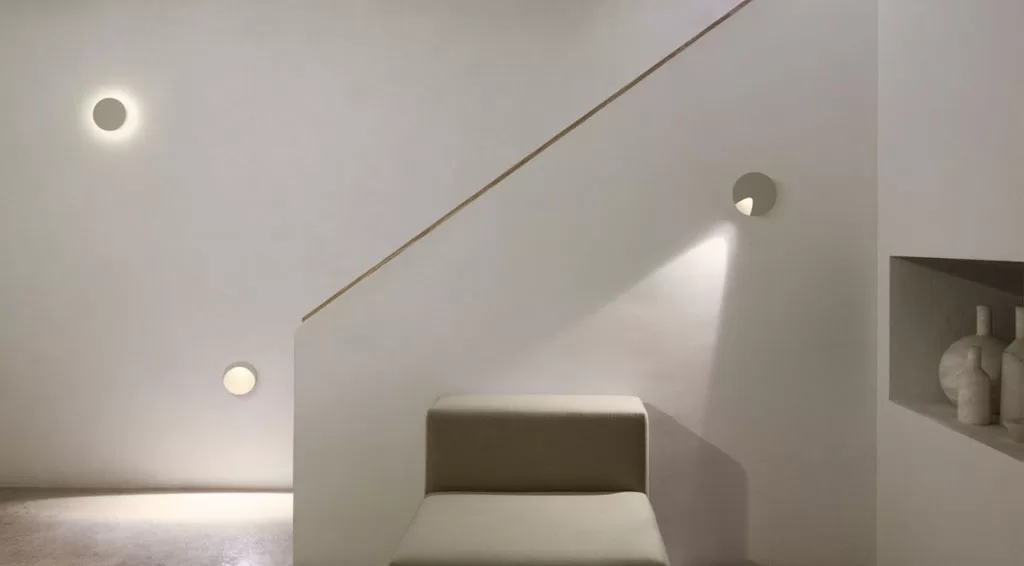
Vibia Wall Lights Turn Architectural Surfaces into Opportunities for Illumination
Wall lighting plays an important role in creating layered interiors.
Unlike overhead lighting, sconces and wall-mounted fixtures bring illumination closer to eye level and can emphasize texture, circulation, artwork, and architectural surfaces.
Vibia offers wall lighting ranging from restrained geometric fixtures to highly expressive systems.
Palma can become an illuminated garden.
Origami turns the wall into a composition of folded forms, while Pin, Dots, Top, Puck, and other collections provide different combinations of ambient, decorative, and functional light.
Used thoughtfully, these fixtures can reduce dependence on a single central source and create richer nighttime environments.
Vibia Ceiling Lights Provide Architectural Illumination Without Sacrificing Material and Design
Ceiling lights are essential in rooms where pendant fixtures are impractical or where designers want illumination to remain closer to the architecture.
Vibia approaches this category with the same attention given to more expressive chandeliers.
Collections such as Duo, Puck, Top, Bigger, Bind, Flat, and others provide different relationships between surface, material, geometry, and light.
Some fixtures visually recede.
Others deliberately establish a graphic ceiling presence.
This variety allows ceiling lighting to respond to room height, circulation, furniture placement, and architectural character rather than being treated as a purely technical necessity.
Vibia Floor and Table Lamps Create Intimate Layers of Light Within Residential and Hospitality Interiors
A successful lighting scheme rarely depends on one source.
Floor and table lamps bring illumination closer to people, creating more intimate pools of light for reading, conversation, work, and relaxation.
Vibia’s collection includes designs such as Mayfair, Africa, I.cono, Class, Flat, North, Warm, Bamboo, Empty, Meridiano, and other families.
These pieces allow designers to create atmosphere at the scale of furniture.
A floor lamp can establish a reading zone beside a lounge chair.
A table lamp can soften a bedroom, restaurant, or hotel setting.
Used together with ceiling, pendant, and wall lighting, these smaller sources help create a layered and adaptable interior.
Vibia Outdoor Lighting Extends Architectural Atmosphere into Terraces, Gardens, and Landscape
Contemporary architecture increasingly connects interior and exterior environments.
Lighting plays a critical role in maintaining that continuity after dark.
Vibia’s outdoor collection brings the company’s restrained design language into terraces, pathways, gardens, covered exterior spaces, and landscape environments.
Rather than overwhelming the setting, outdoor lighting can reveal surfaces, vegetation, circulation, and architectural boundaries.
The objective is often not to make the exterior uniformly bright.
Selective illumination creates depth and helps preserve the atmosphere of the landscape.
This approach allows exterior lighting to become a continuation of the interior design rather than a separate technical system.
Vibia’s Lighting Toolkit Gives Architects and Interior Designers Freedom to Create Bespoke Lighting Solutions
Customization is increasingly important in architectural lighting.
A standard fixture may work beautifully in one room but fail to respond to the scale, geometry, electrical conditions, or functional requirements of another.
Vibia’s Lighting Toolkit addresses this challenge through collections conceived for composition and personalization.
Designers can work with different components, colors, textures, lighting effects, and configurations to develop solutions tailored to a specific project.
This changes the role of the manufacturer.
Instead of simply offering a catalog of finished objects, Vibia provides a vocabulary from which architects and designers can compose.
Custom Vibia Lighting Can Respond Directly to Architecture Rather Than Forcing Architecture Around a Fixture
The most successful custom lighting often appears inseparable from the space in which it is installed.
Its scale responds to the room.
Its geometry follows or deliberately contrasts with architectural lines.
Illumination occurs precisely where it is needed, and the fixture contributes to the identity of the project.
Collections such as Plusminus, Wireflow, Algorithm, Rhythm, Sticks, and Array make this kind of thinking possible.
Rather than asking which standard chandelier fits a room, designers can begin with a different question: what should the light do within this architecture?
The resulting solution can then be developed around that objective.
Vibia Collaborates with International Designers to Explore New Relationships Between Light and Space
Vibia’s collection is shaped through collaboration with designers who bring different perspectives to illumination.
Antoni Arola explores atmosphere, nature, and refined geometry.
Arik Levy approaches lighting through systems, structure, and spatial composition.
Stefan Diez and Diez Office rethink the infrastructure of electricity itself through Plusminus.
Umut Yamac explores tension and thread with Array.
Ramos & Bassols, Lievore Altherr Molina, Jordi Vilardell, Xuclà, and other designers contribute additional interpretations of material, technology, function, and emotion.
This diversity prevents the collection from being reduced to one visual style.
What connects the products is a shared interest in the experience created by light.
Vibia Lighting Is Designed for Architects, Interior Designers, and Lighting Professionals
Professional lighting specification requires much more than selecting an attractive fixture.
Designers need dimensions, photometric information, color temperature, control options, mounting conditions, finishes, technical drawings, installation information, and digital models.
Complex projects may also require assistance with composition and configuration.
Vibia supports this process with technical resources and project assistance intended specifically for design professionals.
Its digital resources include technical documentation and 2D and 3D files, while configurable systems provide tools for developing project-specific compositions.
This professional orientation is particularly important for hospitality, workplace, retail, and large residential projects where lighting needs to coordinate closely with architecture and engineering.
Vibia Lighting Creates Sophisticated Atmospheres for Contemporary Residential Interiors
In a residence, lighting affects how architecture is experienced from morning through evening.
A sculptural pendant can establish a dining room.
Wall lights can create softer circulation after dark.
Floor and table lamps make living spaces more intimate, while architectural systems can illuminate art, furniture, and surfaces without visually cluttering the ceiling.
Vibia’s breadth allows these layers to work together.
An expressive Array or Wireflow installation can coexist with restrained wall and ceiling lights.
Plusminus can organize an open-plan environment, while portable and smaller-scale fixtures introduce more intimate illumination.
The result is not simply a collection of lamps.
It is an atmosphere designed around the way people live.
Vibia Lighting Helps Hotels and Restaurants Create Memorable Guest Experiences
Hospitality lighting must perform several roles simultaneously.
It needs to support practical activities, guide circulation, create flattering environments, reinforce the identity of the property, and change character between day and evening.
Vibia’s collection is particularly suited to this complexity.
Large pendants and chandeliers can define lobbies and dining rooms.
Wall lighting establishes more intimate layers, while architectural systems create visual hierarchy throughout public spaces.
Restaurants can use pendant lighting to make individual tables feel more intimate.
Hotels can combine dramatic public-area installations with quieter illumination in lounges, corridors, and guest rooms.
Light becomes part of the guest experience.
Vibia Lighting Supports Flexible, Human-Centered Workplace Design
Contemporary workplaces require more than uniform overhead illumination.
Focused work, collaboration, meetings, social interaction, presentations, and relaxation all create different lighting needs.
Vibia’s approach to dynamic scenes and flexible systems allows designers to respond to these changes.
Plusminus can define areas within open-plan offices.
Pendant systems can bring light closer to tables and collaborative zones, while wall and floor lighting can create softer lounge environments.
The objective is to support the activity taking place rather than treating every square foot identically.
This human-centered approach aligns lighting more closely with contemporary workplace design.
Vibia Uses LED Technology to Combine Lighting Performance with Energy Efficiency
LED technology has transformed contemporary lighting design.
Its compact dimensions allow light sources to be integrated into forms that would have been difficult or impossible with traditional lamps.
Vibia uses this freedom throughout its collection.
Thin profiles, concealed sources, linear systems, and compact luminous elements become possible because the technology occupies less physical space.
Efficiency is equally important.
Vibia emphasizes low-voltage LEDs with strong lighting performance as part of its approach to reducing everyday electrical consumption.
Technology therefore serves both creative and environmental objectives.
Vibia Approaches Sustainability Through Durability, Efficient Light, and Responsible Material Use
Sustainability at Vibia extends beyond energy consumption.
The company emphasizes timeless, durable design intended to remain useful across changing contexts and timeframes.
Material efficiency is another focus.
Vibia works to minimize unnecessary material thickness, avoid glues where possible, and design pieces so components can be separated and disassembled more easily.
Efficient low-voltage LED technology reduces electrical consumption during use.
These principles reinforce one another.
A well-designed product that lasts, consumes less energy, uses material carefully, and can be more easily disassembled offers a more considered alternative to short-lived decorative lighting.
Timeless Vibia Lighting Is Designed to Outlast Short-Lived Interior Trends
One of Vibia’s sustainability principles is closely connected to aesthetics.
Timeless design can have environmental value.
A light fixture that feels dated after a few years may be replaced even if it still functions perfectly.
Vibia instead emphasizes essential forms and enduring design values.
This does not mean the products lack personality.
Wireflow, Palma, Array, and Plusminus are all highly distinctive.
Their identities, however, emerge from strong ideas about structure, light, material, and space rather than superficial decorative trends.
That gives them a better chance of remaining relevant as surrounding interiors evolve.
Vibia Allows Light to Become a Material for Designing Space
The most interesting way to understand Vibia may be to stop thinking of light as something emitted by a fixture.
Light itself becomes a design material.
It can draw a line.
Define a boundary.
Reveal a texture.
Create a volume.
Emphasize an object.
Bring people together around a table.
Make a large room feel intimate or a small space feel more expansive.
Vibia’s most innovative collections give architects and designers tools for manipulating these effects.
The fixture remains important, but it becomes part of a larger objective: shaping how the space feels.
Discover Vibia Contemporary Spanish Lighting, Architectural Systems, Pendants, Chandeliers, and Custom Lighting at Scott + Cooner
Scott + Cooner offers Vibia as part of our curated collection of exceptional contemporary lighting and international design.
Since 1995, Scott + Cooner has worked with architects, interior designers, and design-conscious clients seeking extraordinary modern furniture, lighting, kitchens, closets, rugs, accessories, and architectural products for sophisticated residential and contract interiors.
Our experienced team can help you explore Vibia pendant lights, chandeliers, ceiling fixtures, wall sconces, floor and table lamps, outdoor lighting, architectural systems, finishes, LED color temperatures, control options, and configurable lighting solutions.
Whether you’re searching for a sculptural Array pendant, a minimalist Wireflow chandelier, the flexible Plusminus lighting system, a Palma illuminated garden, Knit textile lighting, Flamingo pendants, or a custom architectural composition designed specifically for your project, Scott + Cooner can help you discover Vibia and create lighting that transforms architecture into atmosphere.