
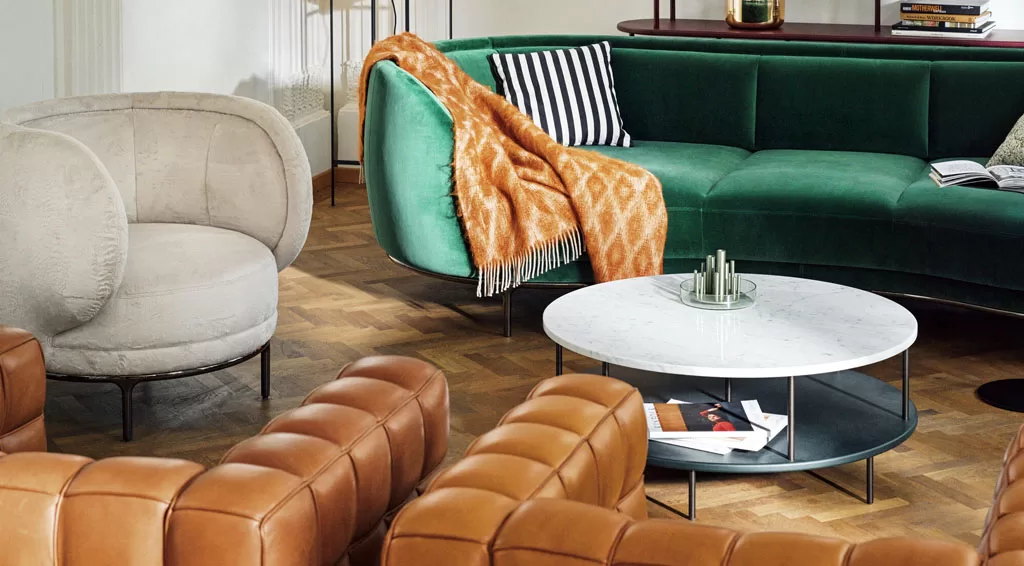

Wittmann Luxury Austrian Furniture, Handcrafted Sofas & Timeless Modern Design
Wittmann creates luxury Austrian furniture defined by exceptional comfort, masterful upholstery, meticulous craftsmanship, and a design culture shaped by more than a century of experience. Founded in 1896 and still family-owned, Wittmann produces its furniture at its workshops in Etsdorf, Lower Austria, where generations of specialized knowledge inform every sofa, lounge chair, dining chair, bed, and upholstered piece.
The Wittmann collection brings Austrian craftsmanship into dialogue with contemporary international design. Collaborations with Jaime Hayon, Sebastian Herkner, Luca Nichetto, EOOS, Federica Biasi, and other leading designers complement the company’s important relationship with Viennese Modernism and the work of Josef Hoffmann. The result is furniture that can be expressive or restrained, sculptural or architectural, but is always grounded in comfort, material quality, and enduring design.
What Makes Wittmann Furniture Different?
Wittmann distinguishes itself through an unusually close relationship between design, craftsmanship, and comfort.
Every piece begins with an idea, but that idea must ultimately succeed at the scale of the human body. A sofa needs to look beautiful from across the room and feel exceptional when someone sits on it. An armchair needs a distinctive silhouette while supporting the body naturally. A bed must contribute to the architecture of a bedroom while delivering the comfort expected from a company with generations of upholstery and mattress expertise.
This combination of aesthetic ambition and physical comfort is central to Wittmann.
The company does not separate design from craftsmanship. Designers create the vision, while experienced craftspeople translate that vision into furniture through upholstery, sewing, construction, material selection, and finishing.
The result is furniture designed not simply to be admired, but to be lived with.
Wittmann Has Been Creating Exceptional Austrian Furniture Since 1896
Wittmann’s history began in 1896 as a saddlery.
That origin is important because saddlery requires many of the same skills that later became essential to the company’s upholstered furniture: knowledge of leather and textiles, precision stitching, an understanding of tension and structure, and highly developed handcraftsmanship.
By the 1950s, Wittmann had established an international reputation as a manufacturer of upholstered furniture.
Today, sofas, chairs, armchairs, beds, and mattresses continue to be made according to demanding standards at the company’s Austrian workshops.
More than a century of accumulated knowledge gives Wittmann an unusually deep understanding of what lies beneath the visible surface of upholstered furniture.
Wittmann Furniture Is Handmade in Etsdorf, Lower Austria
Wittmann continues to manufacture exclusively at its headquarters in Etsdorf, Lower Austria.
This concentration of production allows specialist knowledge to remain closely connected to the company.
Experienced craftspeople work across upholstery, sewing, construction, assembly, and finishing, passing techniques from one generation to the next.
The value of this approach becomes apparent in the details.
Seams follow complex curves with precision. Upholstery transitions smoothly around sculptural forms. Different materials meet cleanly, while internal structures are engineered to maintain comfort and appearance over time.
The finished furniture may appear effortless, but that simplicity depends upon substantial expertise.
Austrian Craftsmanship Gives Wittmann Furniture Its Exceptional Character
Craftsmanship at Wittmann is not used as decoration.
Its purpose is to make sophisticated furniture possible.
Complex upholstery requires knowledge of how fabrics and leather behave under tension. Sculptural furniture requires an understanding of how padding can shape a form without compromising comfort.
Even seemingly simple pieces depend upon countless decisions about seams, foam density, support, structure, proportion, and finishing.
This expertise allows designers greater freedom.
An ambitious curve or unusual proportion can move from sketch to finished furniture because the workshops understand how to resolve it technically.
Craftsmanship therefore becomes a creative tool.
How Does Wittmann Create Such Exceptional Seating Comfort?
Wittmann develops upholstered furniture from the inside outward.
Comfort depends upon much more than the softness of the visible cushion. Internal structure, springs or webbing, multiple layers of carefully selected foam, upholstery techniques, seat depth, back angle, and overall proportion all influence how a sofa or chair feels.
Wittmann uses handmade metal or solid wood frames along with meticulously constructed sub-upholstery. Multiple layers of foam with different densities and compression characteristics help create support while maintaining comfort over time.
This sophisticated internal construction is one reason a Wittmann sofa or armchair can feel noticeably different from furniture designed primarily around appearance.
Comfort is engineered into the piece rather than added at the end.
Wittmann Luxury Sofas Combine Sculptural Design with Masterful Upholstery
Sofas sit at the center of the Wittmann collection.
The range includes individual sofas as well as highly flexible modular systems capable of creating expansive seating landscapes.
Some Wittmann sofas emphasize architectural clarity.
Others use soft curves, expressive upholstery, sculptural backs, or unusual proportions to establish a stronger visual identity.
What connects them is an emphasis on comfort.
The sofa is not treated as an architectural object that happens to provide seating. It is designed around the experience of sitting, relaxing, talking, reading, and living.
This makes Wittmann sofas particularly compelling for sophisticated residential interiors where comfort and design are equally important.
Wittmann Modular Sofas Adapt to Contemporary Living and Changing Interiors
Modular seating allows furniture to respond to architecture rather than forcing every room into a predetermined configuration.
Individual Wittmann sofa elements can be arranged according to room dimensions, circulation, views, and the way people use the space.
A compact composition can work within an apartment.
Larger configurations can organize an expansive living room, while open seating landscapes can establish zones within contemporary architecture.
Modularity also creates flexibility over time.
Additional components can allow a seating system to evolve as requirements change.
This gives modular furniture an important advantage in interiors designed for long-term use.
Vuelta by Jaime Hayon Has Become a Contemporary Wittmann Design Icon
Vuelta captures the distinctive character of the collaboration between Spanish designer Jaime Hayon and Wittmann.
Introduced in 2016, the collection combines sculptural curves, carefully controlled proportions, precise seam patterns, and exceptional upholstery.
The Vuelta armchair can be playful or sophisticated depending upon its material and color.
Velvet emphasizes its sensual character.
Leather gives it a more classic expression, while saturated colors transform the chair into a strong visual focal point.
Despite its distinctive silhouette, Vuelta remains remarkably versatile.
It can function as an individual statement chair or become part of a larger composition with Vuelta sofas and complementary pieces.
The Vuelta Anniversary Collection Celebrates Ten Years of a Wittmann Favorite
The tenth anniversary of Vuelta demonstrates how quickly a contemporary design can establish lasting relevance.
For the anniversary collection, Jaime Hayon revisited the design through carefully considered details rather than fundamentally changing its identity.
Optional piping emphasizes the contours of selected pieces, drawing attention to the precision of the silhouette and upholstery.
This approach reflects an important characteristic of Wittmann.
Good design does not need constant reinvention.
A strong piece can evolve through materials, details, colors, and craftsmanship while retaining the qualities that made the original successful.
Jaime Hayon Brings Spanish Exuberance to Austrian Furniture Craftsmanship
The collaboration between Jaime Hayon and Wittmann creates a compelling cultural dialogue.
Hayon brings imagination, humor, expressive curves, color, and a willingness to reinterpret historical references.
Wittmann contributes generations of Austrian upholstery expertise and a deep connection to Viennese design culture.
Together, these qualities produce furniture that feels sophisticated without becoming overly serious.
The Wittmann Hayon Workshop has explored sofas, armchairs, tables, and other furniture through sculptural proportions and unexpected material combinations.
Spanish exuberance meets Austrian precision.
Kolinas by Jaime Hayon Turns Upholstered Furniture into a Sculptural Landscape
Kolinas demonstrates the continuing evolution of the Hayon-Wittmann collaboration.
Inspired by the rolling hills of Austria, the collection uses rounded forms and flowing contours to create furniture with an almost landscape-like character.
The sofa and armchair feel generous and inviting, yet their proportions and piping details reveal the precision behind the apparent softness.
Kolinas reflects a broader movement within contemporary interiors toward furniture that feels emotional and tactile.
Minimalism is no longer the only expression of sophistication.
Softness, personality, color, and sculptural form can coexist with exceptional craftsmanship.
WittmannHayon Workshop Reinterprets the Spirit of Viennese Modernism
Jaime Hayon’s work with Wittmann is informed in part by the extraordinary design culture of early twentieth-century Vienna.
Rather than copying historical furniture, Hayon interprets the period’s holistic approach to interiors through a contemporary lens.
Curves become more playful.
Proportions become unexpected.
Materials interact in new ways, while color introduces another layer of expression.
This relationship between historical awareness and contemporary creativity is particularly appropriate for Wittmann.
The company preserves important Austrian design classics while simultaneously developing entirely new furniture for the way people live today.
Josef Hoffmann Remains Central to Wittmann’s Austrian Design Heritage
Josef Hoffmann is one of the most important figures in Austrian and international modern design.
Architect, designer, and co-founder of the Wiener Werkstätte, Hoffmann believed that architecture, furniture, objects, and interiors should be considered as parts of a complete environment.
Wittmann continues to produce authorized re-editions of important Hoffmann designs.
These pieces are not simply historical references.
Their clarity, proportion, craftsmanship, and understanding of the relationship between furniture and architecture continue to influence the contemporary Wittmann collection.
Hoffmann’s work provides a bridge between Viennese design history and the company’s future.
Josef Hoffmann Furniture Demonstrates Why Great Design Can Remain Relevant for Generations
One of the strongest arguments for timeless design is the continued relevance of furniture created many decades ago.
Hoffmann’s work demonstrates this clearly.
His furniture can sit naturally within contemporary architecture because its identity is based on proportion, structure, craftsmanship, and strong ideas rather than temporary stylistic trends.
Placed alongside contemporary Wittmann furniture, the historical pieces create an interesting dialogue.
The interior gains depth without becoming nostalgic.
Classic and contemporary design become parts of the same evolving story.
Wittmann’s Historic Austrian Furniture Re-Editions Preserve Important Design Culture
Producing a historical re-edition requires more than copying the appearance of an old piece.
Proportions, construction, upholstery, materials, and details all contribute to the authenticity of the design.
Wittmann’s manufacturing expertise makes the company particularly well suited to this work.
The historical furniture also influences the contemporary collection.
Designers working with Wittmann encounter a company whose archive includes important expressions of Austrian modernism and whose craftspeople understand techniques developed over generations.
History becomes an active creative resource.
Sebastian Herkner Brings Material Sensitivity and Contemporary Comfort to Wittmann
Sebastian Herkner is known for an approach to furniture that values material, craftsmanship, cultural references, and the human experience of objects.
These interests align naturally with Wittmann.
His designs for the company explore new ways of organizing seating while maintaining a strong emphasis on comfort.
Herkner’s work can feel relaxed without becoming informal and distinctive without depending upon novelty.
This balance makes his furniture particularly appropriate for residential, hospitality, and sophisticated contract interiors.
Miles by Sebastian Herkner Creates a New Kind of Freestanding Sofa
Miles challenges the assumption that a sofa should be positioned against a wall or organized around one obvious front.
Designed by Sebastian Herkner, the sofa is conceived as a freestanding object capable of participating more dynamically within a room.
This makes Miles particularly relevant to open-plan architecture.
Rather than defining the edge of a space, the sofa can inhabit its center and influence circulation around it.
Different sizes and seating heights extend its possibilities, including configurations appropriate for dining.
The result is a piece that sits between familiar furniture categories while maintaining the comfort expected from Wittmann.
Luca Nichetto Reinterprets Viennese Elegance Through Contemporary Furniture
Italian-Swedish designer Luca Nichetto brings an international perspective to Wittmann while engaging thoughtfully with the company’s Austrian heritage.
His work often balances clean structure with rich materiality and carefully considered details.
For Wittmann, Nichetto has explored the character of Viennese salon furniture through a contemporary vocabulary.
The result is not historical reproduction.
Instead, traditional ideas about elegance, conversation, and social interiors become the starting point for furniture designed around modern architecture and lifestyles.
Andes by Luca Nichetto Reimagines the Elegance of the Viennese Salon
The Andes collection takes inspiration from classically elegant salon furniture while giving it a contemporary architectural character.
Sofas and individual elements can be arranged in numerous compositions, allowing the collection to adapt to different spaces.
The proportions feel refined rather than oversized.
Metal details, piping, upholstery, and carefully controlled geometry give the furniture a sophisticated presence.
Andes works particularly well in interiors where designers want substantial comfort without visually heavy seating.
Its Viennese references remain subtle, allowing the furniture to feel unmistakably contemporary.
Federica Biasi Brings Relaxed Contemporary Design to the Wittmann Collection
Federica Biasi introduces another perspective into Wittmann’s evolving design vocabulary.
Her work demonstrates that relaxed furniture can still be precisely designed.
Softness is carefully controlled.
Casual proportions are balanced rather than arbitrary, and simplicity depends upon thoughtful decisions about scale and detail.
This sensibility complements Wittmann’s craftsmanship particularly well because apparently effortless upholstered forms often require considerable technical skill to execute successfully.
Bun by Federica Biasi Combines Casual Comfort with Sophisticated Austrian Upholstery
Bun has an inviting, relaxed character.
Its curved back and generous seat depth encourage the sitter to settle into the furniture rather than maintain a formal posture.
Different sizes make the sofa suitable for a range of interiors, while additional cushions can adjust seat depth and provide another layer of personalization.
The design appears uncomplicated, but its success depends upon proportion.
Bun is soft without becoming shapeless and casual without appearing careless.
This makes it particularly appealing for contemporary residential interiors where comfort is expected to feel immediate.
Wittmann Armchairs Combine Distinctive Design with Exceptional Upholstered Comfort
An armchair can have more personality than almost any other piece of furniture.
Unlike a large sofa, it does not need to visually organize an entire room.
This gives designers freedom to explore unusual forms, expressive colors, sculptural backs, distinctive legs, and different upholstery techniques.
Wittmann’s armchair collection takes advantage of this opportunity.
Designs range from historical classics to contemporary statement pieces, high-backed chairs, compact lounge chairs, and generously upholstered forms.
A single chair can become a focal point, while multiple chairs can create intimate conversation areas within larger rooms.
High-Backed Wittmann Chairs Create Privacy and Comfort Within Open Interiors
High-backed seating performs both an aesthetic and spatial function.
The extended back creates a stronger silhouette while providing a greater sense of enclosure for the sitter.
Within open-plan interiors, this can establish a small zone of privacy without constructing walls.
High-backed armchairs work especially well in reading areas, hotel lobbies, executive spaces, bedrooms, and large residential living rooms.
They create a place within a place.
Combined with Wittmann’s upholstery expertise, the typology becomes both visually architectural and physically comfortable.
Wittmann Dining Chairs Bring Upholstered Comfort to the Dining Table
Dining furniture increasingly reflects the desire to spend more time around the table.
Meals extend into conversation.
Dining tables become places for work, meetings, games, and everyday family life.
Comfort therefore becomes essential.
Wittmann’s upholstered dining chairs apply the company’s seating expertise at a more upright scale.
Proportion, back support, cushioning, and material all contribute to the experience.
The result is dining seating capable of complementing sophisticated contemporary tables while encouraging people to remain comfortably seated.
Wittmann Tables Add Material Contrast and Sculptural Form to Upholstered Interiors
Although Wittmann is renowned for upholstery, tables play an important role in creating complete interiors.
Occasional tables introduce contrast beside soft seating.
Dining tables establish gathering places, while carefully selected stone, wood, glass, and metal surfaces create relationships with the textures of sofas and chairs.
Tables also provide an opportunity for more structural and sculptural expression.
A strong base can become an architectural element within the room, while a refined top allows the beauty of the material to take greater prominence.
Wittmann Furniture Celebrates Fine Fabrics, Leather, Color, and Texture
Upholstery material can fundamentally change the character of a piece.
A sculptural armchair in velvet feels very different from the same design in leather.
A neutral textile can emphasize form, while a saturated color transforms the furniture into a focal point.
Piping can quietly outline a silhouette or create deliberate contrast.
Wittmann’s expertise allows designers to use these choices with confidence.
Material is not simply applied to the finished form.
Its thickness, elasticity, texture, grain, and behavior influence how the furniture is upholstered and how the final piece feels.
Wittmann Leather Furniture Combines Natural Material with Precision Upholstery
Leather is particularly revealing because it makes the quality of upholstery easy to see.
Curves, seams, edges, and transitions must be resolved precisely.
The natural character of the hide adds depth and individuality to the furniture.
Over time, leather also develops a patina that records use.
This makes it particularly appropriate for furniture intended to remain in an interior for many years.
Wittmann’s heritage in saddlery gives leather a meaningful connection to the company’s origins as well as its contemporary collection.
Wittmann Beds Bring Austrian Upholstery Expertise into the Bedroom
Wittmann’s knowledge of comfort extends naturally into sleeping.
The company offers a comprehensive bed collection spanning Design Line complete beds, Classic Line complete beds, and Advanced Line modular beds, together with bed bases, inserts, mattresses, and toppers.
This allows the sleeping environment to be considered as a complete system.
Visual design and physical comfort receive equal attention.
Upholstered beds bring softness and material richness to the room, while mattresses and internal components address the quality of sleep itself.
The bedroom becomes an environment for both design and restoration.
Wittmann Design Line Beds Turn the Bed into a Complete Design Statement
Within the Design Line, the bed becomes a major piece of furniture rather than simply a frame surrounding a mattress.
Upholstered headboards, distinctive proportions, material choices, and carefully developed forms give the bed architectural presence.
This is particularly effective in contemporary bedrooms where the bed occupies a large portion of the visual field.
Rather than treating the bedroom as an afterthought to the living areas, a design-focused bed establishes the room’s character and creates a strong foundation for lighting, rugs, side tables, and other furnishings.
Wittmann Advanced Line Modular Beds Allow Greater Flexibility and Personalization
Bedrooms vary considerably in architecture and individual requirements.
A modular bed system can respond more precisely to these differences.
Headboards, bed components, upholstery, mattresses, and other elements can be considered according to the desired sleeping experience and visual composition.
This flexibility reflects the same thinking found in Wittmann’s modular sofas.
Furniture should respond to the person and the space rather than requiring the person to adapt to a fixed solution.
Wittmann Mattresses Extend the Company’s Understanding of Comfort Beyond Furniture Design
The quality of a bed cannot be judged only by its exterior.
Mattress construction plays a fundamental role in sleep, support, and long-term comfort.
Wittmann’s history of producing both upholstered furniture and sleeping systems gives the company an unusual perspective.
The visible design and the invisible performance are developed within the same culture of comfort.
For clients creating sophisticated bedrooms, this makes it possible to consider aesthetics and sleep quality together rather than as unrelated purchases.
Wittmann Creates Furniture for Sophisticated Residential Interiors
Wittmann’s collection is particularly well suited to residential environments where furniture is expected to provide long-term comfort as well as strong design.
A modular sofa can establish the social center of a living room.
An expressive Vuelta or Kolinas armchair creates an individual moment, while dining chairs and tables support gathering.
Beds extend the same level of craftsmanship into private spaces.
Historical Josef Hoffmann designs can then introduce another layer of cultural depth.
The result can feel curated rather than coordinated.
Different periods and designers coexist through shared standards of craftsmanship and quality.
Wittmann Furniture Brings Residential Comfort to Luxury Hospitality Interiors
Hotels and hospitality spaces increasingly seek the comfort and individuality associated with residential design.
Wittmann is particularly well suited to this approach.
Sofas can create inviting lobby landscapes.
Armchairs establish intimate conversation areas.
Dining seating supports restaurants and lounges, while beds bring the company’s expertise directly into guestrooms and suites.
Because the collection combines contemporary designs with established classics, hospitality interiors can achieve character without depending upon short-lived trends.
Wittmann Furniture Is Designed for High-End Public and Private Interiors
Wittmann works across private residences, hospitality environments, public interiors, and bespoke projects.
This versatility comes from the relationship between sophisticated design and rigorous craftsmanship.
A piece needs to function beautifully in a private living room, but the same standards of comfort, durability, and material quality can also make it appropriate for demanding professional environments.
For architects and interior designers, this broad applicability makes Wittmann a valuable resource when a project requires furniture with both visual distinction and proven manufacturing expertise.
Bespoke Wittmann Furniture Supports Custom Interior Design and Architectural Projects
Some projects cannot be resolved entirely through standard furniture specifications.
Dimensions may need to respond to unusual architecture.
Materials may need to coordinate with a highly specific palette, or an interior may require a unique furniture solution.
Wittmann’s craftsmanship and flexible production make bespoke commissions an important part of the company’s capabilities.
This is particularly relevant for architects and interior designers working on high-end residential, hospitality, and public projects where exclusivity and project-specific detailing matter.
Wittmann Gives Interior Designers Exceptional Freedom Through Upholstery and Material Selection
The character of upholstered furniture can change dramatically through specification.
A restrained neutral textile creates a very different impression from richly colored velvet or fine leather.
Contrasting piping can emphasize geometry.
Tone-on-tone detailing makes the silhouette quieter.
Wood, metal, stone, and glass then create additional relationships throughout the interior.
Wittmann’s material expertise allows designers to develop furniture around the broader project palette.
The goal is not merely to select a product.
It is to configure that product so that it belongs naturally within the room.
Wittmann Furniture Can Be Expressive Without Becoming Trend-Driven
Many of Wittmann’s most memorable contemporary designs have strong personalities.
Vuelta is unmistakable.
Kolinas is sculptural.
Andes has a distinct sense of Viennese elegance, while Bun feels relaxed and contemporary.
Yet these designs do not depend entirely upon fashion.
Their character is grounded in proportion, comfort, material, and craftsmanship.
This gives them a greater chance of remaining relevant as surrounding interiors evolve.
Distinctive furniture and timeless furniture do not need to be opposites.
A piece can have personality and still possess longevity.
Wittmann Connects Viennese Modernism with Contemporary International Design
Few furniture manufacturers can move as naturally between Josef Hoffmann and Jaime Hayon.
That range is one of Wittmann’s greatest strengths.
The company’s Austrian heritage provides historical depth, but contemporary collaborations keep the collection evolving.
Sebastian Herkner, Luca Nichetto, EOOS, Federica Biasi, Jaime Hayon, and other designers bring perspectives shaped by different countries, disciplines, and generations.
Their work enters a manufacturing culture with more than a century of accumulated knowledge.
The resulting furniture feels international while retaining a distinctly Austrian foundation.
Why Is Wittmann Furniture a Strong Choice for Architects and Interior Designers?
Wittmann combines qualities that are particularly valuable in sophisticated design projects: distinctive contemporary furniture, important historical re-editions, exceptional upholstery expertise, extensive material options, modular systems, sleeping solutions, bespoke capabilities, and production rooted in one Austrian workshop.
This gives designers considerable flexibility.
A project can incorporate one sculptural statement chair or develop an entire collection of sofas, dining seating, beds, tables, and complementary furniture.
Equally important, the designs have enough individuality to create memorable interiors without sacrificing the comfort clients expect from furniture they will use every day.
Long-Lasting Furniture Begins with Quality Materials and Repairable Craftsmanship
Furniture designed to remain in use for many years requires more than a timeless appearance.
Its internal construction needs to retain support.
Upholstery must be expertly executed, and materials need to be selected with longevity in mind.
Craft-based manufacturing can also make maintenance and refurbishment more realistic over the life of a piece.
This approach represents a practical form of sustainability.
The longer furniture remains desirable, comfortable, and serviceable, the less frequently it needs to be replaced.
Wittmann’s emphasis on enduring quality therefore has environmental as well as aesthetic value.
Wittmann’s Workshop Culture Preserves Specialized Furniture-Making Knowledge
Furniture manufacturing depends upon skills that can disappear when production becomes disconnected from craft.
Wittmann’s continued production in Etsdorf allows specialist knowledge to remain concentrated within the company.
Experienced upholsterers and craftspeople understand techniques that cannot be fully captured by drawings or digital files.
They know how materials behave.
They recognize when a curve is correct by sight and touch, and they understand how subtle changes beneath the upholstery affect the finished piece.
Preserving this knowledge is an important part of preserving the quality of European furniture making.
Wittmann Demonstrates Why Comfort Is an Essential Part of Luxury Furniture
Luxury furniture is sometimes defined primarily by material or appearance.
Wittmann adds another criterion: how the furniture feels when it is used.
A beautiful sofa that is uncomfortable fails at one of its most important purposes.
A lounge chair should invite someone to sit.
A dining chair should remain comfortable through a long conversation, while a bed should contribute meaningfully to restorative sleep.
This focus on physical experience makes comfort part of the design rather than a technical specification.
The most successful Wittmann furniture feels as considered to the body as it appears to the eye.
Wittmann’s 2026 Collection Continues the Dialogue Between Heritage and Contemporary Design
Wittmann continues to develop new furniture while revisiting established designs with care.
Recent introductions and developments include pieces such as Beletage, Beletage Modular, Tuya, Kolinas, Bun “Petit,” Bun, and Atrium Modular Sofa, alongside anniversary editions of the Vuelta collection.
These additions demonstrate that the company does not treat its heritage as a fixed archive.
Historical knowledge becomes the foundation for experimentation.
New designers, new forms, new materials, and evolving ways of living continue to expand what Austrian upholstered furniture can become.
Discover Wittmann Austrian Sofas, Armchairs, Beds, Designer Furniture, and Modern Classics at Scott + Cooner
Scott + Cooner offers Wittmann as part of our curated collection of exceptional contemporary European furniture and international design.
Since 1995, Scott + Cooner has worked with architects, interior designers, and design-conscious clients seeking extraordinary modern furniture, lighting, kitchens, closets, rugs, accessories, textiles, and architectural products for sophisticated residential and contract interiors.
Our experienced team can help you explore Wittmann sofas, modular seating, armchairs, lounge chairs, dining furniture, tables, beds, mattresses, Josef Hoffmann classics, contemporary collections, fabrics, leather, finishes, and project-specific configurations.
Whether you’re furnishing a contemporary residence, luxury bedroom, hospitality environment, hotel, lounge, public interior, or bespoke architectural project, Scott + Cooner can help you discover Wittmann furniture that brings together Austrian craftsmanship, extraordinary comfort, Viennese design heritage, international creativity, and timeless modern design.