
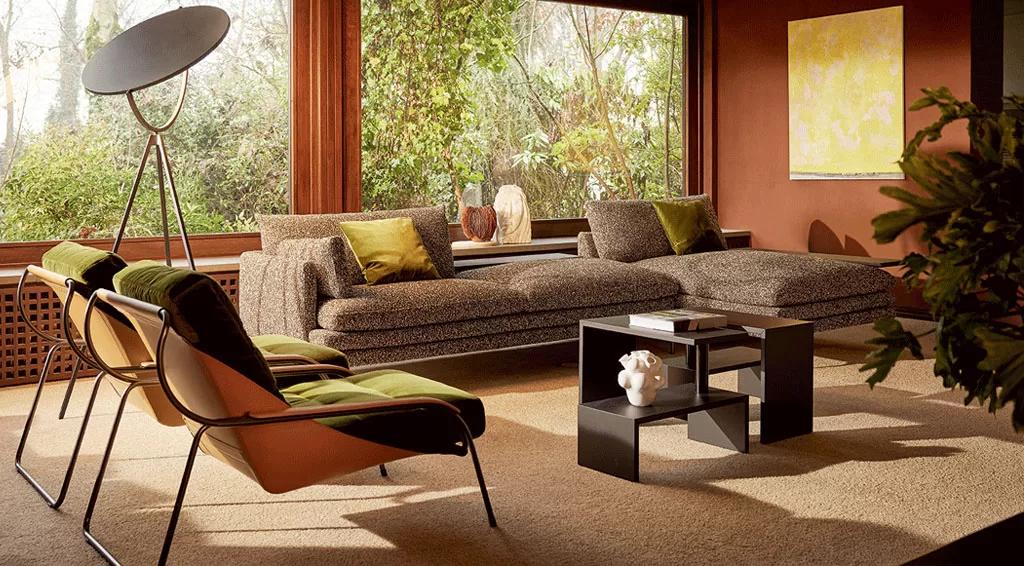

Zanotta Iconic Italian Furniture, Radical Design Classics & Contemporary Living
Zanotta occupies a singular place in the history of modern Italian furniture. For seventy years, the company has brought together experimentation, Italian craftsmanship, technological innovation, radical thinking, and an extraordinary roster of architects and designers to create furniture that challenges convention while remaining deeply connected to everyday life.
The Zanotta collection spans contemporary sofas, modular seating, armchairs, lounge chairs, dining chairs, tables, desks, coffee tables, beds, storage, mirrors, and accessories alongside legendary design icons such as Sacco, Mezzadro, Quaderna, Sciangai, Tonietta, and Leonardo. The result is not simply a furniture catalogue, but an evolving portrait of Italian design culture—from postwar experimentation and Radical Design to sophisticated contemporary living.
What Is Zanotta Known for in Italian Furniture and Modern Design?
Zanotta is known for transforming provocative design ideas into furniture that becomes part of everyday life.
Throughout its history, the company has collaborated with some of the most influential figures in architecture and industrial design, producing pieces that challenged conventional assumptions about what a chair, table, sofa, or household object should be.
The result is an unusually diverse collection.
Zanotta can be playful, conceptual, architectural, elegant, minimalist, colorful, or deliberately unconventional. What connects these different expressions is a willingness to experiment while maintaining the material quality and manufacturing expertise associated with exceptional Italian furniture.
Zanotta Has Helped Shape the History of Italian Design
Few furniture companies have participated so directly in so many important chapters of modern Italian design.
Zanotta emerged during a period when Italy was becoming an international center for experimentation in furniture, architecture, industrial design, art, and popular culture.
Rather than limiting itself to established furniture conventions, the company became a platform for new ideas.
Designers were given the opportunity to reconsider familiar objects and explore new materials, technologies, behaviors, and forms.
That openness produced furniture that frequently anticipated broader changes in the way people would live.
Zanotta Brings Together Italian Craftsmanship, Radical Thinking, and Industrial Innovation
Zanotta began as a specialist in tailored upholstered furniture and gradually expanded into a remarkably broad collection.
That history remains important.
Even the company’s most conceptual designs ultimately need to succeed as physical objects.
Frames need to support the body.
Upholstery needs to provide comfort.
Surfaces need to withstand everyday use, while experimental materials need to be transformed into reliable furniture.
Zanotta’s importance comes partly from its ability to bridge these worlds: imaginative design thinking on one side and sophisticated Italian production on the other.
How Did Zanotta Help Transform Modern Furniture Design?
Zanotta helped transform modern furniture by being willing to produce ideas that other manufacturers might have considered too experimental, too unconventional, or too difficult to categorize.
A tractor seat could become a stool.
A flexible bag filled with polystyrene beads could become an armchair.
A black grid printed over white laminate could become an entire architectural furniture system.
A folding group of wooden rods could become a coat stand.
These ideas did more than create unusual products.
They questioned established assumptions about furniture and helped expand the vocabulary of modern design.
Zanotta Collaborates with Some of the Most Important Designers in Modern Design History
The history of Zanotta is inseparable from its designers.
The company’s collaborations span generations and movements, bringing together architects, industrial designers, artists, and radical thinkers.
Names associated with Zanotta include Achille Castiglioni, Pier Giacomo Castiglioni, Gae Aulenti, Ettore Sottsass, Carlo Mollino, Joe Colombo, Alessandro Mendini, Marco Zanuso, Bruno Munari, Superstudio, De Pas, D’Urbino and Lomazzi, Max Bill, Giuseppe Terragni, and many others.
Contemporary collaborations continue this tradition, allowing the collection to evolve rather than becoming a museum of its own history.
Sacco Redefined the Very Idea of an Armchair
Few pieces of furniture challenged convention as completely as Sacco.
Designed in 1968 by Piero Gatti, Cesare Paolini, and Franco Teodoro, Sacco abandoned the traditional structure of an armchair.
There was no conventional frame defining the back, arms, or seat.
Instead, the flexible form adapted to the person using it.
This changed the relationship between furniture and body.
Rather than requiring the sitter to conform to a predetermined posture, the chair responded to the sitter.
Sacco became an emblem of informal living and remains one of the most recognizable objects in the history of Italian design.
Sacco Demonstrates How Radical Design Can Become Timeless Design
Experimental furniture can sometimes become inseparable from the moment in which it was created.
Sacco achieved something different.
Its idea was radical, but the underlying concept was remarkably simple: create a seat that adapts to the body rather than prescribing one fixed position.
That idea remains relevant.
Sacco can appear in a sophisticated contemporary residence, creative office, children’s room, hotel lounge, or design collection without losing its identity.
Its continued relevance demonstrates one of Zanotta’s greatest strengths.
A design can be culturally provocative and still become an enduring object.
Mezzadro Turns an Agricultural Tractor Seat into an Icon of Italian Design
Mezzadro is one of the clearest examples of the Castiglioni brothers’ ability to see familiar industrial components in entirely new ways.
Designed by Achille and Pier Giacomo Castiglioni in 1957 and later put into production by Zanotta, Mezzadro incorporates a pressed-metal tractor seat into an unconventional stool.
The design brings components associated with agriculture, industry, cycling, and other practical worlds into the domestic environment.
What might initially appear humorous is also intellectually rigorous.
Mezzadro asks why a component designed perfectly for one context cannot acquire an entirely different meaning in another.
Achille and Pier Giacomo Castiglioni Brought Wit and Intelligence to Zanotta
The work of Achille and Pier Giacomo Castiglioni demonstrates that serious design does not need to be solemn.
Their objects often contain an element of surprise.
Existing components are reconsidered.
Ordinary materials acquire new meanings.
Function is analyzed closely, but humor remains present.
Zanotta provided a natural environment for this kind of thinking.
The company’s willingness to transform unconventional ideas into carefully manufactured products allowed experimental concepts to move from exhibitions and prototypes into actual interiors.
Quaderna by Superstudio Is One of the Defining Icons of Radical Italian Design
Quaderna transforms the simplest possible geometry into an unforgettable visual system.
Developed by Superstudio and produced by Zanotta beginning in the early 1970s, the collection uses pure volumes covered by a precise black grid over white laminate.
The effect is simultaneously neutral and visually powerful.
Tables, desks, consoles, benches, and other objects appear almost like drawings translated into three dimensions.
The grid dissolves the distinction between surface and structure, giving Quaderna an architectural presence that remains unmistakable decades after its creation.
The Quaderna Grid Turns Furniture into an Architectural Landscape
The power of Quaderna lies in repetition.
The same grid continues across horizontal and vertical surfaces, making the furniture appear as part of a potentially endless system.
A table is no longer simply a tabletop supported by legs.
It becomes one fragment of a larger conceptual landscape.
This relationship to architecture makes Quaderna particularly compelling in contemporary interiors.
Against stone, wood, concrete, plaster, or saturated color, its precise black-and-white geometry creates a strong graphic counterpoint.
Superstudio and Zanotta Connected Radical Architecture with Everyday Furniture
Superstudio emerged from the experimental architectural culture of Florence during the late 1960s.
The group’s work questioned conventional assumptions about cities, buildings, objects, and consumer culture.
Quaderna translated some of those ideas into usable furniture.
This was an important achievement.
A conceptual architectural investigation became a table, desk, bench, or storage object that could physically enter someone’s home.
Zanotta’s role was essential because the manufacturer understood that an intellectually challenging idea could also become a compelling commercial product.
Sciangai Turns the Everyday Coat Rack into a Kinetic Sculpture
Designed by De Pas, D’Urbino and Lomazzi, Sciangai reconsiders one of the most ordinary household objects.
Instead of a fixed vertical stand, a group of wooden elements opens and closes through a central connection.
When expanded, the coat rack resembles a burst of oversized sticks.
When folded, it becomes compact.
The movement is part of the design.
Sciangai therefore changes not only how the object looks but how the user interacts with it.
This ability to find unexpected possibilities within familiar typologies is characteristic of Zanotta.
Zanotta’s Design Icons Remain Relevant Because Their Ideas Are Stronger Than Trends
A furniture design can survive stylistic change when its identity comes from a clear idea rather than superficial fashion.
Zanotta’s icons demonstrate this repeatedly.
Sacco is based on adaptability.
Mezzadro is based on reinterpretation.
Quaderna explores the relationship between geometry, architecture, and objects.
Sciangai transforms function through movement.
Because these concepts remain understandable, the furniture continues to communicate with new generations.
The pieces feel historical without becoming obsolete.
Zanotta’s Museum Presence Reflects Its Importance to International Design Culture
Zanotta furniture is represented extensively in museum collections around the world.
That recognition reflects more than aesthetic quality.
Many Zanotta designs represent important moments in the evolution of furniture typology, technology, material, or cultural thinking.
Museum recognition also gives designers and collectors an interesting opportunity.
A piece can function perfectly within daily life while simultaneously belonging to the broader history of design.
The object becomes both furniture and cultural artifact.
Zanotta Has Received Some of the Most Important Awards in International Design
The company’s history includes dozens of award-winning designs and multiple Compasso d’Oro recognitions.
Awards alone do not make furniture significant, but Zanotta’s record demonstrates the consistency with which the company has supported meaningful innovation.
Recognition spans different generations and categories.
This is particularly notable because Zanotta has never depended upon one single design language.
Experimental icons coexist with restrained contemporary pieces, sophisticated upholstery, sculptural tables, and highly functional everyday objects.
Zanotta Sofas Combine Italian Upholstery with Contemporary Flexibility
Zanotta began with a strong foundation in upholstered furniture, and sofas remain central to the collection.
Current designs include monobloc, linear, corner, and modular configurations capable of adapting to both residential and public environments.
Comfort is fundamental, but the collection explores it through different visual approaches.
Some sofas are architectural and restrained.
Others use softer volumes, relaxed upholstery, visible tailoring, or more expressive proportions.
This variety allows designers to choose seating according to the specific character of the room rather than adapting every project to one house style.
Zanotta Modular Sofas Create Flexible Contemporary Living Landscapes
Contemporary living spaces often need furniture capable of adapting to architecture and changing patterns of use.
Modular sofas provide this flexibility.
Individual components can create compact configurations or expand into large seating landscapes.
Open-ended elements can maintain visual connection between different areas of a room, while corner pieces establish more defined zones.
This approach is particularly useful within open-plan architecture where furniture needs to help organize space without relying upon walls.
Za Brings Relaxed Contemporary Comfort to Zanotta Seating
Za represents a softer and more informal side of contemporary Zanotta.
Generous upholstery and a relaxed visual character create seating that feels immediately inviting.
This type of sofa responds to the changing role of the living room.
People no longer sit in only one formal position.
They read, work, talk, watch, recline, and move throughout the day.
Furniture needs to support these different behaviors while still contributing to the architecture of the room.
Pianoalto Demonstrates Zanotta’s Approach to Refined Modular Upholstery
Pianoalto explores the sofa as an adaptable system.
Different components can create compositions appropriate for rooms of varying scales.
The visual language remains sophisticated and architectural, allowing the seating to establish a strong presence without overwhelming surrounding furniture or art.
This balance is important in luxury residential interiors.
A large sofa often occupies more visual space than any other piece in the room, making proportion, upholstery, detailing, and configuration essential design decisions.
Zanotta Armchairs Range from Historic Icons to Contemporary Statement Seating
The armchair category reveals the extraordinary breadth of Zanotta.
Historic pieces can sit beside new designs without making the collection feel disconnected.
Some armchairs emphasize upholstery and comfort.
Others explore structure, unusual materials, movement, or sculptural form.
This makes Zanotta especially useful for interiors built through contrast.
A contemporary sofa can be paired with a historic design icon.
A restrained architectural room can accommodate one highly expressive chair.
Furniture from different periods creates a richer interior conversation.
Maggiolina Brings Italian Elegance and Modernist Structure to the Lounge Chair
Maggiolina is an important example of Zanotta’s relationship with historic Italian design.
Designed by Marco Zanuso, the chair demonstrates how structure, upholstery, and material can remain visibly distinct while forming one coherent object.
Rather than hiding the construction completely beneath upholstery, the design allows different components to express their own roles.
This gives the chair a sense of technical clarity as well as comfort.
Within contemporary interiors, that visible logic feels remarkably current.
Carlo Mollino Adds an Expressive Architectural Dimension to Zanotta
Carlo Mollino occupies a unique position within twentieth-century Italian architecture and design.
His furniture combines structural experimentation, sensual curves, craftsmanship, and an unmistakably personal imagination.
Zanotta’s relationship with Mollino’s work adds another dimension to the collection.
Where Radical Design might rely on conceptual provocation, Mollino’s furniture often creates intensity through structure and form.
The result demonstrates how many different creative movements can coexist within the broader history of Italian design.
Zanotta Dining Chairs Combine Everyday Function with Design Intelligence
Dining chairs are among the most demanding furniture typologies.
They need to remain comfortable through extended meals and conversation while being compact enough to work in groups around a table.
They must also look compelling from multiple angles.
Zanotta’s chair collection approaches these requirements through different materials and structural ideas.
Wood, metal, upholstery, leather, and molded components create varied expressions while maintaining an emphasis on proportion and usability.
Tonietta Demonstrates the Elegance of Structural Reduction
Tonietta is a particularly refined example of design through reduction.
The chair achieves character without unnecessary visual complexity.
Its slender structure creates lightness, while carefully resolved proportions allow it to remain elegant from every angle.
This kind of furniture is especially valuable in dining rooms because repetition magnifies every design decision.
A chair that appears beautifully balanced individually becomes even more compelling when six, eight, or more surround a table.
Zanotta Tables Bring Architecture and Sculpture into Everyday Life
Tables occupy a unique position between furniture and architecture.
Their large horizontal surfaces influence circulation and organize the way people gather.
Zanotta has repeatedly used the table as a field for experimentation.
The collection includes restrained contemporary dining tables, expressive sculptural bases, historic masterpieces, desks, consoles, and conceptual designs such as Quaderna.
Materials and structural approaches vary considerably.
This breadth allows tables to serve either as quiet foundations for an interior or as significant visual statements.
Reale Demonstrates the Structural Imagination of Carlo Mollino
Reale transforms the table base into an expressive structural system.
The design demonstrates Mollino’s fascination with the relationship between engineering and organic form.
Instead of concealing how the table stands, the structure becomes the primary visual event.
A transparent top can make this especially apparent, allowing the base to be understood from above as well as from the side.
The result is furniture that rewards close observation while remaining completely functional.
Leonardo Brings the Familiar Trestle Table into the Modern Design Canon
The trestle is one of the oldest and most practical table structures.
Leonardo demonstrates how an established typology can be refined into a modern design object.
The supporting structure remains visually understandable.
There is no need to hide the way the table works.
This directness gives Leonardo a lasting quality.
It can sit comfortably within a contemporary interior because its character comes from proportion, construction, and material rather than decorative styling.
Zanotta Desks and Console Tables Bring Design to Work and Transitional Spaces
The boundaries between living and working continue to evolve.
A desk within a home needs to function efficiently without making the surrounding room feel like a conventional office.
Console tables need to occupy narrow spaces while still contributing to the architecture.
Zanotta’s collection addresses these categories with the same design attention given to more prominent furniture.
A work surface can become an elegant piece of the interior rather than a purely utilitarian necessity.
Zanotta Coffee Tables Turn Small Functional Surfaces into Design Objects
Coffee tables and side tables may be smaller than sofas or dining tables, but they are often viewed at close range and used constantly.
Zanotta has long treated these categories as opportunities for experimentation.
The collection explores different heights, shapes, materials, storage functions, mobility, and structural ideas.
Some designs are deliberately quiet.
Others are immediately recognizable icons.
Their relatively small scale also makes occasional tables an accessible way to introduce an important piece of Italian design into an existing interior.
Quaderna Coffee Tables Bring Radical Italian Design to the Center of the Living Room
The Quaderna grid becomes particularly powerful at coffee-table scale.
Placed within a seating composition, the precise black-and-white geometry creates a graphic contrast with soft upholstery.
The table can work equally well beside neutral contemporary furniture or within a more colorful, eclectic interior.
Because the visual idea is so clear, Quaderna does not depend upon matching pieces.
One table can introduce the conceptual language of Superstudio into the room.
Zanotta Beds Bring Tailored Italian Design into the Bedroom
Zanotta’s bed collection combines upholstered comfort with careful attention to structure, stitching, proportion, and useful details.
Current designs range from visually restrained beds to more expressive upholstered forms and models incorporating storage or accessory functions.
The bed is treated as a major piece of furniture rather than merely a support for a mattress.
This is particularly important in contemporary bedrooms where the bed often establishes the room’s principal architectural and material character.
Za Bed Extends Relaxed Contemporary Design into the Bedroom
The design philosophy behind Za extends naturally from living into sleeping.
Soft upholstery creates an inviting atmosphere while the bed maintains the contemporary identity of the broader collection.
This continuity can be especially effective in residences where designers want bedrooms and living spaces to feel connected without simply repeating the same materials.
A well-designed upholstered bed brings texture, comfort, and visual softness into the room.
Zanotta Storage Furniture Combines Organization with Distinctive Italian Design
Storage is essential to creating calm interiors.
Sideboards and cupboards organize everyday objects while providing surfaces for art, lighting, books, and personal collections.
Zanotta approaches storage as furniture rather than anonymous cabinetry.
Proportion, material, detailing, and visual identity remain important.
This allows a storage piece to participate in the overall composition of a room rather than disappearing completely into the architecture.
Quaderna Storage Extends Superstudio’s Grid into Functional Contemporary Furniture
The Quaderna system demonstrates how one strong idea can move across multiple furniture categories.
Applied to sideboards and cupboards, the grid turns storage into an architectural object.
Doors and volumes become almost abstract because the continuous pattern reduces the visual distinction between individual components.
Within a contemporary room, this can create an especially striking contrast with natural wood, stone, textured fabrics, or expressive art.
Zanotta Mirrors Add Shape, Reflection, and Visual Depth to Contemporary Interiors
Mirrors alter both perception and light.
They can visually expand a room, reflect architecture, introduce unusual geometry, and create relationships between different areas of an interior.
Zanotta treats mirrors as designed objects rather than purely functional surfaces.
Their shape, frame, scale, and position can contribute to the composition of the room.
In smaller spaces, this can be especially powerful because one object can simultaneously provide function and change the perceived architecture.
Zanotta Accessories Demonstrate That Everyday Objects Deserve Serious Design
Some of Zanotta’s most memorable designs belong to categories that might otherwise receive little attention.
Coat racks, stools, small tables, and other accessories become opportunities to reconsider familiar behavior.
Sciangai and Mezzadro demonstrate this clearly.
The lesson is broader than the individual products.
Good design does not need to be reserved for the largest or most expensive objects in a room.
Everyday interactions can become more interesting when familiar things are reconsidered intelligently.
Zanotta Edizioni Blurs the Boundary Between Furniture, Art, and Collectible Design
Zanotta Edizioni extends the company’s experimental character into limited and numbered pieces that occupy the territory between furniture and art.
These works demonstrate the importance of artistic dialogue within Zanotta’s history.
Unusual materials, forms, and concepts can be explored without the constraints associated with conventional furniture categories.
For collectors and sophisticated interiors, Edizioni pieces can function as usable objects while carrying the presence and individuality of sculptural art.
Zanotta Has Maintained a Long Dialogue with Contemporary Art
Italian Radical Design emerged within a cultural environment where architecture, visual art, performance, politics, and industrial design frequently overlapped.
Zanotta’s history reflects that cross-pollination.
The company has repeatedly supported objects that resist simple classification.
Some pieces function as furniture while making conceptual statements.
Others approach sculpture.
This relationship with art helps explain why so many Zanotta designs continue to feel provocative even after becoming established classics.
Italian Craftsmanship Gives Zanotta’s Experimental Ideas Physical Credibility
A provocative concept is only the beginning of a successful product.
Furniture needs to be constructed, finished, upholstered, assembled, transported, maintained, and used.
Zanotta’s manufacturing knowledge allows experimental ideas to survive this transition.
Fine upholstery, precise metalwork, woodworking, laminate technology, molded components, and other specialized processes turn drawings and prototypes into durable furniture.
This is where Italian craftsmanship and radical design meet.
One provides imagination; the other makes that imagination inhabitable.
Zanotta Upholstery Combines Tailoring, Ergonomics, and Material Quality
Contemporary Zanotta sofas and armchairs reveal the company’s original expertise in sartorial upholstered furniture.
Tailored stitching defines surfaces and edges.
Internal construction provides support and ergonomics, while carefully selected fabrics and leathers influence both appearance and touch.
These details matter because upholstered furniture is experienced physically.
A sofa must succeed when viewed from across the room, but its real test begins when someone sits down.
Zanotta’s design culture recognizes both requirements.
Zanotta Uses Material Innovation to Expand the Possibilities of Furniture
The history of modern design is closely tied to material experimentation.
New foams, plastics, metals, laminates, textiles, and manufacturing processes changed what furniture could become.
Zanotta embraced these possibilities early.
Sacco would not exist in its familiar form without expanded polystyrene beads.
Quaderna depends upon its specially developed grid laminate.
Other designs reveal equally close relationships between concept and material.
The material is not simply selected after the form has been designed.
It frequently makes the form possible.
Zanotta Furniture Is Designed for Durability and Long-Term Relevance
Zanotta describes its contemporary approach around quality, natural materials, durability, and products designed to avoid rapid obsolescence.
This is an important evolution of the modern design tradition.
Innovation does not need to imply disposability.
A product can introduce a new idea while still being engineered for a long life.
Zanotta’s historic collection offers compelling evidence.
Many pieces designed decades ago remain desirable precisely because the original concepts were strong enough to survive changing trends.
Furniture That Can Be Disassembled Supports a More Circular Approach to Design
Zanotta emphasizes design synthesis and the use of components that can be assembled and disassembled.
This approach can improve maintenance while making materials easier to separate at the end of a product’s useful life.
It also encourages designers to think more carefully about how furniture is constructed.
Complexity is not automatically a sign of sophistication.
Sometimes the more intelligent solution uses fewer, better-considered components.
Zanotta Demonstrates That Sustainability and Design Longevity Are Closely Connected
One of the most sustainable pieces of furniture may be the one people never want to discard.
Longevity depends partly upon construction, but emotional and cultural durability matter too.
An object that remains useful yet feels aesthetically obsolete may still be replaced.
Zanotta’s strongest designs resist that problem.
Clear ideas and distinctive identities allow pieces such as Sacco, Mezzadro, Quaderna, Sciangai, and Tonietta to remain relevant across generations.
Zanotta Furniture Works Beautifully in Sophisticated Contemporary Residences
Zanotta offers designers an unusually broad palette for residential interiors.
A room can begin with a comfortable contemporary modular sofa and incorporate a historic icon as a counterpoint.
A Quaderna table can introduce graphic architecture.
Mezzadro can add wit.
A Carlo Mollino design brings sculptural complexity, while quieter contemporary tables and chairs allow art or architecture to take greater prominence.
The result does not need to resemble a showroom.
Zanotta works particularly well in interiors that feel collected over time.
Zanotta Design Icons Can Create Powerful Focal Points Without Furnishing an Entire Room
One of the advantages of iconic furniture is that a single piece can transform the character of an interior.
A Sacco chair introduces informality.
Mezzadro creates an immediate moment of recognition and surprise.
Quaderna adds graphic precision.
Sciangai becomes a functional sculpture.
This allows designers to incorporate Zanotta selectively.
One historic piece can coexist with furniture from other manufacturers, custom millwork, antiques, contemporary art, and architectural materials.
Zanotta Furniture Encourages Interiors That Mix Different Periods of Design
Sophisticated contemporary interiors increasingly avoid rigid adherence to one historical period.
A 1950s chair might sit beside a newly designed sofa.
Radical Italian furniture from the 1970s can coexist with contemporary lighting or a traditional artwork.
Zanotta’s catalogue naturally supports this approach because the collection itself spans multiple generations.
The common thread is not a uniform visual style.
It is the quality and intelligence of the design.
Zanotta Is Particularly Relevant to Collectors of Important Modern Design
For collectors, provenance and cultural significance matter alongside beauty and function.
Zanotta’s long relationships with major designers and architects give many pieces an established place within design history.
Yet the furniture does not need to remain untouched.
These are objects intended for use.
A Quaderna table can host dinner.
A Sacco chair can be sat in.
A Sciangai can hold coats.
This combination of cultural importance and everyday usefulness is part of the appeal.
Zanotta Furniture Brings Design History into Everyday Life
Design history can sometimes feel remote when encountered only through books and museums.
Furniture changes that relationship.
Living with an important design allows its ideas to be understood physically.
The scale, weight, materials, construction, ergonomics, and interaction become tangible.
Zanotta has helped preserve this connection by keeping important designs in production rather than allowing them to exist only as historical references.
Zanotta Is an Exceptional Resource for Architects and Interior Designers
For architects and interior designers, Zanotta provides both breadth and depth.
The collection spans major furniture categories while offering designs with very different levels of visual intensity.
A project can use restrained contemporary upholstery as a foundation and introduce iconic pieces strategically.
Alternatively, historically important furniture can become the central concept of the interior.
Material, upholstery, dimensions, and configurations provide additional specification possibilities.
This flexibility allows Zanotta to work across residential, hospitality, executive, cultural, and other sophisticated environments.
Why Is Zanotta Still Relevant After Seventy Years of Italian Design?
Zanotta remains relevant because it has never treated design history as something finished.
Its icons continue to be produced, but the company also develops new sofas, chairs, tables, beds, storage, and accessories for contemporary life.
The historic collection provides cultural depth.
New collaborations provide evolution.
Italian craftsmanship connects the two.
This balance prevents heritage from becoming nostalgia.
Zanotta can celebrate designs created decades ago while continuing to ask the same fundamental question that produced them: how might familiar objects be reconsidered for the way people live now?
Zanotta’s Contemporary Collection Continues the Company’s Culture of Experimentation
The newest Zanotta designs do not need to imitate Sacco, Mezzadro, or Quaderna to belong to the same company.
What matters is the willingness to reconsider typology, comfort, construction, and material.
Contemporary sofas explore evolving ways of sitting.
Tables investigate structure and proportion.
Beds respond to the changing bedroom, while storage and occasional furniture address the realities of modern interiors.
Innovation becomes an attitude rather than a particular visual style.
Zanotta Connects Radical Italian Design History with Contemporary Living
Zanotta’s greatest strength may be its ability to hold apparent opposites together.
It can be radical and comfortable.
Historical and contemporary.
Conceptual and practical.
Industrial and handcrafted.
Playful and sophisticated.
The collection demonstrates that these qualities do not need to compete.
The most enduring furniture often becomes interesting precisely because several ideas coexist within one object.
Discover Zanotta Italian Furniture, Iconic Design Classics, Sofas, Tables & Contemporary Collections at Scott + Cooner
Scott + Cooner offers Zanotta as part of our curated collection of exceptional Italian furniture and international contemporary design.
Since 1995, Scott + Cooner has worked with architects, interior designers, and design-conscious clients seeking extraordinary modern furniture, lighting, kitchens, closets, rugs, accessories, textiles, and architectural products for sophisticated residential and contract interiors.
Our experienced team can help you explore Zanotta sofas, modular seating, armchairs, dining chairs, tables, coffee tables, desks, beds, storage, accessories, contemporary collections, and celebrated icons including Sacco, Mezzadro, Quaderna, Sciangai, Tonietta, and other important designs.
Whether you’re furnishing a contemporary residence, specifying an architectural project, collecting an important piece of Italian design history, or creating an interior that combines modern classics with new furniture, Scott + Cooner can help you discover Zanotta designs that unite Italian craftsmanship, cultural significance, experimentation, comfort, and enduring modern design.