
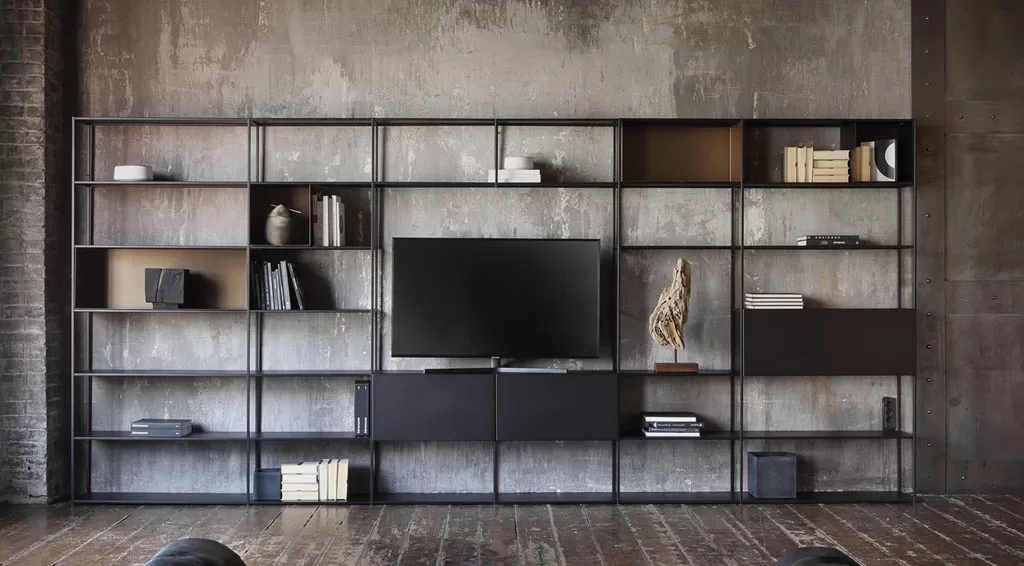

ZEUS Noto Minimalist Italian Furniture, Handcrafted Metal Design & Timeless Modernism
ZEUS Noto creates minimalist Italian furniture defined by essential forms, expressive materials, handcrafted metalwork, and a distinctive philosophy of design through reduction. Founded in Milan in 1984, ZEUS emerged as an alternative to the colorful exuberance of postmodernism, developing instead a rigorous aesthetic of black, graphic, understated furniture that has remained remarkably relevant for more than four decades.
Led creatively by co-founder Maurizio Peregalli, ZEUS produces contemporary tables, chairs, stools, benches, coffee tables, consoles, sideboards, bookshelves, shelving, beds, lighting, mirrors, accessories, and outdoor furniture. Made entirely in Italy by skilled artisans, the collection combines industrial materials with hand-finished production, creating furniture that feels architectural, authentic, and deliberately removed from short-lived trends.
What Is ZEUS Noto Known for in Contemporary Italian Furniture?
ZEUS is known for minimalist Italian furniture that reduces form to its essential elements while allowing material, structure, craftsmanship, and surface to create character.
Metal is fundamental to the collection.
Rather than disguising industrial materials beneath decorative finishes, ZEUS often celebrates their inherent qualities. Steel plate, iron, wood, linoleum, concrete effects, oxidized surfaces, and other materials are treated as expressive elements within the design.
The result is furniture with an unmistakably architectural character—direct, functional, understated, and sophisticated.
ZEUS Was Founded in Milan at the Intersection of Design, Fashion, and Art
ZEUS began in 1984 as the project of a group of friends interested in exchanging ideas across design, fashion, and art.
This interdisciplinary beginning is important to understanding the company.
ZEUS was never conceived simply as a conventional furniture manufacturer.
The founders developed graphics, fashion, exhibitions, interiors, and furniture within one creative environment, allowing ideas from different disciplines to influence one another.
The approach gave the young brand a distinctive identity within Milan’s rapidly evolving design culture.
ZEUS Rejected Colorful Postmodernism in Favor of Black Minimalist Furniture
The early 1980s were an extraordinary period for Italian design.
Postmodernism introduced expressive color, pattern, symbolism, historical references, and visual exuberance into furniture and architecture.
ZEUS deliberately moved in another direction.
The founders were drawn to synthesis, reduction, black, and understatement.
Furniture became almost graphic.
Lines were direct.
Structures remained visually understandable, and industrial materials were celebrated rather than disguised.
This contrast established a design language that remains central to ZEUS today.
How Does ZEUS Create Its Distinctive Minimalist Furniture?
ZEUS creates minimalist furniture through a process of subtraction—removing unnecessary elements until material, structure, proportion, and function become the principal expression of the object.
For Maurizio Peregalli, simplicity is not merely an aesthetic preference.
It is a design discipline.
A table does not need decorative gestures when its structure, surface, scale, and material are resolved intelligently.
A shelving system can derive its character from the rhythm of steel uprights and shelves.
A bench can become compelling through proportion and the honesty of its construction.
This approach creates furniture that is visually restrained but far from anonymous.
Maurizio Peregalli Defines the Creative Identity of ZEUS
Maurizio Peregalli was one of the founding members of ZEUS and remains its CEO and creative director.
His work has defined much of the company’s visual language for more than forty years.
Peregalli’s approach emphasizes essentiality, simplicity, industrial materials, handcrafted production, and a deep interest in how materials change through fabrication and time.
Rather than beginning every project with a predetermined shape, the design process often explores what a material can do.
Bending, welding, cutting, oxidation, surface treatment, and finishing become part of the creative vocabulary.
Japanese Culture Has Influenced the Rigorous Simplicity of ZEUS Furniture
Peregalli’s search for simplicity is informed in part by his study of Eastern and Japanese culture.
This influence can be understood less as stylistic imitation than as an appreciation for reduction, discipline, material honesty, and the expressive power of restraint.
An object does not need visual excess to command attention.
A carefully considered line, junction, surface, or proportion can be enough.
Within contemporary interiors, this restraint allows ZEUS furniture to coexist beautifully with architecture, art, natural materials, and other significant design pieces.
ZEUS Furniture Is Entirely Made in Italy by Skilled Artisans
ZEUS furniture is made in Italy through production that combines an industrial sensibility with intensive handcraftsmanship.
The company’s artisans work through individual production stages including bending, welding, and surface treatment.
This hands-on approach is particularly important when working with metal.
Small decisions affect the precision of a joint, the character of a surface, and the overall balance of the finished object.
ZEUS uses industrial materials, but the furniture does not feel anonymous or mass-produced.
The hand of the maker remains present.
Hand Welding Gives ZEUS Metal Furniture an Authentic Material Character
Welding is normally thought of as a purely technical necessity.
Within ZEUS furniture, fabrication itself contributes to the object’s identity.
Steel elements are cut, bent, joined, and finished by craftspeople who understand how the material behaves.
This creates a subtle tension between industrial precision and human workmanship.
The furniture can appear extremely minimal from a distance, yet closer inspection reveals the physical processes through which it was made.
That relationship is fundamental to the ZEUS aesthetic.
ZEUS Uses Industrial Materials to Create Refined Contemporary Furniture
Industrial materials are often associated with factories, workshops, infrastructure, and utilitarian environments.
ZEUS demonstrates how those same materials can become sophisticated furniture.
Steel plate can form an elegant dining table.
Thin metal structures can create visually light shelving.
Oxidized surfaces can introduce warmth and variation.
Concrete-like finishes can give a table architectural weight without requiring ornamental detail.
The refinement comes not from concealing the material’s industrial origin, but from understanding and controlling it.
Natural Steel Is One of the Defining Materials of ZEUS Design
Steel provides strength with relatively slender dimensions, making it ideal for furniture based on visual reduction.
ZEUS frequently allows the material itself to remain visible.
Rather than coating every surface until the steel’s identity disappears, finishes can reveal its underlying character.
Variations become part of the object.
This makes each piece feel slightly different and reinforces the idea that material is not simply a neutral substrate waiting to be decorated.
It is an active component of the design.
Phosphated Steel Allows the Material to Develop Character Over Time
One of ZEUS’s characteristic approaches to steel involves phosphating.
Instead of covering the natural metal completely with conventional paint, the treatment preserves more of the underlying material expression.
The resulting surface can respond to time and use.
For ZEUS, this is not necessarily an imperfection.
A material capable of showing its history can become more personal as it ages.
This philosophy contrasts with furniture designed to remain visually frozen from the moment it leaves the factory.
ZEUS ART Turns Hand-Finished Metal Surfaces into Unique Furniture
ZEUS ART represents one of the most expressive dimensions of the collection.
These pieces use artistic, handcrafted surface treatments developed through Maurizio Peregalli’s long experimentation with materials.
The finishes are intentionally irregular and unpredictable.
No two surfaces can be perfectly identical because the process itself allows variation.
The furniture therefore occupies an interesting territory between industrial design, craftsmanship, and art.
A functional object becomes a unique material composition.
Imperfection Gives ZEUS Furniture Individuality
Contemporary manufacturing often attempts to eliminate every visible difference between objects.
ZEUS takes a more nuanced position.
Precision remains important, but certain materials and finishes are allowed to retain natural variation.
An oxidized or hand-treated metal surface does not need to appear mechanically uniform.
These variations reveal how the furniture was made.
For clients and designers who value authenticity, this gives the object greater depth than a surface engineered to appear completely identical from one piece to another.
ZEUS Tables Bring Minimalist Italian Design to Dining and Work Spaces
Tables form an important part of the ZEUS collection.
Dining tables, work tables, bar-height tables, desks, and outdoor tables explore the structural possibilities of metal, wood, and other materials.
The designs tend to avoid unnecessary complexity.
A tabletop, supporting frame, and material relationship are resolved with clarity.
This makes ZEUS tables particularly effective in contemporary architecture, where furniture often needs to establish presence without competing with the room itself.
Big Irony Is One of the Defining ZEUS Furniture Collections
The Big Irony collection captures many of the ideas that define ZEUS.
Metal is direct and substantial.
The construction is visually understandable.
Proportions are carefully controlled, and the furniture avoids decorative excess.
Tables, benches, stools, and related pieces create a family of architectural objects capable of working in residential, hospitality, workplace, and outdoor settings.
The strength of Big Irony comes from the confidence of its simplicity.
Big Irony Tables Create a Strong Architectural Center for Contemporary Rooms
A dining table often becomes one of the largest individual objects in a room.
Big Irony embraces that presence rather than attempting to make the table visually disappear.
Its materiality creates an architectural anchor.
At the same time, the simplicity of the design leaves considerable freedom around it.
Minimal dining chairs can reinforce the restrained character, while more expressive seating or lighting can create contrast.
The table becomes a foundation rather than a complete stylistic prescription.
Big Irony Benches Bring Structural Simplicity to Flexible Seating
The bench is one of the oldest furniture typologies.
ZEUS reduces it to a clear relationship between surface, support, material, and proportion.
This simplicity makes a bench remarkably versatile.
It can accompany a dining table, sit within an entry, provide seating along a wall, occupy a gallery-like corridor, or function outdoors in appropriate versions.
The lack of unnecessary stylistic gestures allows the piece to move easily between different architectural environments.
Big Irony Outdoor Extends ZEUS Minimalism Beyond the Interior
ZEUS develops outdoor versions of several important designs, allowing the company’s architectural vocabulary to continue onto terraces, patios, courtyards, and other exterior spaces.
This continuity can be particularly effective in contemporary architecture.
Rather than treating outdoor furniture as a completely separate decorative category, the same design principles can move through glass walls and openings from interior to exterior.
The result supports a more unified indoor-outdoor environment.
Slim Irony Explores the Visual Possibilities of Thin Metal Furniture
Where Big Irony emphasizes material presence, Slim Irony explores greater visual lightness.
Thin steel structures and surfaces create furniture with a precise graphic quality.
The collection includes coffee tables, consoles, sideboards, racks, bookcases, columns, and other storage pieces.
The reduction of visual mass makes Slim Irony especially useful in interiors where designers want functional furniture without introducing bulky volumes.
Slim Irony Coffee Tables Create Graphic Layers Within Seating Areas
Coffee tables play an important role in organizing living spaces.
A visually light metal table can provide necessary surface area without blocking sightlines through the room.
Slim Irony works particularly well in this context.
Its slender construction can create a graphic layer against rugs and flooring while allowing sofas, lounge chairs, art, and architecture to remain dominant.
Multiple sizes or forms can also be combined to create more flexible compositions.
Slim Irony Consoles Bring Minimalist Storage and Display to Narrow Spaces
Console tables often occupy transitional areas—entrances, corridors, behind sofas, or along architectural walls.
These locations benefit from furniture with limited visual and physical depth.
Slim Irony translates ZEUS’s minimalist metal vocabulary into precisely these situations.
The console can support art, lighting, books, or personal objects without becoming visually heavy.
Its structural clarity complements both minimal interiors and more layered rooms.
Slim Irony Sideboards Combine Storage with an Architectural Metal Expression
Storage furniture often becomes a large visual block.
ZEUS approaches the category differently.
Slim Irony sideboards use controlled proportions and metal construction to give storage a more architectural identity.
The result can work against a wall as a functional piece while still participating actively in the room’s material composition.
For contemporary interiors, this provides an alternative to conventional wood cabinetry.
ZEUS Bookshelves Turn Storage into Open Architectural Structure
Bookshelves occupy a boundary between furniture and architecture.
They organize objects while dividing, framing, or activating walls and open spaces.
ZEUS emphasizes this structural quality.
Metal uprights and shelves create rhythm rather than a solid visual mass.
Books, art, ceramics, and personal objects then become part of the composition.
The shelving provides the framework while allowing the contents to supply color and individuality.
Easy Irony Creates Flexible Modular Storage for Contemporary Interiors
The Easy Irony system expands ZEUS’s metal vocabulary into modular storage.
Components can address different functional needs while maintaining a consistent architectural language.
This makes the system particularly valuable in interiors where shelving and storage need to respond to specific dimensions or changing requirements.
Open and enclosed elements can create different levels of visual density, allowing the furniture to balance display and organization.
Slim Irony Bookcase Brings Visual Lightness to Large-Scale Storage
A large bookcase can easily dominate a room.
Slim Irony’s reduced metal structure helps minimize this effect.
The shelving remains clearly present, but its visual weight is controlled.
This makes the system suitable for extensive book collections, display objects, and architectural walls where storage needs to occupy significant space without becoming oppressive.
Against a contrasting wall, the metal structure can also create a strong linear graphic.
iWALL Integrates Shelving More Closely with Architecture
Wall-mounted shelving changes the relationship between furniture and room.
Without a conventional base occupying the floor, storage can feel lighter and more integrated with the architecture.
ZEUS’s iWALL explores this possibility.
The system provides useful display and organization while maintaining the company’s emphasis on essential structure.
It is particularly effective where floor area needs to remain visually open.
ZEUS Chairs Reduce Seating to Structure, Material, and Essential Form
The earliest ZEUS collection included archetypal pieces simply named Sedia, Poltroncina, Savonarola, Tavolo, and Panca.
The names themselves reveal the concept.
Rather than inventing elaborate identities, Peregalli returned to fundamental furniture typologies and reconsidered them through reduction.
The resulting chairs emphasize structure and line.
They are recognizable as familiar objects yet distinctly ZEUS in their graphic simplicity.
Sedia Represents the Archetypal Thinking Behind Early ZEUS Furniture
Sedia—simply “chair”—embodies the company’s early interest in archetypes.
The goal was not to disguise the chair beneath styling.
Instead, the design begins with the fundamental idea of a seat and reduces it to an essential contemporary expression.
This gives the piece an almost diagrammatic clarity.
Its identity comes from proportion, structure, and the black graphic language associated with early ZEUS.
Poltroncina Reinterprets the Small Armchair Through Minimal Structure
Poltroncina continues the archetypal approach while adding the enclosure and support associated with an armchair.
Again, the design avoids unnecessary decoration.
The object is immediately understandable.
This directness is part of what gives early ZEUS furniture its longevity.
The designs do not rely upon a trend that needs historical context to make sense.
Their simplicity remains legible decades later.
Savonarola Connects Historical Furniture Typology with Contemporary Minimalism
The Savonarola chair refers to a historic folding-chair typology while filtering it through the rigorous ZEUS vocabulary.
This demonstrates that minimalism does not require designers to ignore history.
An established furniture archetype can become the starting point for a contemporary interpretation.
What matters is the process of reduction and reconsideration.
The result connects cultural memory with modern material and proportion.
ZEUS Stools and Barstools Bring Minimalist Design to Kitchens and Hospitality Interiors
Stools are especially suited to ZEUS’s philosophy because the typology can be reduced to very few components.
Seat, support, footrest, and proportion need to work together efficiently.
ZEUS offers stools and barstools for kitchen counters, bars, restaurants, workspaces, and other environments.
Metal construction provides strength while allowing relatively slender structures.
The result is seating that can remain visually light even when repeated in groups.
ZEUS Benches Provide Flexible Seating with Architectural Clarity
Benches can solve many different interior-design problems.
They provide seating without the visual complexity of individual chairs and can reinforce strong architectural lines.
ZEUS benches are particularly suited to this role.
Their restrained construction allows them to work beside dining tables, in galleries and hallways, within retail or hospitality environments, or as independent objects in residential spaces.
ZEUS Coffee Tables Celebrate Material Rather Than Ornament
A coffee table is viewed from above more frequently than most furniture.
This makes the surface itself especially important.
ZEUS uses this category to explore steel, marble, wood, artistic finishes, and other material effects.
Slim Irony, Slim Marble, Roma, Lara & Dara, Solitaire, and other collections demonstrate how different surfaces can create very different atmospheres while maintaining a restrained structural vocabulary.
Slim Marble Combines Minimal Metal Structure with the Natural Richness of Stone
Marble introduces natural pattern into the disciplined ZEUS aesthetic.
Against a slender metal structure, the stone becomes more visually prominent.
Veining, color, and surface variation provide the ornament naturally.
Nothing additional needs to be applied.
This relationship illustrates an important principle of sophisticated minimalism: reduction does not need to produce sterility when the materials themselves have depth.
ZEUS Consoles Transform Transitional Areas into Designed Moments
Hallways, entrances, and circulation areas are often overlooked.
A narrow console can turn these transitional spaces into intentional parts of the interior.
ZEUS offers numerous console designs that maintain a shallow footprint while providing useful display surfaces.
Metal, wood, artistic finishes, and different structural approaches allow the console to range from nearly invisible to distinctly sculptural.
ZEUS Sideboards and Racks Provide an Industrial Alternative to Conventional Cabinetry
Wood cabinetry dominates much residential storage.
ZEUS offers a different perspective.
Metal sideboards, racks, and open storage introduce a more architectural and industrial character.
These pieces can work particularly well against plaster, stone, brick, concrete, or wood walls.
The contrast between materials helps define both the furniture and the architecture more clearly.
ZEUS Beds Bring Industrial Minimalism into Contemporary Bedrooms
The ZEUS collection extends even into the bedroom.
A minimal metal bed provides a very different atmosphere from heavily upholstered or traditional wood designs.
The structure can feel visually light and architectural, allowing bedding, textiles, rugs, and surrounding materials to create softness.
This balance between hard structure and soft textile is particularly effective in contemporary bedrooms.
Old Times Explores the Beauty of Weathered and Aged Materials
The Old Times collection reflects ZEUS’s interest in surfaces that appear to carry history.
Rather than insisting that every object look untouched and new, the collection embraces material character.
Aged or weathered effects introduce warmth and imperfection into otherwise minimal forms.
This creates furniture that can feel established within a room from the moment it arrives.
ZEUS Lighting Extends the Company’s Material Philosophy into Illumination
Lighting allows ZEUS to explore the relationship between metal, structure, shadow, and light.
The collection includes designs such as Tree Light, Old Times Lamp, Istanbul, and Starcube.
These pieces maintain the company’s preference for strong concepts and material expression.
A lamp is not treated merely as a decorative accessory.
It becomes another architectural object within the room.
ZEUS Mirrors and Clothes Stands Turn Everyday Functions into Graphic Objects
Mirrors and coat stands often occupy secondary positions within furniture collections.
ZEUS treats them with the same design discipline applied to tables and shelving.
Simple functions become opportunities to explore line, reflection, structure, and movement.
Because these objects are frequently placed in entrances, bedrooms, and transitional spaces, their graphic character can have an outsized influence on the way an interior is experienced.
ZEUS Outdoor Furniture Creates Minimalist Terraces and Contemporary Exterior Spaces
The ZEUS outdoor collection includes tables, benches, stools, chairs, armchairs, and accessories designed to extend the company’s minimalist aesthetic into exterior environments.
Pieces such as Big Irony Outdoor, Tommaso Outdoor, Tavolo Outdoor, Porcin’Off, Slim Sissi, and Tondella provide designers with multiple ways to furnish terraces and patios.
The restrained forms work especially well with contemporary architecture and landscape design.
Big Irony Outdoor Connects Interior and Exterior Architecture
Using related furniture languages indoors and outdoors can create stronger architectural continuity.
Big Irony Outdoor makes this possible without requiring identical environments.
The same essential material character that works inside can continue onto a terrace or courtyard.
Through large openings or glass walls, the furniture establishes a visual relationship between the two zones.
Tommaso Outdoor Tables and Benches Create Minimal Contemporary Gathering Spaces
The combination of a long table and bench creates one of the most direct forms of communal furniture.
Tommaso Outdoor uses this familiar arrangement within the ZEUS design vocabulary.
The result is well suited to terraces, outdoor dining areas, and contemporary courtyards where furniture needs to remain visually disciplined while supporting relaxed social use.
ZEUS Furniture Works Particularly Well with Contemporary Architecture
ZEUS rarely attempts to overpower the architecture around it.
Its furniture tends to reinforce proportion, line, material, and negative space.
This makes the collection especially compatible with contemporary homes, lofts, galleries, offices, restaurants, and hospitality spaces.
Against concrete, a metal table can emphasize the building’s industrial character.
Against warm wood, the same table creates contrast.
Within a white interior, black ZEUS furniture can become almost graphic.
ZEUS Furniture Is Especially Effective in Modern Loft Interiors
Lofts often combine large volumes, exposed structure, concrete, brick, steel, and open floor plans.
ZEUS furniture naturally responds to these environments.
Its industrial materials feel authentic rather than decorative, while the minimal forms preserve the openness of the architecture.
Shelving can help define zones without constructing solid walls.
Tables provide gathering points, and benches or stools introduce seating without visually crowding the space.
Black ZEUS Furniture Creates Graphic Contrast in Minimal Interiors
Black has been central to ZEUS since the beginning.
Within an interior, black furniture can behave almost like line work in an architectural drawing.
A slender table leg creates a vertical mark.
A shelving unit establishes a grid.
A chair becomes a silhouette.
This graphic quality is particularly powerful against white, pale wood, stone, concrete, and other neutral surfaces.
The furniture helps articulate the room without requiring decorative pattern.
ZEUS Furniture Also Works Beautifully with Warm Natural Materials
Industrial minimalism does not require an interior to feel cold.
Metal becomes particularly compelling when contrasted with natural materials.
A ZEUS table can sit on a textured rug.
Steel shelving can stand against warm wood.
Leather, wool, linen, stone, and ceramics can soften the precision of black metal.
These combinations allow designers to create interiors that are rigorous yet comfortable.
ZEUS Is Well Suited to Contemporary Dining Rooms
Dining rooms benefit from furniture with strong proportions and enough restraint to support other elements.
A ZEUS table can establish the architectural center.
Chairs can either continue the minimalist vocabulary or introduce a contrasting material.
Pendant lighting, artwork, rugs, and tableware then create additional layers.
Because the table itself is not dependent upon decorative styling, it can remain relevant as those surrounding elements change.
ZEUS Furniture Can Create Sophisticated Home Offices
Home offices increasingly occupy visible areas within residences.
Furniture therefore needs to work both functionally and aesthetically.
ZEUS desks, tables, shelving, and storage offer an architectural alternative to conventional office furniture.
Metal structures provide visual clarity, while modular storage can organize books, documents, and objects.
The result can feel integrated with the home rather than resembling a corporate workstation.
ZEUS Furniture Brings Character to Creative Workplaces and Studios
Design studios, architectural offices, fashion companies, galleries, and other creative workplaces often benefit from furniture that communicates a strong point of view.
ZEUS’s history at the intersection of design, art, and fashion makes it especially appropriate for these environments.
Tables support collaboration.
Shelving organizes materials and books.
Benches and stools provide flexible seating, while the industrial aesthetic connects naturally with studios and adaptive-reuse architecture.
ZEUS Furniture Is Well Suited to Restaurants and Hospitality Interiors
Hospitality interiors need furniture with identity.
Tables, stools, benches, shelving, and consoles all contribute to the atmosphere experienced by guests.
ZEUS offers a particularly useful vocabulary for restaurants, cafés, hotels, and lounges seeking an understated European or industrial-modern character.
The furniture can reinforce architecture without making the environment feel overly themed.
ZEUS Has Applied Its Design Expertise to International Retail Interiors
Beyond its own furniture collection, ZEUS has collaborated on retail environments for fashion and luxury companies.
This work reflects the company’s broader understanding of furniture as part of architecture and brand identity.
Designing and engineering store furniture requires careful attention to function, durability, display, circulation, and material.
That experience reinforces the architectural thinking visible throughout the standard ZEUS collection.
ZEUS Furniture Gives Interior Designers a Distinctive Material Palette
For interior designers, ZEUS offers something different from conventional luxury furniture.
The collection is not primarily about plushness, decorative detailing, or precious finishes.
Its luxury comes from design intelligence, authentic material, skilled handwork, and control.
Steel, wood, stone, concrete effects, oxidation, linoleum, and artistic finishes create a palette capable of introducing texture without visual excess.
Customization Allows ZEUS Furniture to Respond to Architectural Projects
Because production remains closely connected to Italian artisans and hand processes, ZEUS can address various project customization requirements.
This is particularly useful when furniture needs to coordinate with architecture, specific dimensions, or material palettes.
Customization also reinforces the company’s philosophy.
Industrial production provides consistency, but artisanal flexibility prevents the process from becoming rigid.
ZEUS Balances Industrial Production with Italian Craftsmanship
The phrase “industrial furniture” can imply anonymous mass production.
ZEUS offers a different model.
The materials and structural logic may be industrial, but production remains strongly artisanal.
Metal is bent and welded by hand.
Surfaces are individually treated.
Craftspeople make decisions throughout the process.
The finished object therefore combines the visual rigor of industrial design with the individuality of handmade production.
Recyclable Metal Supports the Material Philosophy of ZEUS
ZEUS works primarily with metal, a material that can be recycled and recovered.
The company also emphasizes attention to materials and their life cycle within its production philosophy.
Durability is equally important.
Furniture designed to remain useful and visually relevant over a long period reduces the need for constant replacement.
This aligns naturally with ZEUS’s rejection of short-lived design trends.
ZEUS Designs Furniture to Age Rather Than Become Obsolete
A surface that changes over time can develop character.
A design based on a temporary fashion simply becomes dated.
ZEUS clearly favors the former.
Materials such as natural steel and hand-treated finishes can acquire subtle evidence of age, while essential forms remain visually relevant.
The objective is not to preserve an object in a perfect, untouched state forever.
It is to create furniture capable of living with its environment.
Timelessness at ZEUS Comes from Refusing Short-Lived Trends
ZEUS’s earliest designs remain in production decades after their introduction.
This continuity illustrates the value of designing around archetypes, proportion, material, and function rather than fashion.
A simple black chair does not need to belong to one specific season.
A steel table can work across changing interior styles.
Timelessness, in this sense, is not achieved by making furniture generic.
It comes from making the underlying idea strong enough to survive change.
ZEUS Was an Early Participant in the Culture That Became Milan’s Fuorisalone
ZEUS’s history is closely connected to Milan’s independent design culture.
In the mid-1980s, the company used its own showroom to present furniture and host experimental design exhibitions during the period surrounding Salone del Mobile.
This approach helped establish the model of design activity outside the traditional fairgrounds that would eventually become a defining characteristic of Milan Design Week.
For ZEUS, the showroom was never simply a store.
It was a place for design, art, experimentation, conversation, and exchange.
The ZEUS Milan Showroom Embodies the Brand’s Independent Design Spirit
From its beginnings, ZEUS has placed considerable importance on presenting furniture within its own environment.
A dedicated space allows the company to communicate more than individual products.
Materials, art, furniture, lighting, and architecture can be experienced together.
This reflects the interdisciplinary origins of the brand and reinforces the idea that design is part of a broader cultural conversation.
ZEUS Continues to Evolve While Preserving Its Minimalist Identity
More than forty years after its founding, ZEUS continues to introduce new furniture without abandoning the principles that established the brand.
New chairs, stools, tables, sideboards, shelving, and accessories enter a collection already rich with long-running designs.
The objective is not to reinvent the company’s identity every season.
Instead, new products explore how the established ideas of simplicity, material honesty, handcraftsmanship, and experimentation can address contemporary life.
The ZEUS Collection Extends Across Nearly Every Major Furniture Category
ZEUS today offers chairs, stools and barstools, benches, dining and bar tables, coffee tables, consoles, racks, sideboards, bookshelves, wall shelves, beds, lamps, clothes stands, mirrors, accessories, and outdoor furniture.
This breadth allows designers to use ZEUS in different ways.
One table can serve as a singular architectural statement.
Alternatively, multiple categories can establish a consistent material vocabulary across an entire residence, office, restaurant, or hospitality project.
Why Choose ZEUS Noto Furniture for a Contemporary Interior?
ZEUS Noto is particularly compelling for interiors that value material authenticity, architectural clarity, Italian craftsmanship, and design with a strong point of view.
The collection avoids decorative excess without becoming impersonal.
Industrial steel is balanced by hand fabrication.
Minimal geometry is balanced by expressive surfaces.
Historical designs coexist with new pieces, while indoor and outdoor collections allow the aesthetic to move through different architectural zones.
For architects, interior designers, and clients seeking furniture that is understated but unmistakable, ZEUS offers a distinctive alternative to conventional contemporary luxury.
Discover ZEUS Noto Italian Furniture, Minimalist Tables, Shelving & Metal Design at Scott + Cooner
Scott + Cooner offers ZEUS Noto as part of our curated collection of exceptional contemporary Italian furniture and international design.
Since 1995, Scott + Cooner has worked with architects, interior designers, and design-conscious clients seeking extraordinary modern furniture, lighting, kitchens, closets, rugs, accessories, textiles, and architectural products for sophisticated residential and contract interiors.
Our experienced team can help you explore ZEUS dining tables, coffee tables, consoles, chairs, stools, benches, sideboards, bookshelves, modular storage, beds, lighting, mirrors, outdoor furniture, distinctive metal finishes, and project-specific possibilities.
Whether you’re furnishing a contemporary residence, loft, dining room, home office, creative studio, restaurant, hotel, retail environment, or architectural project, Scott + Cooner can help you discover ZEUS furniture that combines Italian craftsmanship, industrial materials, rigorous minimalism, and an enduring philosophy of design through reduction.